DHS explains Comprehensive Community Services in Dunn County and its $2.135 million 2026 budget projection
January 05, 2026 | Dunn County, Wisconsin
This article was created by AI summarizing key points discussed. AI makes mistakes, so for full details and context, please refer to the video of the full meeting. Please report any errors so we can fix them. Report an error »
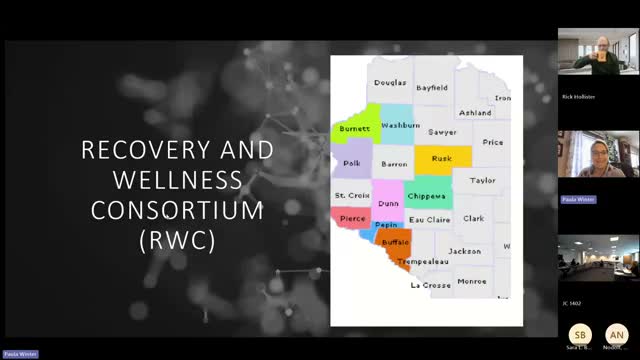
Dunn County DHS Director Paula Winter outlined Comprehensive Community Services (CCS), a Medicaid-eligible, person-centered program for mental health and substance-use recovery delivered through a nine-county Recovery and Wellness Consortium led by Chippewa County.
Winter described CCS as team-based, emphasizing consumer-driven planning, natural supports and a mix of traditional (counseling, medication management) and nontraditional services (peer support, employment skills, equine therapy). "CCS stands for comprehensive community services," she said, adding the program typically lasts one to two years and requires both Medicaid financial eligibility and a functional assessment for clinical eligibility.
On finances Winter reported a projected 2026 expense and revenue figure of $2,135,000 and explained the state backfills the county share when counties participate in a consortium. She summarized the billing process: local providers and the county bill the consortium lead (Chippewa County), which bills Medicaid and manages contracts and centralized operations, and the county receives reimbursement through the provider portion of CCS. Winter also described WINCR reporting that captures non-billable service time to secure funding in the subsequent year.
Why it matters: CCS provides locally delivered, Medicaid-funded supports for people with behavioral-health needs. The consortium model reduces the county's immediate financial burden but requires careful administration (contracts, audits by the Department of Quality Assurance) and ongoing attention to eligibility, service authorization and staff capacity to collect evaluative data.
Winter said the county's clinic provides CCS services and that roles within CCS include local service facilitation, clinical consultation, local management and provider staff (nurse practitioner, nurse, therapists, education and employment specialists). She noted that audit requirements include state reviews of functional screens and case picks for compliance.
Next steps: CJCC members heard the presentation and asked no substantive follow-up questions in the meeting; DHS will continue operating CCS under the consortium arrangement and include CCS finance and utilization metrics in future reports.
Winter described CCS as team-based, emphasizing consumer-driven planning, natural supports and a mix of traditional (counseling, medication management) and nontraditional services (peer support, employment skills, equine therapy). "CCS stands for comprehensive community services," she said, adding the program typically lasts one to two years and requires both Medicaid financial eligibility and a functional assessment for clinical eligibility.
On finances Winter reported a projected 2026 expense and revenue figure of $2,135,000 and explained the state backfills the county share when counties participate in a consortium. She summarized the billing process: local providers and the county bill the consortium lead (Chippewa County), which bills Medicaid and manages contracts and centralized operations, and the county receives reimbursement through the provider portion of CCS. Winter also described WINCR reporting that captures non-billable service time to secure funding in the subsequent year.
Why it matters: CCS provides locally delivered, Medicaid-funded supports for people with behavioral-health needs. The consortium model reduces the county's immediate financial burden but requires careful administration (contracts, audits by the Department of Quality Assurance) and ongoing attention to eligibility, service authorization and staff capacity to collect evaluative data.
Winter said the county's clinic provides CCS services and that roles within CCS include local service facilitation, clinical consultation, local management and provider staff (nurse practitioner, nurse, therapists, education and employment specialists). She noted that audit requirements include state reviews of functional screens and case picks for compliance.
Next steps: CJCC members heard the presentation and asked no substantive follow-up questions in the meeting; DHS will continue operating CCS under the consortium arrangement and include CCS finance and utilization metrics in future reports.
View the Full Meeting & All Its Details
This article offers just a summary. Unlock complete video, transcripts, and insights as a Founder Member.
✓
Watch full, unedited meeting videos
✓
Search every word spoken in unlimited transcripts
✓
AI summaries & real-time alerts (all government levels)
✓
Permanent access to expanding government content
30-day money-back guarantee
