Residents press Louisa County on LOST transfer to secondary roads; supervisors explain funding and salt-shed payment
December 30, 2025 | Louisa County, Iowa
This article was created by AI summarizing key points discussed. AI makes mistakes, so for full details and context, please refer to the video of the full meeting. Please report any errors so we can fix them. Report an error »
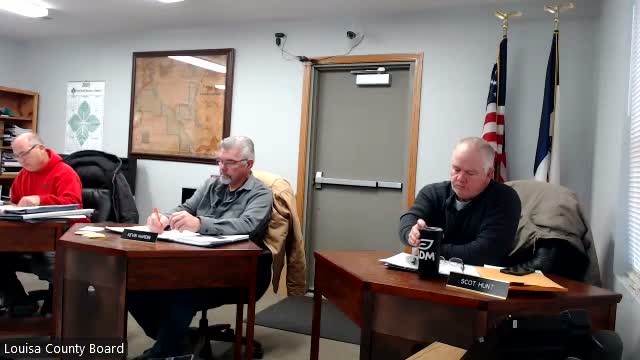
During public comment and a later discussion, a resident asked the Louisa County Board of Supervisors to explain a $130,000 internal transfer to secondary roads that will cover the county's cost for a salt-shed project.
Speaker 4 (public commenter) urged the board to reconsider appointing supervisors to the conservation board and also pressed to know where LOST/internal-transfer dollars would be spent. Speaker 8 later returned to the same concern, asking why so much tax money appears to be concentrated in secondary roads and whether those funds could be used for other budget pressures.
Speaker 2 and the board chair (Speaker 1) provided detail: they said the salt-shed project cost was about $250,000 and that the $130,000 transfer was the county's committed portion. Staff explained secondary roads receive roughly $4.8 million per year (two-thirds from gas tax, about one-third from property-tax distributions) and that funds are kept in dedicated accounts and used for qualifying projects such as bridges and salt/shed infrastructure or to respond to disasters. Speaker 1 said, as board chair, he would not use LOST-designated funds to shore up wages because voters approved those dollars for infrastructure and assets.
The board approved Resolution 202549 to transfer $130,000 into the secondary-roads account to pay the county's share of the salt-shed cost; staff noted the transfer just formalizes an earlier commitment. The transcript shows the resolution bundled with a brief explanation and a recorded "aye" vote.
Speakers also discussed how secondary-road spending varies by traffic and condition; staff gave a range for gravel-road maintenance (roughly $1,500'$5,000 per mile per year depending on traffic and treatment). The board agreed to continue reviewing appointments and budgets and to include appropriate documentation when funds are moved so taxpayers can see how voter-approved dollars are used.
Speaker 4 (public commenter) urged the board to reconsider appointing supervisors to the conservation board and also pressed to know where LOST/internal-transfer dollars would be spent. Speaker 8 later returned to the same concern, asking why so much tax money appears to be concentrated in secondary roads and whether those funds could be used for other budget pressures.
Speaker 2 and the board chair (Speaker 1) provided detail: they said the salt-shed project cost was about $250,000 and that the $130,000 transfer was the county's committed portion. Staff explained secondary roads receive roughly $4.8 million per year (two-thirds from gas tax, about one-third from property-tax distributions) and that funds are kept in dedicated accounts and used for qualifying projects such as bridges and salt/shed infrastructure or to respond to disasters. Speaker 1 said, as board chair, he would not use LOST-designated funds to shore up wages because voters approved those dollars for infrastructure and assets.
The board approved Resolution 202549 to transfer $130,000 into the secondary-roads account to pay the county's share of the salt-shed cost; staff noted the transfer just formalizes an earlier commitment. The transcript shows the resolution bundled with a brief explanation and a recorded "aye" vote.
Speakers also discussed how secondary-road spending varies by traffic and condition; staff gave a range for gravel-road maintenance (roughly $1,500'$5,000 per mile per year depending on traffic and treatment). The board agreed to continue reviewing appointments and budgets and to include appropriate documentation when funds are moved so taxpayers can see how voter-approved dollars are used.
Don't Miss a Word: See the Full Meeting!
Go beyond summaries. Unlock every video, transcript, and key insight with a Founder Membership.
✓
Get instant access to full meeting videos
✓
Search and clip any phrase from complete transcripts
✓
Receive AI-powered summaries & custom alerts
✓
Enjoy lifetime, unrestricted access to government data
30-day money-back guarantee
