BCPS outlines multi-year plan to address middle-school math proficiency and implement MSDE's integrated-algebra sequence
December 02, 2025 | Baltimore County Public Schools, School Boards, Maryland
This article was created by AI summarizing key points discussed. AI makes mistakes, so for full details and context, please refer to the video of the full meeting. Please report any errors so we can fix them. Report an error »
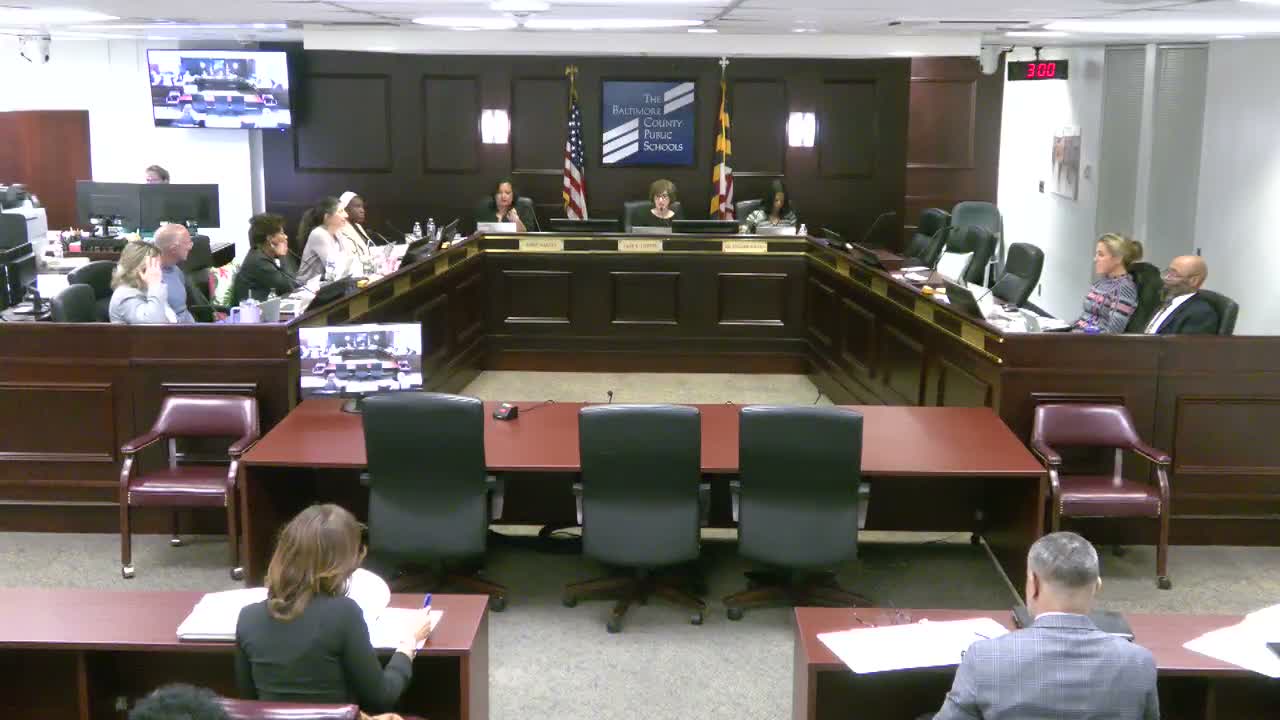
BCPS curriculum leaders presented an update on secondary mathematics and steps the district is taking to raise proficiency among middle-school students.
Staff said 9 of 10 student groups showed growth in math, but grades 7 and 8 and Algebra I continue to lag. The district expanded its STAR screening program (K–Algebra II) to establish baseline diagnostics and to provide predictive links to MCAP performance. Digital supports and pilots (Freckle, Conmigo) have expanded to additional middle schools as targeted interventions tied to the district’s illustrative mathematics curriculum.
The district described a redesigned professional-learning sequence delivered in-school with follow-up implementation coaching to increase teacher content and pedagogical knowledge. Leaders also announced a math task force focused on sequencing, feasible bell schedules to meet new instructional-minute requirements, multi-tiered systems of support and family communications. This work aligns with the Maryland State Department of Education timelines: revised K–8 College and Career Ready Standards implementation in 2026, integrated Algebra I in 2027 and integrated Algebra II in 2028. District staff said they will use pilot data (STAR-to-MCAP linking study with Renaissance) and MSDE partnerships to shape professional learning and instructional materials.
Board members asked about the role of digital platforms and the teacher's pedagogical role; leaders emphasized that digital tools are interventions and that the teacher remains the primary instructional agent, supported by training in pedagogy and implementation science.
Staff said 9 of 10 student groups showed growth in math, but grades 7 and 8 and Algebra I continue to lag. The district expanded its STAR screening program (K–Algebra II) to establish baseline diagnostics and to provide predictive links to MCAP performance. Digital supports and pilots (Freckle, Conmigo) have expanded to additional middle schools as targeted interventions tied to the district’s illustrative mathematics curriculum.
The district described a redesigned professional-learning sequence delivered in-school with follow-up implementation coaching to increase teacher content and pedagogical knowledge. Leaders also announced a math task force focused on sequencing, feasible bell schedules to meet new instructional-minute requirements, multi-tiered systems of support and family communications. This work aligns with the Maryland State Department of Education timelines: revised K–8 College and Career Ready Standards implementation in 2026, integrated Algebra I in 2027 and integrated Algebra II in 2028. District staff said they will use pilot data (STAR-to-MCAP linking study with Renaissance) and MSDE partnerships to shape professional learning and instructional materials.
Board members asked about the role of digital platforms and the teacher's pedagogical role; leaders emphasized that digital tools are interventions and that the teacher remains the primary instructional agent, supported by training in pedagogy and implementation science.
View the Full Meeting & All Its Details
This article offers just a summary. Unlock complete video, transcripts, and insights as a Founder Member.
✓
Watch full, unedited meeting videos
✓
Search every word spoken in unlimited transcripts
✓
AI summaries & real-time alerts (all government levels)
✓
Permanent access to expanding government content
30-day money-back guarantee
