Monterey-area consolidation projects cited as examples of progress and remaining barriers
December 24, 2025 | State Water Resources Control Board, Agencies under Office of the Governor, Executive, California
This article was created by AI summarizing key points discussed. AI makes mistakes, so for full details and context, please refer to the video of the full meeting. Please report any errors so we can fix them. Report an error »
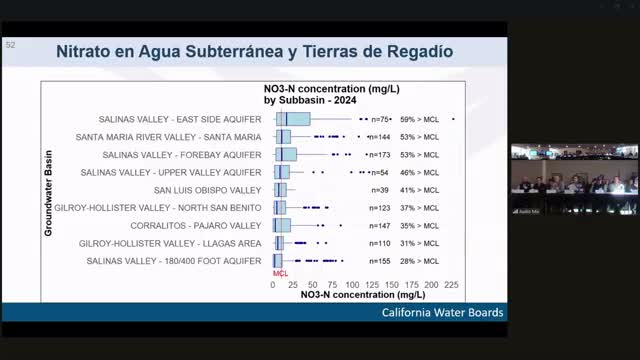
State and local presenters described multi-agency consolidation projects in the Monterey region as examples of how the Safer program’s technical assistance translates into construction and connections.
Presenters described a Gavilán consolidation project that includes more than 160 primary connections plus additional adjacent sources and multiple owners; staff said the project used grant funds and coordination with RCAC (Rural Community Assistance Corporation), engineering consultants and Monterey County. One presenter described a mobile-home park consolidation affecting roughly 160 homes and said community outreach secured participation rates above 95%.
Project engineers who discussed options for a small school with elevated arsenic said the school is currently using bottled water while a pilot and an engineering report run through the spring to determine the most feasible treatment option. Project-level cost examples were presented for a large regional consolidation (an example figure above $70 million was cited for a comprehensive regional consolidation) and staff stressed that refinancing and legal/title work were common barriers that the board’s assistance can help resolve.
Local advocates repeatedly raised access and trust issues: several speakers described how multi-page, documentation-heavy applications create barriers for residents with limited English or incomplete records. Meeting presenters said increased technical assistance, direct outreach and community-based engagement are key steps to improve participation and reduce delays.
Why it matters: consolidation can reduce the per-household cost of compliant water and provide long-term operational stability; however, projects can be costly and require careful outreach, title resolution and local partnerships to succeed.
What’s next: staff said planned site visits and continued county collaboration will follow the advisory meeting; engineering reports and town-hall outreach for individual projects are scheduled as the next implementation steps.
Presenters described a Gavilán consolidation project that includes more than 160 primary connections plus additional adjacent sources and multiple owners; staff said the project used grant funds and coordination with RCAC (Rural Community Assistance Corporation), engineering consultants and Monterey County. One presenter described a mobile-home park consolidation affecting roughly 160 homes and said community outreach secured participation rates above 95%.
Project engineers who discussed options for a small school with elevated arsenic said the school is currently using bottled water while a pilot and an engineering report run through the spring to determine the most feasible treatment option. Project-level cost examples were presented for a large regional consolidation (an example figure above $70 million was cited for a comprehensive regional consolidation) and staff stressed that refinancing and legal/title work were common barriers that the board’s assistance can help resolve.
Local advocates repeatedly raised access and trust issues: several speakers described how multi-page, documentation-heavy applications create barriers for residents with limited English or incomplete records. Meeting presenters said increased technical assistance, direct outreach and community-based engagement are key steps to improve participation and reduce delays.
Why it matters: consolidation can reduce the per-household cost of compliant water and provide long-term operational stability; however, projects can be costly and require careful outreach, title resolution and local partnerships to succeed.
What’s next: staff said planned site visits and continued county collaboration will follow the advisory meeting; engineering reports and town-hall outreach for individual projects are scheduled as the next implementation steps.
View the Full Meeting & All Its Details
This article offers just a summary. Unlock complete video, transcripts, and insights as a Founder Member.
✓
Watch full, unedited meeting videos
✓
Search every word spoken in unlimited transcripts
✓
AI summaries & real-time alerts (all government levels)
✓
Permanent access to expanding government content
30-day money-back guarantee
