Committee Flags Funding Options: CoSWAP/CWCB Grants, Match Challenges and Revolving Loan Models
December 23, 2025 | Department of Natural Resources, State Agencies, Organizations, Executive, Colorado
This article was created by AI summarizing key points discussed. AI makes mistakes, so for full details and context, please refer to the video of the full meeting. Please report any errors so we can fix them. Report an error »
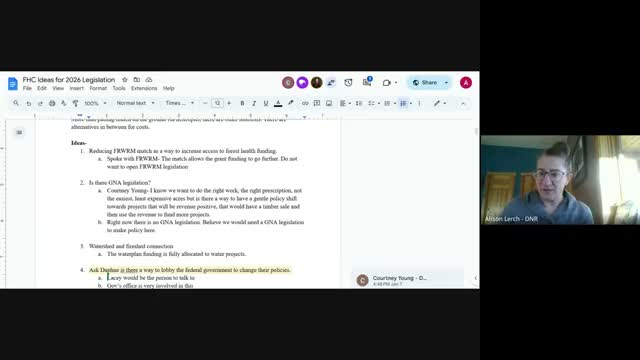
Committee staff told members that grant match requirements remain a barrier for some applicants, but that recent changes can reduce match in areas with higher social vulnerability. Courtney and Allison reported that conversations with the Colorado State Forest Service indicated the 50/50 match structure helps multiply project size and that reducing match broadly could shrink project capacity.
Staff also described how the Colorado Water Conservation Board’s Wildfire Ready Watersheds program and CoSWAP are coordinating to invest roughly $6.5 million in projects that tie watershed resilience to forest-health work, and noted that funding for those projects generally requires inclusion in an action plan or watershed boundary.
Committee members discussed mechanisms to help community partners bridge cash-flow gaps created by reimbursement-style grants. Courtney read an email noting that pilot revolving loan options have been proposed to front funding for coalitions and collaboratives; members also discussed the Colorado Water Resources and Power Development Authority’s state revolving loan fund as a low-interest option that can cover forest-health projects for water utilities and municipalities. Members said eligibility for very small nonprofits is unclear and asked staff to investigate.
The committee placed several funding ideas in a “parking lot” for further research and suggested staff prepare outreach materials to educate local collaboratives about available loan and grant pathways.
Key follow-ups: staff will (1) map match-reduction rules for socially vulnerable areas, (2) confirm eligibility criteria and contact points at the state revolving loan authority, and (3) produce a short resource note for collaboratives on potential loan and grant tools.
Staff also described how the Colorado Water Conservation Board’s Wildfire Ready Watersheds program and CoSWAP are coordinating to invest roughly $6.5 million in projects that tie watershed resilience to forest-health work, and noted that funding for those projects generally requires inclusion in an action plan or watershed boundary.
Committee members discussed mechanisms to help community partners bridge cash-flow gaps created by reimbursement-style grants. Courtney read an email noting that pilot revolving loan options have been proposed to front funding for coalitions and collaboratives; members also discussed the Colorado Water Resources and Power Development Authority’s state revolving loan fund as a low-interest option that can cover forest-health projects for water utilities and municipalities. Members said eligibility for very small nonprofits is unclear and asked staff to investigate.
The committee placed several funding ideas in a “parking lot” for further research and suggested staff prepare outreach materials to educate local collaboratives about available loan and grant pathways.
Key follow-ups: staff will (1) map match-reduction rules for socially vulnerable areas, (2) confirm eligibility criteria and contact points at the state revolving loan authority, and (3) produce a short resource note for collaboratives on potential loan and grant tools.
View the Full Meeting & All Its Details
This article offers just a summary. Unlock complete video, transcripts, and insights as a Founder Member.
✓
Watch full, unedited meeting videos
✓
Search every word spoken in unlimited transcripts
✓
AI summaries & real-time alerts (all government levels)
✓
Permanent access to expanding government content
30-day money-back guarantee
