Nursery trade group warns current nitrogen reporting will overestimate impacts, asks for alternative pathway
December 19, 2025 | State Water Resources Control Board, Agencies under Office of the Governor, Executive, California
This article was created by AI summarizing key points discussed. AI makes mistakes, so for full details and context, please refer to the video of the full meeting. Please report any errors so we can fix them. Report an error »
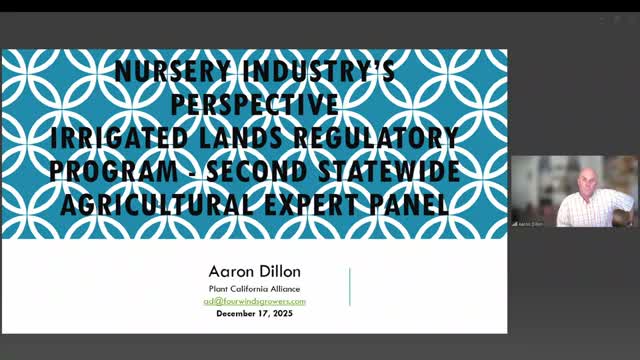
Aaron Dillon, representing the Plant California Alliance, told the Agricultural Expert Panel that current A‑minus‑R reporting will overstate nurseries’ contribution to groundwater nitrogen because of unique practices in container production.
Dillon said California nurseries account for about 45,000 acres of production (roughly 0.19% of the total farmland in a cited 2022 USDA tally) and are dominated by small, family businesses. Drawing on research presented by Bruno Petain, Dillon said about 61% of nitrogen applied to containerized plants remains in the plant/container, some is off‑gassed and roughly "less than 3%" is potentially leached into underlying soils. "We're going to end up with a SWAG — a scientific wild‑*** — if forced to report removed nitrogen without valid crop coefficients for the hundreds of crops nurseries grow," he said.
Dillon explained the technical challenge: nurseries lack robust nitrogen‑removal coefficients across diverse crop types, container sizes and production timelines, making annualized removed‑per‑year reporting difficult and liable to inconsistent estimates. He asked the panel to consider a separate waste discharge requirement (WDR) or an alternative, industry‑specific compliance pathway that could rely on farm evaluations, verifiable best management practices and third‑party auditing rather than the same A‑minus‑R approach used for field crops.
"It will take a ton of work and a ton of money to try to figure out all of these crop coefficients for all the different crops...is the impact from nursery truly that great?" Dillon asked. He also noted precedent for industry‑specific programs (dairy, rice) and urged a system emphasizing improvement and incentives rather than punitive measures.
The nursery presentation was part of the meeting’s extended public comment and technical presentation section; state staff and other presenters later discussed research and modeling constraints and next steps toward the panel’s February 2026 draft report.
Dillon said California nurseries account for about 45,000 acres of production (roughly 0.19% of the total farmland in a cited 2022 USDA tally) and are dominated by small, family businesses. Drawing on research presented by Bruno Petain, Dillon said about 61% of nitrogen applied to containerized plants remains in the plant/container, some is off‑gassed and roughly "less than 3%" is potentially leached into underlying soils. "We're going to end up with a SWAG — a scientific wild‑*** — if forced to report removed nitrogen without valid crop coefficients for the hundreds of crops nurseries grow," he said.
Dillon explained the technical challenge: nurseries lack robust nitrogen‑removal coefficients across diverse crop types, container sizes and production timelines, making annualized removed‑per‑year reporting difficult and liable to inconsistent estimates. He asked the panel to consider a separate waste discharge requirement (WDR) or an alternative, industry‑specific compliance pathway that could rely on farm evaluations, verifiable best management practices and third‑party auditing rather than the same A‑minus‑R approach used for field crops.
"It will take a ton of work and a ton of money to try to figure out all of these crop coefficients for all the different crops...is the impact from nursery truly that great?" Dillon asked. He also noted precedent for industry‑specific programs (dairy, rice) and urged a system emphasizing improvement and incentives rather than punitive measures.
The nursery presentation was part of the meeting’s extended public comment and technical presentation section; state staff and other presenters later discussed research and modeling constraints and next steps toward the panel’s February 2026 draft report.
Don't Miss a Word: See the Full Meeting!
Go beyond summaries. Unlock every video, transcript, and key insight with a Founder Membership.
✓
Get instant access to full meeting videos
✓
Search and clip any phrase from complete transcripts
✓
Receive AI-powered summaries & custom alerts
✓
Enjoy lifetime, unrestricted access to government data
30-day money-back guarantee
