Glendale planning commission recommends ASOZ expansion to allow animated signs on Masonic Temple
December 18, 2025 | Glendale, Los Angeles County, California
This article was created by AI summarizing key points discussed. AI makes mistakes, so for full details and context, please refer to the video of the full meeting. Please report any errors so we can fix them. Report an error »
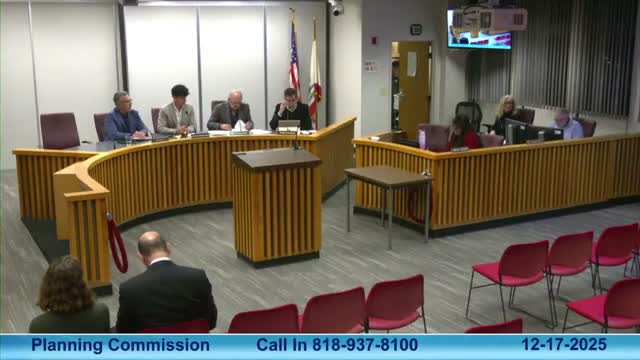
The Glendale Planning Commission on Dec. 17, 2025 voted to recommend that City Council adopt a zone map amendment, a text amendment to Chapter 30.26 of the Glendale zoning code (the Advertising Signage Overlay Zone, or ASOZ), and a statutory development agreement to allow two ASOZ wall signs on the Masonic Temple property at 230–238 South Brand Boulevard.
City staff said the application from the Caruso organization would place ASOZ overlay zoning over three parcels that include the Masonic Temple building and would authorize two non-accessory animated ASOZ wall signs — one on the north elevation and one on the south — each proposed at 38 by 21 feet. Staff described a proposed new definition, “ASOZ wall sign,” to clarify that signs attached to appurtenant structures such as exterior staircases may qualify. The staff report recommends the commission forward the zone map amendment, zoning text change and development agreement to City Council for adoption.
The staff presentation said the proposal includes a statutory development agreement that implements public-benefit payments, an amortization schedule, and that the project follows prior ASOZ revisions dating to 2010 and 2013. A preservation consultant, Architectural Resources Group, concluded the signs would have “minimal to no impact” on the character‑defining features of the historic Masonic Temple and that the work would be consistent with the Secretary of the Interior’s standards for treatment of historic properties, according to staff. Staff also stated the project is exempt from the California Environmental Quality Act under the Guidelines sections cited in the report (15305, 15303 and 15331), and that the draft development agreement’s legal description will be revised to include Lot 17, which had been omitted in error.
Commissioners asked detailed questions about a projected 14‑inch encroachment of the north sign onto an adjacent parcel, whether easements or building permits would address encroachments, whether the Historic Preservation Commission would review attachments to the historic building, and how lighting and animation would be regulated. Staff and a second city representative said easements or use agreements would be pursued for the projected encroachment, that the current proposal is not scheduled for additional HPC review, and that ASOZ rules limit brightness to ambient light levels and allow the director to require field measurements or a lighting study to verify compliance; enforcement is typically complaint‑driven.
Chris Robertson, Senior Vice President of Planning and Development for Caruso, told the commission the company helped restore the Masonic Temple and that revenue from the signage will help offset maintenance costs for the nearly 100‑year‑old structure while providing a revenue share to the city. Robertson said Caruso already holds an easement on the southern property and expects to establish an easement or use agreement for the northern property where the sign projects beyond the lot line.
During deliberation, a commissioner moved to recommend City Council adoption of the zone map amendment, text amendment to Chapter 30.26, and the statutory development agreement as revised; the commission recorded a roll‑call vote in which Commissioners Malekian, Manasian, Nazarian and the chair voted yes and the motion passed. The staff presenter said the development agreement language will be corrected to include Lot 17 and that subsequent City Council materials will reflect that revision.
The matter now moves to the Glendale City Council for final action on the zone map amendment, text amendment and development agreement. Staff noted that authorizations for any future signs beyond the two proposed on these parcels would require a separate zone map amendment and development agreement if they differ from the approved plans.
City staff said the application from the Caruso organization would place ASOZ overlay zoning over three parcels that include the Masonic Temple building and would authorize two non-accessory animated ASOZ wall signs — one on the north elevation and one on the south — each proposed at 38 by 21 feet. Staff described a proposed new definition, “ASOZ wall sign,” to clarify that signs attached to appurtenant structures such as exterior staircases may qualify. The staff report recommends the commission forward the zone map amendment, zoning text change and development agreement to City Council for adoption.
The staff presentation said the proposal includes a statutory development agreement that implements public-benefit payments, an amortization schedule, and that the project follows prior ASOZ revisions dating to 2010 and 2013. A preservation consultant, Architectural Resources Group, concluded the signs would have “minimal to no impact” on the character‑defining features of the historic Masonic Temple and that the work would be consistent with the Secretary of the Interior’s standards for treatment of historic properties, according to staff. Staff also stated the project is exempt from the California Environmental Quality Act under the Guidelines sections cited in the report (15305, 15303 and 15331), and that the draft development agreement’s legal description will be revised to include Lot 17, which had been omitted in error.
Commissioners asked detailed questions about a projected 14‑inch encroachment of the north sign onto an adjacent parcel, whether easements or building permits would address encroachments, whether the Historic Preservation Commission would review attachments to the historic building, and how lighting and animation would be regulated. Staff and a second city representative said easements or use agreements would be pursued for the projected encroachment, that the current proposal is not scheduled for additional HPC review, and that ASOZ rules limit brightness to ambient light levels and allow the director to require field measurements or a lighting study to verify compliance; enforcement is typically complaint‑driven.
Chris Robertson, Senior Vice President of Planning and Development for Caruso, told the commission the company helped restore the Masonic Temple and that revenue from the signage will help offset maintenance costs for the nearly 100‑year‑old structure while providing a revenue share to the city. Robertson said Caruso already holds an easement on the southern property and expects to establish an easement or use agreement for the northern property where the sign projects beyond the lot line.
During deliberation, a commissioner moved to recommend City Council adoption of the zone map amendment, text amendment to Chapter 30.26, and the statutory development agreement as revised; the commission recorded a roll‑call vote in which Commissioners Malekian, Manasian, Nazarian and the chair voted yes and the motion passed. The staff presenter said the development agreement language will be corrected to include Lot 17 and that subsequent City Council materials will reflect that revision.
The matter now moves to the Glendale City Council for final action on the zone map amendment, text amendment and development agreement. Staff noted that authorizations for any future signs beyond the two proposed on these parcels would require a separate zone map amendment and development agreement if they differ from the approved plans.
Don't Miss a Word: See the Full Meeting!
Go beyond summaries. Unlock every video, transcript, and key insight with a Founder Membership.
✓
Get instant access to full meeting videos
✓
Search and clip any phrase from complete transcripts
✓
Receive AI-powered summaries & custom alerts
✓
Enjoy lifetime, unrestricted access to government data
30-day money-back guarantee
