Newington outlines indoor air quality sensor program and seeks state leeway on 5‑year compliance
December 12, 2025 | Newington School District, School Districts, Connecticut
This article was created by AI summarizing key points discussed. AI makes mistakes, so for full details and context, please refer to the video of the full meeting. Please report any errors so we can fix them. Report an error »
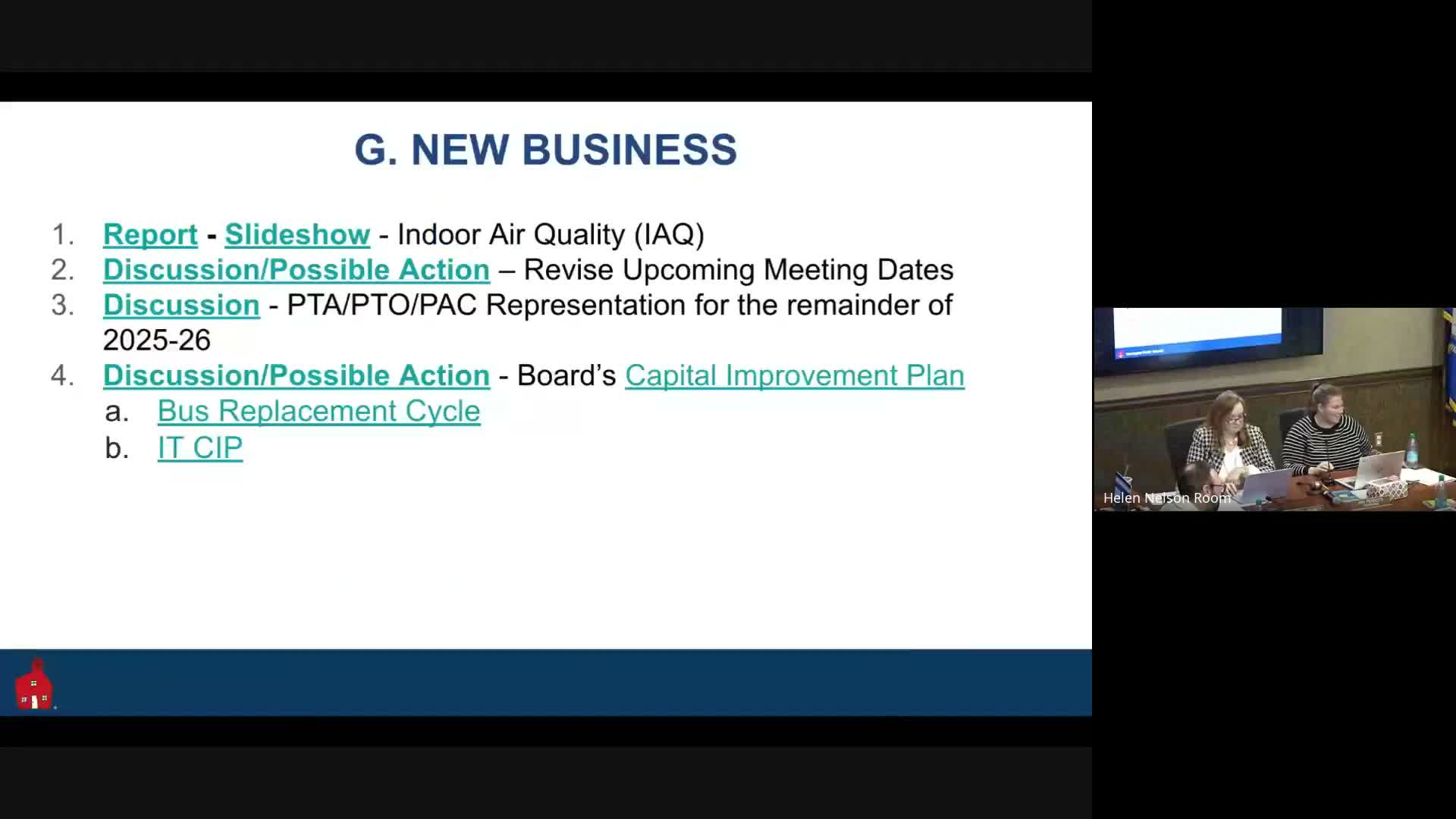
Newington school officials on Dec. 10 presented their annual indoor air/environment quality update and described a plan to expand classroom monitoring with portable sensors and the district's building management system (BMS).
Facilities staff explained the Connecticut requirement for a uniform inspection and evaluation program and said the district completes EPA "Tools for Schools" checklists annually, runs biannual staff surveys and supplements those with portable monitors that log temperature, CO2 and relative humidity every five seconds. The presenter said the district has 175 of the portable units currently and has a purchase order for the remainder needed to cover occupied spaces.
State five‑year requirement: The district noted a separate five‑year compliance element in state guidance that would require an "air balancer" and hygienist checks of many individual HVAC units. Staff described an initial price estimate for the full five‑year mechanical audit near $340,000 but said they believe combining BMS logs and portable sensors would meet the state's objective at lower cost and have submitted documentation seeking approval of that approach. The district's first full submittal for the five‑year requirement is currently expected around July 1, 2026.
Operational details and quality control: Presenters discussed sensor calibration and lifespan: units are recalibrated using outdoor baseline conditions (roughly 420 ppm CO2 outdoors), and staff estimated a sensor lifespan on the order of 5–10 years while promising regular checks and comparisons with higher‑end systems in newer buildings. The portable monitors provide continuous logs that can be graphed and sliced historically, enabling staff to identify when CO2 rises during occupancy and then trace HVAC performance over time.
Why it matters: The IAQ presentation emphasized that ongoing monitoring helps troubleshoot perceived problems (for example, a classroom perceived as "stuff y" can be measured remotely and adjusted via the BMS) and that a combined sensor+BMS approach could reduce the need for costlier per‑unit mechanical tests when the state accepts equivalent documentation.
Next steps: The district will continue deploying sensor units to classrooms, complete recalibration schedules, and await state feedback on whether BMS/sensor records can be accepted as a partial substitute for the more expensive five‑year mechanical audits; staff said they will bring updates to the board as the state responds.
Facilities staff explained the Connecticut requirement for a uniform inspection and evaluation program and said the district completes EPA "Tools for Schools" checklists annually, runs biannual staff surveys and supplements those with portable monitors that log temperature, CO2 and relative humidity every five seconds. The presenter said the district has 175 of the portable units currently and has a purchase order for the remainder needed to cover occupied spaces.
State five‑year requirement: The district noted a separate five‑year compliance element in state guidance that would require an "air balancer" and hygienist checks of many individual HVAC units. Staff described an initial price estimate for the full five‑year mechanical audit near $340,000 but said they believe combining BMS logs and portable sensors would meet the state's objective at lower cost and have submitted documentation seeking approval of that approach. The district's first full submittal for the five‑year requirement is currently expected around July 1, 2026.
Operational details and quality control: Presenters discussed sensor calibration and lifespan: units are recalibrated using outdoor baseline conditions (roughly 420 ppm CO2 outdoors), and staff estimated a sensor lifespan on the order of 5–10 years while promising regular checks and comparisons with higher‑end systems in newer buildings. The portable monitors provide continuous logs that can be graphed and sliced historically, enabling staff to identify when CO2 rises during occupancy and then trace HVAC performance over time.
Why it matters: The IAQ presentation emphasized that ongoing monitoring helps troubleshoot perceived problems (for example, a classroom perceived as "stuff y" can be measured remotely and adjusted via the BMS) and that a combined sensor+BMS approach could reduce the need for costlier per‑unit mechanical tests when the state accepts equivalent documentation.
Next steps: The district will continue deploying sensor units to classrooms, complete recalibration schedules, and await state feedback on whether BMS/sensor records can be accepted as a partial substitute for the more expensive five‑year mechanical audits; staff said they will bring updates to the board as the state responds.
View the Full Meeting & All Its Details
This article offers just a summary. Unlock complete video, transcripts, and insights as a Founder Member.
✓
Watch full, unedited meeting videos
✓
Search every word spoken in unlimited transcripts
✓
AI summaries & real-time alerts (all government levels)
✓
Permanent access to expanding government content
30-day money-back guarantee
