Panelists: Utah needs compute, power and long‑term capital to host OpenAI‑scale companies
December 12, 2025 | Utah Business and Commerce, State Agencies, Organizations, Utah Executive Branch, Utah
This article was created by AI summarizing key points discussed. AI makes mistakes, so for full details and context, please refer to the video of the full meeting. Please report any errors so we can fix them. Report an error »
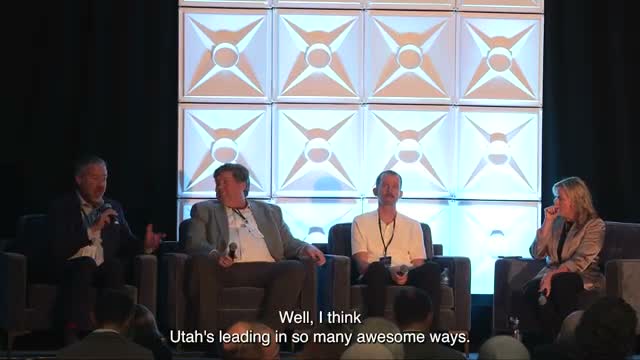
Speakers at the Utah Business and Commerce panel argued that Utah could become a stronger AI hub but must address infrastructure and capital constraints.
Paul, who said he testified to a state senate committee about the Utah State Digital Choice Act, urged that individuals be able to own local, open‑source LLMs and their own contextual data. “Humans should own their own LLM, their own locally open source LLM on their own device,” Paul said, framing ownership and local context as a check against surveillance capitalism.
Andrew said Utah has strong talent but not the locally available large‑scale compute required for state‑of‑the‑art model training. “If someone in Utah were to try to run an experiment on 2,000 GPUs, those 2,000 GPUs would not be in Utah,” Andrew said, identifying GPU access and power as limiting factors for creating an OpenAI‑scale company locally.
Travis highlighted foundational infrastructure such as power generation and water rights, and argued that adjustments to long‑standing rules could make it easier to build industry in the state. He also noted capital—both risk capital and concentrated pools of funding—remains a constraint for startups seeking to scale.
Panelists pointed to concrete levers: expand local compute access, make it easier for data centers and power projects to locate in Utah, invest in K–12 and higher education pipelines, and promote radical transparency in government data so AI can be used to evaluate policy outcomes. Paul suggested broader government transparency—including 'gavel‑to‑gavel' transcription—would create datasets that AI could analyze to inform better policy decisions.
The panel did not announce policy actions or new funding; speakers discussed gaps and recommendations. Several numeric claims made during the discussion (for example, percentages on open‑source usage and a private equity figure cited on stage) were expressed as panelists’ statements and should be verified before being used as factual totals.
Paul, who said he testified to a state senate committee about the Utah State Digital Choice Act, urged that individuals be able to own local, open‑source LLMs and their own contextual data. “Humans should own their own LLM, their own locally open source LLM on their own device,” Paul said, framing ownership and local context as a check against surveillance capitalism.
Andrew said Utah has strong talent but not the locally available large‑scale compute required for state‑of‑the‑art model training. “If someone in Utah were to try to run an experiment on 2,000 GPUs, those 2,000 GPUs would not be in Utah,” Andrew said, identifying GPU access and power as limiting factors for creating an OpenAI‑scale company locally.
Travis highlighted foundational infrastructure such as power generation and water rights, and argued that adjustments to long‑standing rules could make it easier to build industry in the state. He also noted capital—both risk capital and concentrated pools of funding—remains a constraint for startups seeking to scale.
Panelists pointed to concrete levers: expand local compute access, make it easier for data centers and power projects to locate in Utah, invest in K–12 and higher education pipelines, and promote radical transparency in government data so AI can be used to evaluate policy outcomes. Paul suggested broader government transparency—including 'gavel‑to‑gavel' transcription—would create datasets that AI could analyze to inform better policy decisions.
The panel did not announce policy actions or new funding; speakers discussed gaps and recommendations. Several numeric claims made during the discussion (for example, percentages on open‑source usage and a private equity figure cited on stage) were expressed as panelists’ statements and should be verified before being used as factual totals.
Don't Miss a Word: See the Full Meeting!
Go beyond summaries. Unlock every video, transcript, and key insight with a Founder Membership.
✓
Get instant access to full meeting videos
✓
Search and clip any phrase from complete transcripts
✓
Receive AI-powered summaries & custom alerts
✓
Enjoy lifetime, unrestricted access to government data
30-day money-back guarantee
