University presents data linking internships to stronger earnings and plans to expand experiential learning
December 12, 2025 | University of Minnesota, Public Universities Board of Trustees Meeting, School Boards, Minnesota
This article was created by AI summarizing key points discussed. AI makes mistakes, so for full details and context, please refer to the video of the full meeting. Please report any errors so we can fix them. Report an error »
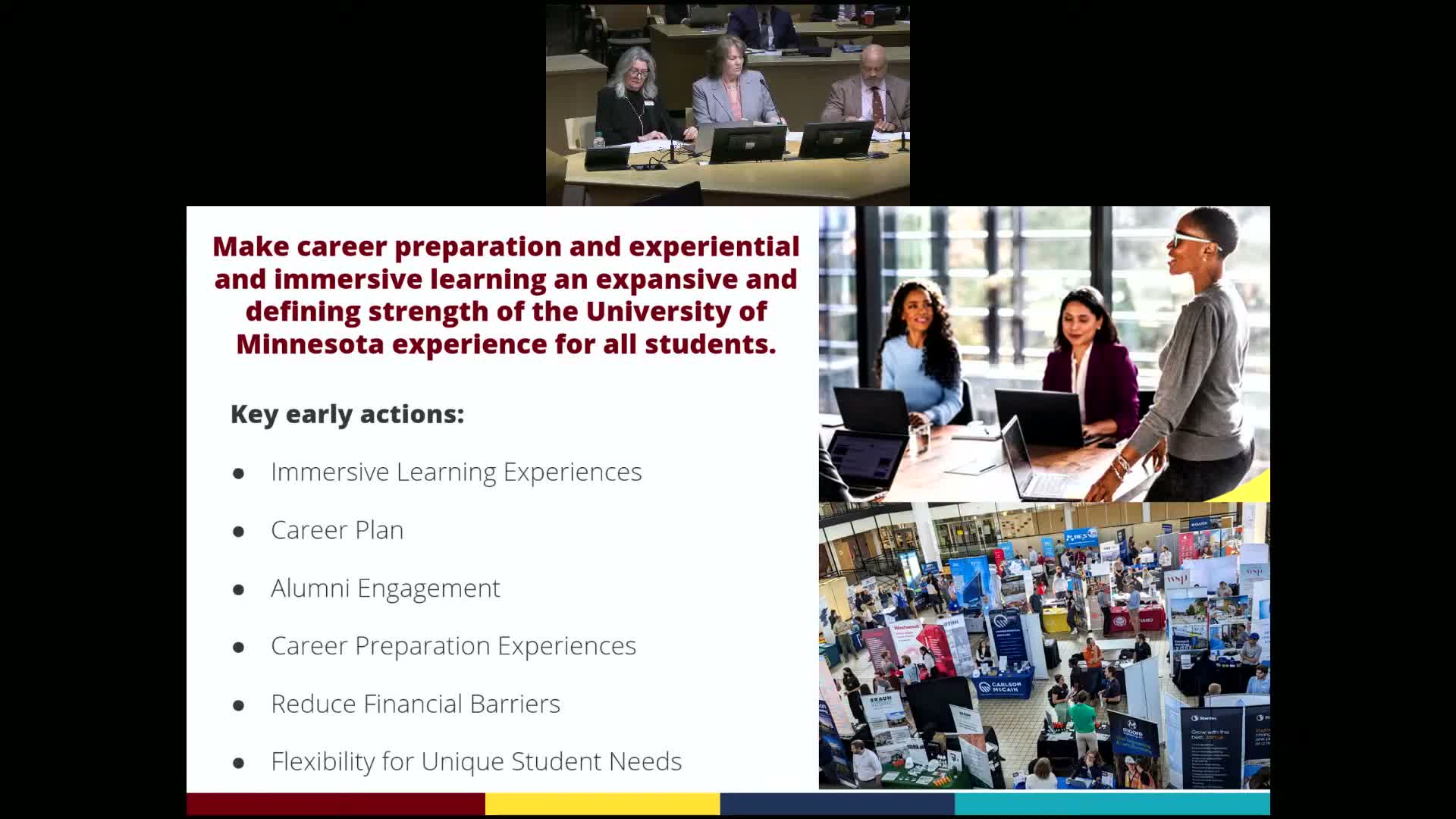
University leaders told the Board’s Mission Fulfillment Committee that expanding high‑quality internships and integrating career education across curricula are essential to student success and social mobility.
Sarah Nagel Newberg, executive director of Career Services Administration, summarized a 10‑year analysis by the university’s Office of Data and Institutional Reporting showing that Pell Grant students who completed internships had, on average, starting salaries $4,592 higher than Pell students who did not complete internships. Newberg said internship experience helps close a historical earnings gap and that for Pell students without internships the gap persists over a 10‑year period.
Presenters outlined three main barriers to internship access: insufficient opportunities closely aligned with student interests, student time constraints, and financial barriers for unpaid or low‑paid placements. They proposed centralizing employer engagement (a concierge model to help employers post opportunities across colleges), integrating career outcomes and employer contacts into coursework, and exploring funding options to offset lost wages for students who forgo paid work for an internship.
Nan Thurston (Crookston career services) shared a Crookston example in which a Deed‑funded placement at a Native‑owned small business gave an international student practical experience and helped him secure future opportunities. Presenters also noted existing infrastructure — shared job/internship platforms across colleges, an alumni Maroon and Gold Network and an employer tracking system in development — that can be scaled.
Regents asked how alumni and philanthropy might help; presenters said there are pockets of donor support for internships but emphasized further development of CRM systems and centralized resources to coordinate alumni engagement and employer relationships. No consent or policy changes were made at the meeting.
Sarah Nagel Newberg, executive director of Career Services Administration, summarized a 10‑year analysis by the university’s Office of Data and Institutional Reporting showing that Pell Grant students who completed internships had, on average, starting salaries $4,592 higher than Pell students who did not complete internships. Newberg said internship experience helps close a historical earnings gap and that for Pell students without internships the gap persists over a 10‑year period.
Presenters outlined three main barriers to internship access: insufficient opportunities closely aligned with student interests, student time constraints, and financial barriers for unpaid or low‑paid placements. They proposed centralizing employer engagement (a concierge model to help employers post opportunities across colleges), integrating career outcomes and employer contacts into coursework, and exploring funding options to offset lost wages for students who forgo paid work for an internship.
Nan Thurston (Crookston career services) shared a Crookston example in which a Deed‑funded placement at a Native‑owned small business gave an international student practical experience and helped him secure future opportunities. Presenters also noted existing infrastructure — shared job/internship platforms across colleges, an alumni Maroon and Gold Network and an employer tracking system in development — that can be scaled.
Regents asked how alumni and philanthropy might help; presenters said there are pockets of donor support for internships but emphasized further development of CRM systems and centralized resources to coordinate alumni engagement and employer relationships. No consent or policy changes were made at the meeting.
Don't Miss a Word: See the Full Meeting!
Go beyond summaries. Unlock every video, transcript, and key insight with a Founder Membership.
✓
Get instant access to full meeting videos
✓
Search and clip any phrase from complete transcripts
✓
Receive AI-powered summaries & custom alerts
✓
Enjoy lifetime, unrestricted access to government data
30-day money-back guarantee
