UMass researcher describes Springfield tornado study and lessons for post-disaster replanting
December 16, 2025 | Northampton City, Hampshire County, Massachusetts
This article was created by AI summarizing key points discussed. AI makes mistakes, so for full details and context, please refer to the video of the full meeting. Please report any errors so we can fix them. Report an error »
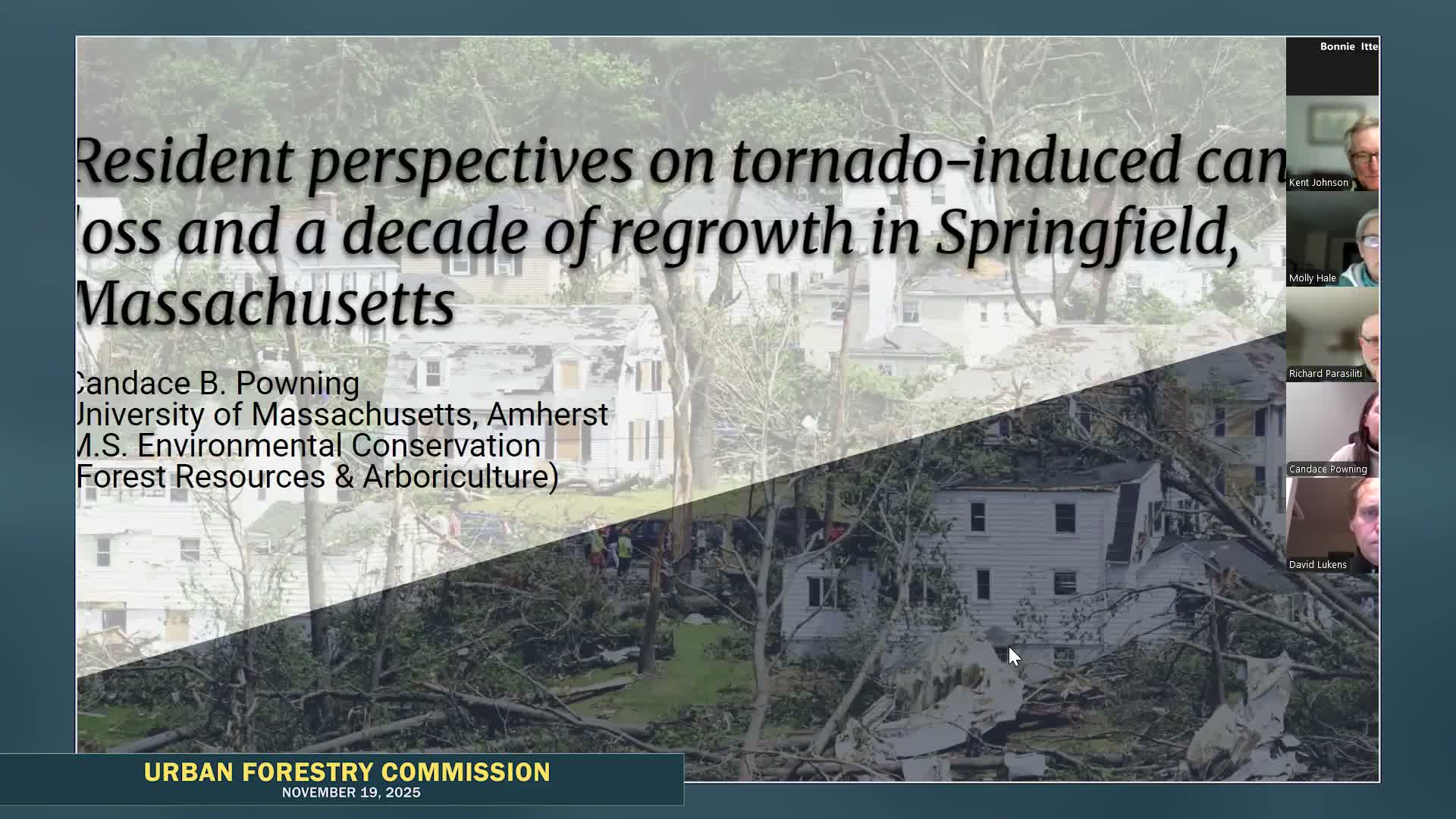
Candace, a PhD student at UMass and an urban forester in Hartford, presented findings from interviews with residents affected by the June 2011 Springfield tornado and discussed how emotional attachments to place influence replanting decisions.
Candace said her team conducted 25 interviews with 29 subjects who largely were older homeowners and described the project’s structure: pre‑tornado impressions, immediate aftermath, midterm replanting choices and long‑term stewardship. "So I spent a couple years interviewing residents in Springfield for my masters, talking to them about their experience of the tornado in 2011," she said, explaining the sampling and coding process.
The research found that many residents who experienced severe property damage nevertheless opted into replanting when offered free trees in the midterm aftermath because residents wanted the landscape to look familiar again. Candace used the term solastalgia — emotional distress tied to environmental loss — to frame residents’ drive to reconstruct a pre‑tornado landscape: residents sought to "recreate what they understand to be a familiar landscape through replanted trees."
Her analysis also showed that plantings clustered in neighborhoods with larger yards and higher owner occupancy (East Forest Park and 16 Acres) while denser urban neighborhoods saw fewer opt‑ins. Candace noted program design matters: the opt‑in giveaway model made participation easy for households dealing with rebuilding and insurance, but it also limits the ability to learn why others declined to participate.
Commissioners asked about the study’s limits and suggested interviewing outreach staff to better capture reasons people declined. Candace acknowledged those limitations and said follow‑up work could include outreach teams and additional data sources.
The presentation concluded with practical recommendations for practitioners: prioritize replanting quickly after disasters, provide low‑ or no‑cost trees, offer informed species choice and follow‑up care, and design outreach to restore both ecosystem services and residents’ relationship with place. Candace said she will share the paper when it is published.
Candace said her team conducted 25 interviews with 29 subjects who largely were older homeowners and described the project’s structure: pre‑tornado impressions, immediate aftermath, midterm replanting choices and long‑term stewardship. "So I spent a couple years interviewing residents in Springfield for my masters, talking to them about their experience of the tornado in 2011," she said, explaining the sampling and coding process.
The research found that many residents who experienced severe property damage nevertheless opted into replanting when offered free trees in the midterm aftermath because residents wanted the landscape to look familiar again. Candace used the term solastalgia — emotional distress tied to environmental loss — to frame residents’ drive to reconstruct a pre‑tornado landscape: residents sought to "recreate what they understand to be a familiar landscape through replanted trees."
Her analysis also showed that plantings clustered in neighborhoods with larger yards and higher owner occupancy (East Forest Park and 16 Acres) while denser urban neighborhoods saw fewer opt‑ins. Candace noted program design matters: the opt‑in giveaway model made participation easy for households dealing with rebuilding and insurance, but it also limits the ability to learn why others declined to participate.
Commissioners asked about the study’s limits and suggested interviewing outreach staff to better capture reasons people declined. Candace acknowledged those limitations and said follow‑up work could include outreach teams and additional data sources.
The presentation concluded with practical recommendations for practitioners: prioritize replanting quickly after disasters, provide low‑ or no‑cost trees, offer informed species choice and follow‑up care, and design outreach to restore both ecosystem services and residents’ relationship with place. Candace said she will share the paper when it is published.
Don't Miss a Word: See the Full Meeting!
Go beyond summaries. Unlock every video, transcript, and key insight with a Founder Membership.
✓
Get instant access to full meeting videos
✓
Search and clip any phrase from complete transcripts
✓
Receive AI-powered summaries & custom alerts
✓
Enjoy lifetime, unrestricted access to government data
30-day money-back guarantee
