Preliminary special-education child count shows rise in autism identifications, division says
December 05, 2025 | CHARLOTTESVILLE CTY PBLC SCHS, School Districts, Virginia
This article was created by AI summarizing key points discussed. AI makes mistakes, so for full details and context, please refer to the video of the full meeting. Please report any errors so we can fix them. Report an error »
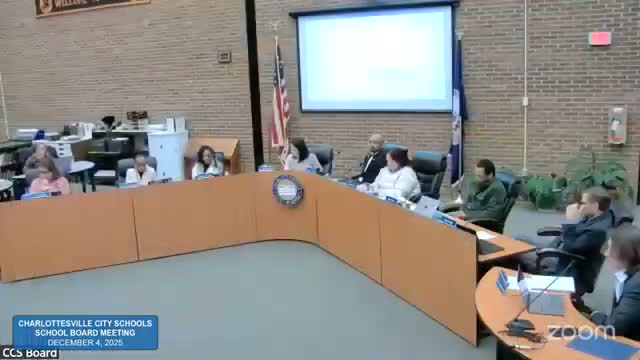
Charlottesville City Schools staff presented the division’s preliminary December 1 child count for special education, describing placement types, indicator metrics and funding implications.
Dr. Resnick (special education lead) told the board identification rates for the division are similar to recent years overall but that the number of students with a primary designation of autism has increased significantly. She emphasized inclusive practices and the division’s goal of serving as many students as possible in public day-school settings rather than in separate public or private placements. Dr. Resnick noted that some students are placed in residential settings by other agencies (the CSB) and not by the division.
The presentation included discussion of indicator 6A (time in general education with specially designed instruction) and the division’s aim to increase these inclusive placements. Dr. Resnick described the intensive-supports application as a funding mechanism intended to offset high per-student costs; staff track per-student costs that can reach approximately $30,000 annually for students with extensive needs and submit the application three times a year.
Board members asked about federal and Title funding implications and whether increased preschool identification will create budgetary pressures; Dr. Resnick said Title VI-B funding is not currently flagged for reductions from the state and that the division has already added positions for early childhood special education in recent years. She said more space (e.g., via an early learning center) would support inclusive instruction and staffing efficiency.
Next steps: staff will include more detailed programmatic updates in a comprehensive special-education update later in the year and supply additional data about exits and transitions for preschool-identified students into K–12 settings.
Dr. Resnick (special education lead) told the board identification rates for the division are similar to recent years overall but that the number of students with a primary designation of autism has increased significantly. She emphasized inclusive practices and the division’s goal of serving as many students as possible in public day-school settings rather than in separate public or private placements. Dr. Resnick noted that some students are placed in residential settings by other agencies (the CSB) and not by the division.
The presentation included discussion of indicator 6A (time in general education with specially designed instruction) and the division’s aim to increase these inclusive placements. Dr. Resnick described the intensive-supports application as a funding mechanism intended to offset high per-student costs; staff track per-student costs that can reach approximately $30,000 annually for students with extensive needs and submit the application three times a year.
Board members asked about federal and Title funding implications and whether increased preschool identification will create budgetary pressures; Dr. Resnick said Title VI-B funding is not currently flagged for reductions from the state and that the division has already added positions for early childhood special education in recent years. She said more space (e.g., via an early learning center) would support inclusive instruction and staffing efficiency.
Next steps: staff will include more detailed programmatic updates in a comprehensive special-education update later in the year and supply additional data about exits and transitions for preschool-identified students into K–12 settings.
Don't Miss a Word: See the Full Meeting!
Go beyond summaries. Unlock every video, transcript, and key insight with a Founder Membership.
✓
Get instant access to full meeting videos
✓
Search and clip any phrase from complete transcripts
✓
Receive AI-powered summaries & custom alerts
✓
Enjoy lifetime, unrestricted access to government data
30-day money-back guarantee
