Baltimore hearing on bill to raise security officers’ wages draws strong worker support and agency questions
December 11, 2025 | Baltimore City, Baltimore County, Maryland
This article was created by AI summarizing key points discussed. AI makes mistakes, so for full details and context, please refer to the video of the full meeting. Please report any errors so we can fix them. Report an error »
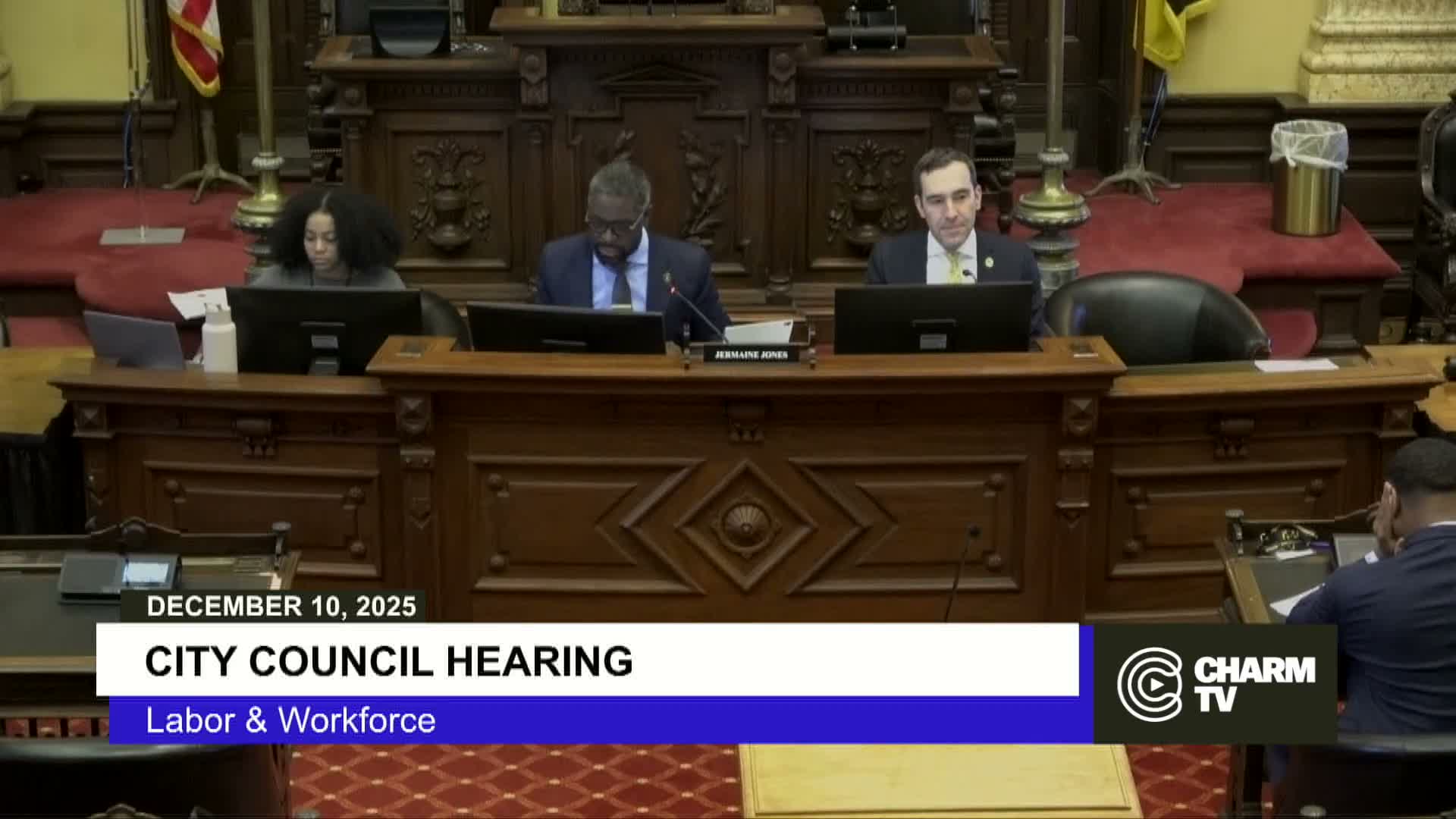
Baltimore City’s Labor and Workforce Committee on a non-voting night heard broad testimony for and against Council Bill 25-0116, which would require certain employers to pay minimum compensation (wages and fringe benefits) to private security officers. Chair Jermaine Jones, sponsor of the bill, opened by saying security officers “make as little as $15.80 an hour” and described the proposal as a way to reduce turnover and stabilize a workforce he called essential to public safety.
Council President Z. Cohen urged passage, arguing security officers are part of the city’s public-safety effort and deserve higher pay: “Passing this bill is the right thing to do,” he said. Jones framed the ordinance to let the city’s Wage Commission set an annual combined wage-and-benefit standard and cited federal comparators, including the Service Contract Act. Jones said the bill’s wage calculation would use the Service Contract Act determination (he cited an $18.29 hourly wage and a $5.55/hour health-and-welfare component as the federal baseline as of July 2025) and that the city’s local standard would not take effect until Jan. 1, 2027.
Administration officials signaled support for the bill’s intent but flagged implementation issues. Tyler Schnell, deputy director for government relations for the mayor, said the administration was ready to “work with you to address some of the issues” and offered collaboration on amendments to ensure the ordinance is implementable. Jeff Hochsteller of the Law Department told the committee the bill could be approved for form and legal sufficiency.
The Finance Department registered opposition to the bill as written because of unbudgeted fiscal impacts. Gabriel Stuart Zikowitz, a finance legislative analyst, said city-managed security contracts and additional enforcement staff would create recurring costs and estimated private businesses could face an average wage increase near $6.82 per hour, not including overhead. Finance told the committee the proposal could require 2–3 additional positions in the Office of Equity and Civil Rights (OECR) to implement and enforce the law.
Representatives from OECR and the Wage Commission said they support the bill’s goals but cannot endorse the current draft without changes. Zachary Wellman, an equity policy analyst, said OCR appreciated the intent but requested an unfavorable committee report on the ordinance “as written,” citing methodology, logistics and staffing gaps. Wage Commission representatives described a small current staff (three investigators and a chief) and said achieving the bill’s compliance and survey demands would likely require more personnel and substantial outreach, because private-sector employers are not uniformly required to submit payroll data under the Article 11 minimum-wage framework.
Committee members pressed whether payroll reporting could be required when vendors do business with the city; council members and administration staff discussed adding contract clauses to capture payroll information for contractors that deliver security services as part of broader city contracts, but counsel said legal review and careful drafting would be needed.
Public testimony strongly favored higher standards. Dozens of workers, unions and advocacy organizations described low pay, limited benefits and high turnover in the security industry. Nicole Tortorello of the Public Justice Center said there are “over 4,500 security officers working in Baltimore,” identified pervasive misclassification and wage-theft risk, and argued higher wages would professionalize the workforce. Several worker witnesses gave first-person accounts of hardship; one testified, “I currently make $15 an hour with no health insurance and no paid time off.” Research testimony from the University of California, Berkeley, and the Center for American Progress cited low median wages, racial and gender disparities, and links between higher pay and reduced turnover.
Industry groups raised concerns about scope and cost. Ari Plout of the Maryland Hotel and Lodging Association asked for narrower coverage or additional exemptions for smaller hotels, saying added costs could affect the hospitality sector’s recovery. The association requested including lodging establishments in the same exclusion that covers unarmed restaurant and bar employees.
Legal analysis offered to the committee addressed preemption and constitutional questions. David Rodwin, an attorney who said he prepared a memo for SEIU Local 32BJ, told the committee federal preemption under the National Labor Relations Act would not bar a broadly applicable minimum standard and that ERISA would not be displaced because the bill would allow employers to provide benefits as a cash fringe, analogous to prevailing-wage models.
The committee concluded without a vote. Chair Jones reiterated that staff and agencies would continue conversations on drafting, budget timing and enforcement mechanics; the hearing was recessed for follow-up work. No formal motions or votes were taken at the session.
Provenance: This account is based on Committee Chair Jermaine Jones’s bill overview and remarks, agency reports from the Law Department, Mayor’s Office, Finance, DGS, OCR/Wage Commission, and public testimony from labor attorneys, union representatives, academic researchers and multiple security officers who testified in support. The committee did not take any formal votes during the hearing.
Council President Z. Cohen urged passage, arguing security officers are part of the city’s public-safety effort and deserve higher pay: “Passing this bill is the right thing to do,” he said. Jones framed the ordinance to let the city’s Wage Commission set an annual combined wage-and-benefit standard and cited federal comparators, including the Service Contract Act. Jones said the bill’s wage calculation would use the Service Contract Act determination (he cited an $18.29 hourly wage and a $5.55/hour health-and-welfare component as the federal baseline as of July 2025) and that the city’s local standard would not take effect until Jan. 1, 2027.
Administration officials signaled support for the bill’s intent but flagged implementation issues. Tyler Schnell, deputy director for government relations for the mayor, said the administration was ready to “work with you to address some of the issues” and offered collaboration on amendments to ensure the ordinance is implementable. Jeff Hochsteller of the Law Department told the committee the bill could be approved for form and legal sufficiency.
The Finance Department registered opposition to the bill as written because of unbudgeted fiscal impacts. Gabriel Stuart Zikowitz, a finance legislative analyst, said city-managed security contracts and additional enforcement staff would create recurring costs and estimated private businesses could face an average wage increase near $6.82 per hour, not including overhead. Finance told the committee the proposal could require 2–3 additional positions in the Office of Equity and Civil Rights (OECR) to implement and enforce the law.
Representatives from OECR and the Wage Commission said they support the bill’s goals but cannot endorse the current draft without changes. Zachary Wellman, an equity policy analyst, said OCR appreciated the intent but requested an unfavorable committee report on the ordinance “as written,” citing methodology, logistics and staffing gaps. Wage Commission representatives described a small current staff (three investigators and a chief) and said achieving the bill’s compliance and survey demands would likely require more personnel and substantial outreach, because private-sector employers are not uniformly required to submit payroll data under the Article 11 minimum-wage framework.
Committee members pressed whether payroll reporting could be required when vendors do business with the city; council members and administration staff discussed adding contract clauses to capture payroll information for contractors that deliver security services as part of broader city contracts, but counsel said legal review and careful drafting would be needed.
Public testimony strongly favored higher standards. Dozens of workers, unions and advocacy organizations described low pay, limited benefits and high turnover in the security industry. Nicole Tortorello of the Public Justice Center said there are “over 4,500 security officers working in Baltimore,” identified pervasive misclassification and wage-theft risk, and argued higher wages would professionalize the workforce. Several worker witnesses gave first-person accounts of hardship; one testified, “I currently make $15 an hour with no health insurance and no paid time off.” Research testimony from the University of California, Berkeley, and the Center for American Progress cited low median wages, racial and gender disparities, and links between higher pay and reduced turnover.
Industry groups raised concerns about scope and cost. Ari Plout of the Maryland Hotel and Lodging Association asked for narrower coverage or additional exemptions for smaller hotels, saying added costs could affect the hospitality sector’s recovery. The association requested including lodging establishments in the same exclusion that covers unarmed restaurant and bar employees.
Legal analysis offered to the committee addressed preemption and constitutional questions. David Rodwin, an attorney who said he prepared a memo for SEIU Local 32BJ, told the committee federal preemption under the National Labor Relations Act would not bar a broadly applicable minimum standard and that ERISA would not be displaced because the bill would allow employers to provide benefits as a cash fringe, analogous to prevailing-wage models.
The committee concluded without a vote. Chair Jones reiterated that staff and agencies would continue conversations on drafting, budget timing and enforcement mechanics; the hearing was recessed for follow-up work. No formal motions or votes were taken at the session.
Provenance: This account is based on Committee Chair Jermaine Jones’s bill overview and remarks, agency reports from the Law Department, Mayor’s Office, Finance, DGS, OCR/Wage Commission, and public testimony from labor attorneys, union representatives, academic researchers and multiple security officers who testified in support. The committee did not take any formal votes during the hearing.
Don't Miss a Word: See the Full Meeting!
Go beyond summaries. Unlock every video, transcript, and key insight with a Founder Membership.
✓
Get instant access to full meeting videos
✓
Search and clip any phrase from complete transcripts
✓
Receive AI-powered summaries & custom alerts
✓
Enjoy lifetime, unrestricted access to government data
30-day money-back guarantee
