San Benito County board advances rezones to meet state housing‑element deadline, stresses no immediate development approvals
December 16, 2025 | San Benito County, California
This article was created by AI summarizing key points discussed. AI makes mistakes, so for full details and context, please refer to the video of the full meeting. Please report any errors so we can fix them. Report an error »
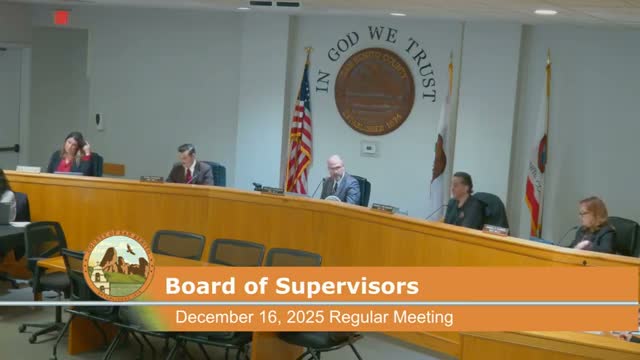
San Benito County supervisors on Dec. 16 introduced, by unanimous vote, a zoning ordinance that would create a new "Residential High" land‑use designation and rezone 12 parcels identified in the county’s 6‑cycle housing element. County planning director Abraham Prado told the board the rezones are required for the county to obtain certification from the California Department of Housing and Community Development (HCD) and to avoid the builders remedy, which allows certain housing projects to proceed without meeting local zoning.
"I just want to be clear that adoption of the rezones does not mean the approval of housing," Prado said during the presentation, stressing rezoning would not automatically authorize building permits or require property owners to develop. Staff recommended waiving first reading, continuing the ordinance for a second reading, and returning with the general plan amendment and CEQA documents on Jan. 13, 2026; the board voted 5‑0 to do so.
Why it matters: County staff and consultants said certification unlocks state grants and prevents developers from using builders remedy to pursue thousands of units outside local review. Planner Brian Del Toro said the county’s RHNA (Regional Housing Needs Allocation) obligation totals 754 units and the rezones would create the potential capacity the housing element assumes — roughly 2,044 units countywide, including 409 units targeted for lower‑income households.
Residents and owners raised concerns during public comment. John Avantkovich asked that access easements to an adjacent parcel be preserved if a county‑owned site is developed; Julie Glage said existing traffic and school overcrowding make high‑density projects difficult for some neighborhoods; Elia Salinas urged that unincorporated island parcels be counted only if utilities and service agreements are enforceable. James Dazzle said he felt some property owners were not adequately notified during the process.
Staff and supervisors pledged additional outreach. Prado and consultant Rita Garcia (environmental project manager) described the CEQA initial study and public review process; Garcia said the environmental analysis found impacts could be mitigated to less‑than‑significant with standard measures. Supervisors emphasized buffers, a three‑story maximum where appropriate and protections for neighboring single‑story homes.
Next steps: The board introduced and waived first reading and directed staff to return Jan. 13, 2026, with the ordinance’s second reading, an associated general plan amendment and the final CEQA documentation. If adopted and certified by HCD the county would regain greater local control over project review and access state funding programs staff tied to the housing element.
"I just want to be clear that adoption of the rezones does not mean the approval of housing," Prado said during the presentation, stressing rezoning would not automatically authorize building permits or require property owners to develop. Staff recommended waiving first reading, continuing the ordinance for a second reading, and returning with the general plan amendment and CEQA documents on Jan. 13, 2026; the board voted 5‑0 to do so.
Why it matters: County staff and consultants said certification unlocks state grants and prevents developers from using builders remedy to pursue thousands of units outside local review. Planner Brian Del Toro said the county’s RHNA (Regional Housing Needs Allocation) obligation totals 754 units and the rezones would create the potential capacity the housing element assumes — roughly 2,044 units countywide, including 409 units targeted for lower‑income households.
Residents and owners raised concerns during public comment. John Avantkovich asked that access easements to an adjacent parcel be preserved if a county‑owned site is developed; Julie Glage said existing traffic and school overcrowding make high‑density projects difficult for some neighborhoods; Elia Salinas urged that unincorporated island parcels be counted only if utilities and service agreements are enforceable. James Dazzle said he felt some property owners were not adequately notified during the process.
Staff and supervisors pledged additional outreach. Prado and consultant Rita Garcia (environmental project manager) described the CEQA initial study and public review process; Garcia said the environmental analysis found impacts could be mitigated to less‑than‑significant with standard measures. Supervisors emphasized buffers, a three‑story maximum where appropriate and protections for neighboring single‑story homes.
Next steps: The board introduced and waived first reading and directed staff to return Jan. 13, 2026, with the ordinance’s second reading, an associated general plan amendment and the final CEQA documentation. If adopted and certified by HCD the county would regain greater local control over project review and access state funding programs staff tied to the housing element.
Don't Miss a Word: See the Full Meeting!
Go beyond summaries. Unlock every video, transcript, and key insight with a Founder Membership.
✓
Get instant access to full meeting videos
✓
Search and clip any phrase from complete transcripts
✓
Receive AI-powered summaries & custom alerts
✓
Enjoy lifetime, unrestricted access to government data
30-day money-back guarantee
