House subcommittee hears testimony on quadrennial wildfire risk review bill
December 12, 2025 | Natural Resources: House Committee, Standing Committees - House & Senate, Congressional Hearings Compilation, Legislative, Federal
This article was created by AI summarizing key points discussed. AI makes mistakes, so for full details and context, please refer to the video of the full meeting. Please report any errors so we can fix them. Report an error »
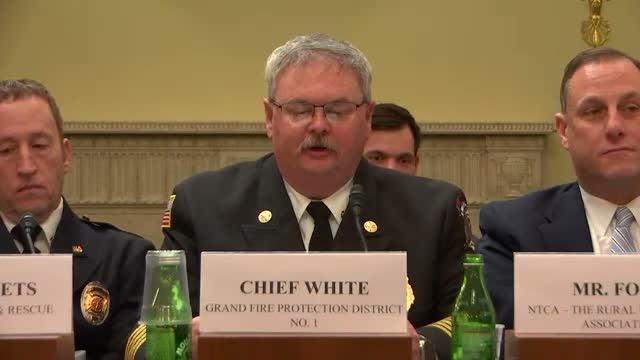
The House Natural Resources Subcommittee on Federal Lands heard bipartisan support for H.R. 3,924, the Wildfire Risk Evaluation Act, during a legislative hearing where local fire chiefs and community leaders urged Congress to require regular, interagency reviews of wildfire risk.
Brad White, chief of the Grand Fire Protection District, told the subcommittee that recurring reviews would help agencies and local responders "work from the same baseline, from the same planning horizon, and use better data, better tools." He said modern satellite detection, higher-resolution fuels mapping and smoke modeling could better prioritize mitigation and response.
Ranking Member Joe Neguse cited a grassroots firefighters' report that found a 38% reduction in completion of hazardous fuels projects since January and said the quadrennial review would help ensure federal efforts keep pace with changing conditions. "Wildfire response requires a coordinated and planned all-of-government approach," Neguse said.
Chief White described Grand County—a jurisdiction with multiple land-management units and roughly 70% federal land—as a case study in the need for shared data and planning across the Park Service, Forest Service, BLM, FEMA and local entities. He said the bill would encourage a predictable review cycle that incorporates public-health considerations and forward-looking scenarios.
Members asked how the reviews would improve local participation and operational decisions. White said better-integrated data and consistent interagency use of modeling and LIDAR can identify priority areas for fuels projects and guide deployment of limited resources.
The hearing concluded with members signaling support for advancing the legislation; no vote was taken. The subcommittee left the record open for written follow-up questions, due Dec. 16, 2025.
Brad White, chief of the Grand Fire Protection District, told the subcommittee that recurring reviews would help agencies and local responders "work from the same baseline, from the same planning horizon, and use better data, better tools." He said modern satellite detection, higher-resolution fuels mapping and smoke modeling could better prioritize mitigation and response.
Ranking Member Joe Neguse cited a grassroots firefighters' report that found a 38% reduction in completion of hazardous fuels projects since January and said the quadrennial review would help ensure federal efforts keep pace with changing conditions. "Wildfire response requires a coordinated and planned all-of-government approach," Neguse said.
Chief White described Grand County—a jurisdiction with multiple land-management units and roughly 70% federal land—as a case study in the need for shared data and planning across the Park Service, Forest Service, BLM, FEMA and local entities. He said the bill would encourage a predictable review cycle that incorporates public-health considerations and forward-looking scenarios.
Members asked how the reviews would improve local participation and operational decisions. White said better-integrated data and consistent interagency use of modeling and LIDAR can identify priority areas for fuels projects and guide deployment of limited resources.
The hearing concluded with members signaling support for advancing the legislation; no vote was taken. The subcommittee left the record open for written follow-up questions, due Dec. 16, 2025.
Don't Miss a Word: See the Full Meeting!
Go beyond summaries. Unlock every video, transcript, and key insight with a Founder Membership.
✓
Get instant access to full meeting videos
✓
Search and clip any phrase from complete transcripts
✓
Receive AI-powered summaries & custom alerts
✓
Enjoy lifetime, unrestricted access to government data
30-day money-back guarantee
