Parents and educators urge Board of Education to pause plan to add history/social studies to ESSA accountability
December 11, 2025 | Department of Education, Executive Agencies, Executive, Virginia
This article was created by AI summarizing key points discussed. AI makes mistakes, so for full details and context, please refer to the video of the full meeting. Please report any errors so we can fix them. Report an error »
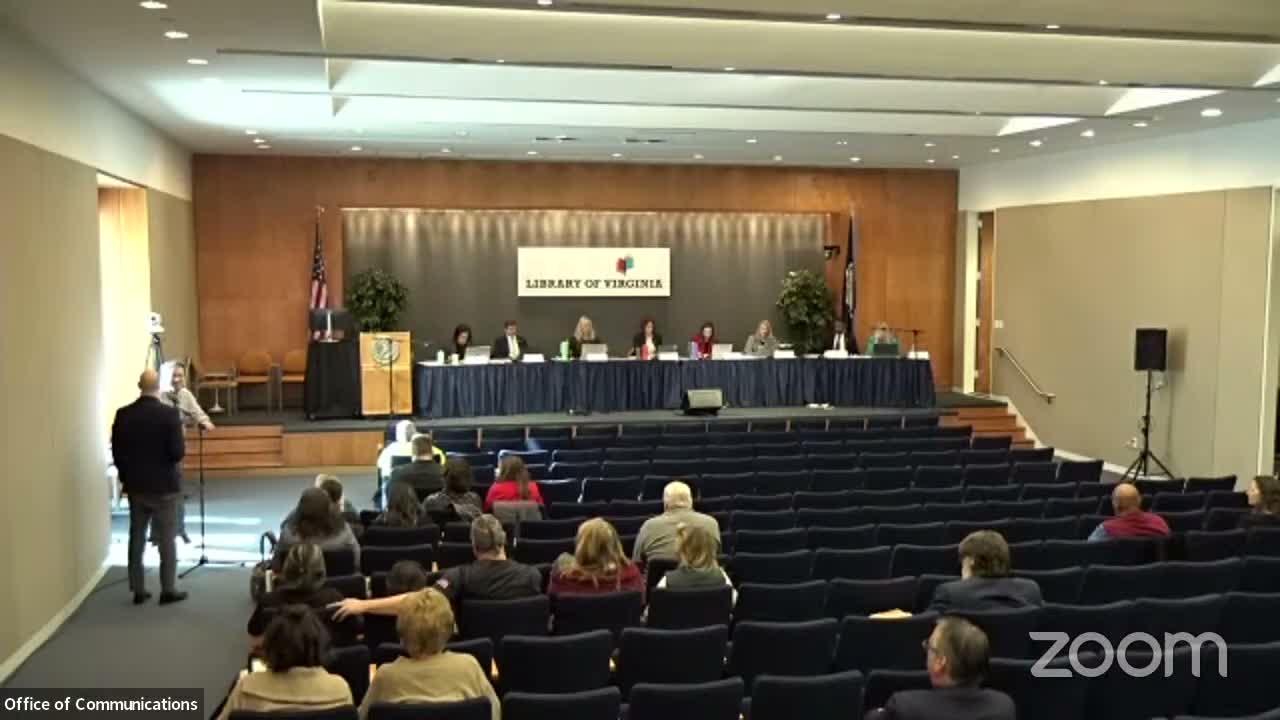
At the Virginia Board of Education meeting, a stream of public commenters — parents, teachers and subject‑area leaders — urged the board to pause or withdraw proposed language that could add history and social science to the state's ESSA consolidated plan.
Multiple speakers argued the change was advanced without robust consultation and could conflict with state law (House Bill 1957) that preserves local flexibility for performance‑based assessments. "Using social studies SOLs and accountability indicators would effectively turn an optional test into a de facto state requirement," said Eric Douche (social studies coordinator), urging the board to "pause adoption of these amendments and engage educators, parents, students and social studies experts." Danielle Graham, president of the Virginia Social Studies Leaders Consortium, said the department's earlier remarks about limited data were "simply inaccurate" and asked the board to allow local divisions to keep performance assessments and flexibility preserved by HB 1957.
Speakers also warned that counting world geography as a middle‑school advanced course could unintentionally reduce students' exposure to world history, including instruction on the Holocaust and Jewish history. "The proposal to count world geography as advanced coursework would limit that flexibility and effectively relegate world history courses to electives," Danielle Graham said.
Several speakers asked for more data and clearer implementation pathways rather than immediate changes to accountability. School division and college leaders described existing alternate assessment pathways and locally awarded verified credits; some urged that any change be accompanied by statewide technical validation and at least two years of field data as required under federal guidance for alternate assessments.
Board staff repeatedly framed the discussion as preliminary: no formal change had been adopted and staff described a timeline for further stakeholder engagement, public comment, technical review and potential staged implementation if the board ultimately decides to pursue an amendment.
What happens next: staff will hold listening sessions, publish proposed language for public comment, and return to the board with modeling and technical recommendations in January and in subsequent months before any final decision on amendment language.
Multiple speakers argued the change was advanced without robust consultation and could conflict with state law (House Bill 1957) that preserves local flexibility for performance‑based assessments. "Using social studies SOLs and accountability indicators would effectively turn an optional test into a de facto state requirement," said Eric Douche (social studies coordinator), urging the board to "pause adoption of these amendments and engage educators, parents, students and social studies experts." Danielle Graham, president of the Virginia Social Studies Leaders Consortium, said the department's earlier remarks about limited data were "simply inaccurate" and asked the board to allow local divisions to keep performance assessments and flexibility preserved by HB 1957.
Speakers also warned that counting world geography as a middle‑school advanced course could unintentionally reduce students' exposure to world history, including instruction on the Holocaust and Jewish history. "The proposal to count world geography as advanced coursework would limit that flexibility and effectively relegate world history courses to electives," Danielle Graham said.
Several speakers asked for more data and clearer implementation pathways rather than immediate changes to accountability. School division and college leaders described existing alternate assessment pathways and locally awarded verified credits; some urged that any change be accompanied by statewide technical validation and at least two years of field data as required under federal guidance for alternate assessments.
Board staff repeatedly framed the discussion as preliminary: no formal change had been adopted and staff described a timeline for further stakeholder engagement, public comment, technical review and potential staged implementation if the board ultimately decides to pursue an amendment.
What happens next: staff will hold listening sessions, publish proposed language for public comment, and return to the board with modeling and technical recommendations in January and in subsequent months before any final decision on amendment language.
Don't Miss a Word: See the Full Meeting!
Go beyond summaries. Unlock every video, transcript, and key insight with a Founder Membership.
✓
Get instant access to full meeting videos
✓
Search and clip any phrase from complete transcripts
✓
Receive AI-powered summaries & custom alerts
✓
Enjoy lifetime, unrestricted access to government data
30-day money-back guarantee
