Southborough ZBA conditionally approves Blue Sky Utility battery storage special permit at 150 Corteville Road
December 11, 2025 | Town of Southborough, Worcester County, Massachusetts
This article was created by AI summarizing key points discussed. AI makes mistakes, so for full details and context, please refer to the video of the full meeting. Please report any errors so we can fix them. Report an error »
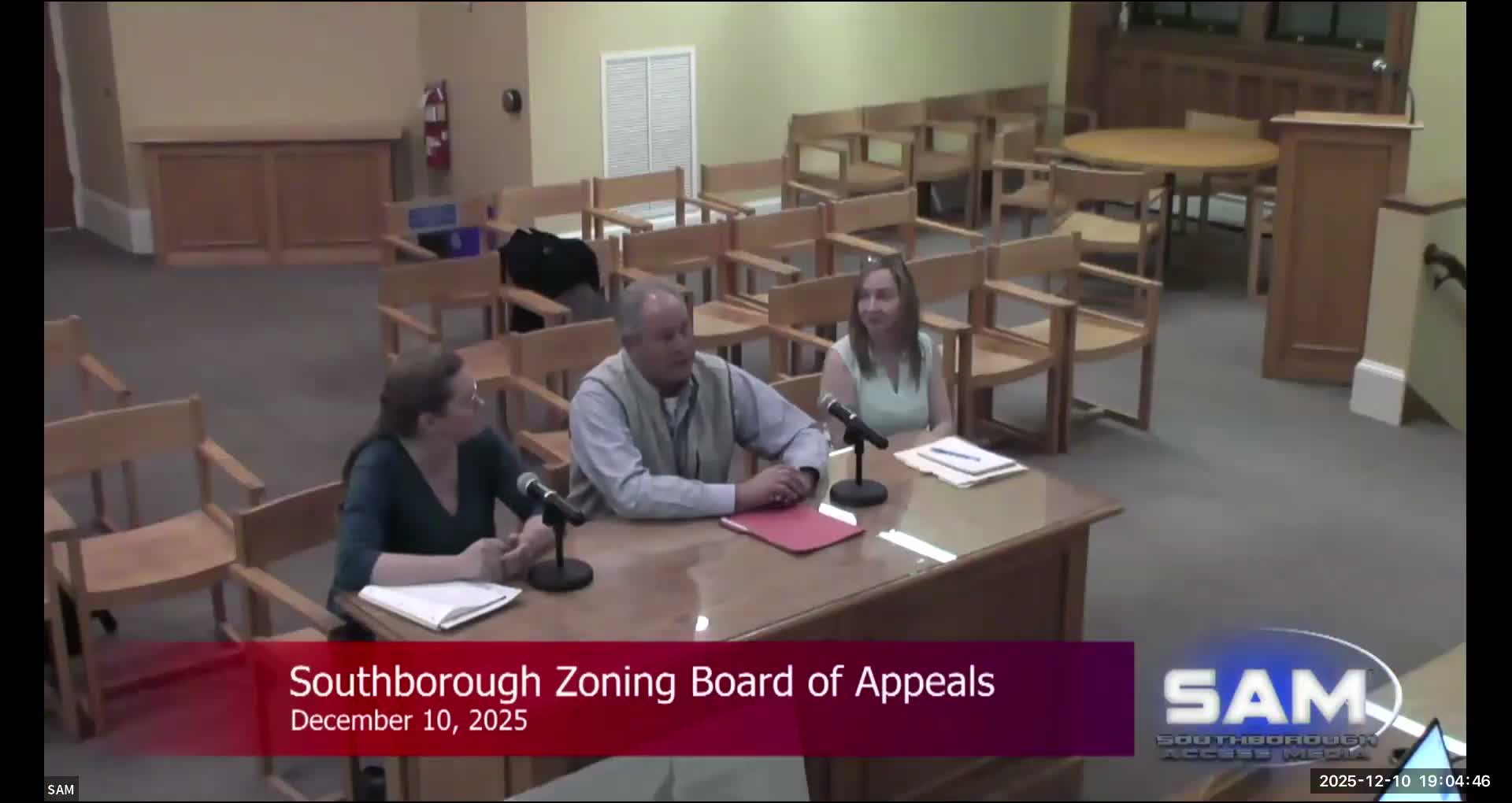
The Southborough Zoning Board of Appeals on Dec. 10 voted 4–1 to grant Blue Sky Utility LLC’s request to allow a battery energy storage system (BESS) as a second use at 150 Corteville Road, contingent on meeting fire-department and code requirements.
Charles Jenkins, who said he represents Blue Sky Utility (a subsidiary of Nofar), told the board the lithium-ion containerized system is intended for peak-demand response and emergency backup and can reduce reliance on diesel peaker plants. Jenkins said the company will coordinate with local utilities and that the system is designed with redundant monitoring and thermal-management systems intended to prevent and detect heat events.
Jen Crawford, the project civil engineer, and Anne Boyce, a managing agent for the property owner (Capital Group Properties), described the proposed location on the southwestern portion of the industrial-zoned site, said the facility would be unmanned with limited maintenance visits, and said it won’t encroach on wetlands or conservation buffers.
Andrew Pantini, Southborough fire chief, told the board he supports renewable energy in general but raised safety concerns because the proposed siting is close to retail and a daycare. Pantini warned that lithium-ion fires can generate highly toxic gases and noted hydrogen fluoride has an immediately dangerous-to-life-or-health (IDLH) concentration far lower than other common combustion hazards; he urged that mitigation and response plans meet the fire department’s standards.
Town counsel Jay Talenbrand advised the board that, while the storage use is often treated similarly to solar-related projects under recent case law, the board retains authority under the special-permit process to impose conditions addressing public health and safety. He recommended conditioning approval on the fire chief’s satisfaction with hazard-mitigation measures, operations-and-maintenance and decommissioning plans, and specific protections for adjacent sensitive uses.
During deliberations board members weighed whether the use would be “detrimental” to the surrounding area, repeatedly returning to the chief’s safety concerns. Several members said many technical issues — including a final energy-storage permit, a model-specific emergency response plan, annual fire-department training and a decommissioning plan — will be resolved through subsequent permitting steps. The board directed staff and counsel to draft findings and a conditions package for review at the January meeting.
The motion to approve the special permit, as moved and seconded at the meeting, specified that the applicant must secure any fire-department energy-storage permit and satisfy the fire chief regarding hazmat releases, emergency-response protocols, annual training and a decommissioning plan. A roll-call showed Jamie opposed; Paul, Doris, Mike and William voted in favor, carrying the motion 4–1.
Next procedural steps: staff and counsel will prepare written findings and a conditions draft for the board’s January meeting; the special-permit decision will be filed in accordance with the town’s permitting timeline and the 90-day decision window for special permits.
Charles Jenkins, who said he represents Blue Sky Utility (a subsidiary of Nofar), told the board the lithium-ion containerized system is intended for peak-demand response and emergency backup and can reduce reliance on diesel peaker plants. Jenkins said the company will coordinate with local utilities and that the system is designed with redundant monitoring and thermal-management systems intended to prevent and detect heat events.
Jen Crawford, the project civil engineer, and Anne Boyce, a managing agent for the property owner (Capital Group Properties), described the proposed location on the southwestern portion of the industrial-zoned site, said the facility would be unmanned with limited maintenance visits, and said it won’t encroach on wetlands or conservation buffers.
Andrew Pantini, Southborough fire chief, told the board he supports renewable energy in general but raised safety concerns because the proposed siting is close to retail and a daycare. Pantini warned that lithium-ion fires can generate highly toxic gases and noted hydrogen fluoride has an immediately dangerous-to-life-or-health (IDLH) concentration far lower than other common combustion hazards; he urged that mitigation and response plans meet the fire department’s standards.
Town counsel Jay Talenbrand advised the board that, while the storage use is often treated similarly to solar-related projects under recent case law, the board retains authority under the special-permit process to impose conditions addressing public health and safety. He recommended conditioning approval on the fire chief’s satisfaction with hazard-mitigation measures, operations-and-maintenance and decommissioning plans, and specific protections for adjacent sensitive uses.
During deliberations board members weighed whether the use would be “detrimental” to the surrounding area, repeatedly returning to the chief’s safety concerns. Several members said many technical issues — including a final energy-storage permit, a model-specific emergency response plan, annual fire-department training and a decommissioning plan — will be resolved through subsequent permitting steps. The board directed staff and counsel to draft findings and a conditions package for review at the January meeting.
The motion to approve the special permit, as moved and seconded at the meeting, specified that the applicant must secure any fire-department energy-storage permit and satisfy the fire chief regarding hazmat releases, emergency-response protocols, annual training and a decommissioning plan. A roll-call showed Jamie opposed; Paul, Doris, Mike and William voted in favor, carrying the motion 4–1.
Next procedural steps: staff and counsel will prepare written findings and a conditions draft for the board’s January meeting; the special-permit decision will be filed in accordance with the town’s permitting timeline and the 90-day decision window for special permits.
View the Full Meeting & All Its Details
This article offers just a summary. Unlock complete video, transcripts, and insights as a Founder Member.
✓
Watch full, unedited meeting videos
✓
Search every word spoken in unlimited transcripts
✓
AI summaries & real-time alerts (all government levels)
✓
Permanent access to expanding government content
30-day money-back guarantee
