Cleveland council hears experts on $100 million Browns settlement as members split over lakefront and lost tax revenue
November 25, 2025 | Cleveland, Cuyahoga County, Ohio
This article was created by AI summarizing key points discussed. AI makes mistakes, so for full details and context, please refer to the video of the full meeting. Please report any errors so we can fix them. Report an error »
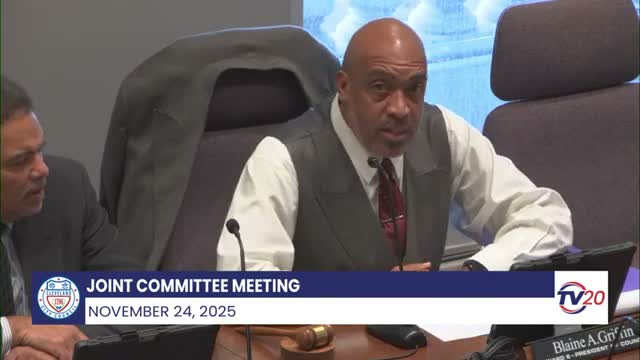
Council President Griffin convened a Nov. 24 hearing on proposed ordinance (the settlement term sheet introduced by Mayor Bibb) that would settle the city’s lawsuits against the Haslam Sports Group and provide $100,000,000 to the City of Cleveland in exchange for allowing the Cleveland Browns to relocate to Brook Park.
The session brought independent legal and economic testimony and public- and business-sector views to a council clearly divided over whether the payment and associated commitments deliver a net benefit for Cleveland.
Ken Silliman, a retired city law-department veteran who helped negotiate earlier stadium deals, told the council the Brook Park plan and the term sheet “is the single worst development deal for the city and the region” in his 38 years of public service. He flagged term sheet sections 2(e) and 2(f), which commit the city to “best efforts” to support Brook Park public safety, utilities and infrastructure. Silliman said that language could be interpreted to require the city to favor Brook Park projects in competitive grant processes and recommended deleting section 2(f) and tightening 2(e) to avoid unintended prioritization. He cited the city’s economic study and summarized projected harms as roughly $11,000,000 a year in lost tax revenues and about $30,000,000 in harder-to-quantify economic-development impacts to downtown if the team relocates.
Administration officials, including Director Mark Griffin, told the council the intention was not to prioritize Brook Park projects over city projects and that the obligations in the term sheet do not require direct city payments to Brook Park. Griffin said legal language would be clarified and that the agreement contains an arbitration clause to help resolve contract uncertainty.
Supporters of the settlement argued the deal provides political and economic certainty that would let downtown leaders and developers move forward on lakefront redevelopment. Michael Diemer, president and CEO of Downtown Cleveland, Inc., urged the council to approve the settlement and use the 3–5 year runway it creates to strengthen downtown’s competitiveness. David Ebersaw of the Greater Cleveland Partnership said comparable domed venues in other cities generate additional large events and visitation and that the settlement helps preserve momentum for waterfront investment. Scott Skinner, president of the North Coast Waterfront Development Corporation, said the term sheet’s $50,000,000 earmark for lakefront development and funds for stadium demolition would materially advance plans and attract private partners; he highlighted prior wins such as a $150,000,000 state/federal award for the North Coast Connector land-bridge project.
Council members pressed panelists and administration officials on multiple fronts: which jurisdictions would collect tax and admission revenues after a Brook Park move (administration and Silliman explained that many admission and parking taxes would shift to Brook Park, and the city’s economic study estimates about $11 million annually now collected by the city could be lost), whether Browns participation in the New Community Authority (NCA) or other local financing vehicles was committed (Skinner said talks had been preliminary and the Browns had not agreed to NCA participation), and how stadium demolition and site-preparation costs would be funded (the term sheet includes demolition funding but council members questioned whether the allocation is sufficient and how funds would be prioritized).
Several council members asked whether the council could unilaterally amend the term sheet. Administration counsel and staff repeatedly answered that any changes to the term sheet would reopen negotiations with Haslam Sports Group and would require their agreement; amendments would be two-party. That reality, and the weakened state-level protections (the transcript references an amended ‘‘Art Modell’’ law), shaped members’ assessment of the city’s legal leverage: several members said litigation likely offered delay but not a reliable path to prevent the move.
Opponents of the current terms — including some council members who described the settlement as insufficient for Cleveland taxpayers — argued that the lakefront and other commitments do not replace annual tax revenue the city now receives and pressed for clearer, enforceable commitments to neighborhood priorities (housing, schools, workforce protections for stadium workers and small-business participation). Other members and the invited business and lakefront leaders urged council to consider the settlement as an opportunity to secure certainty, avoid open-ended liabilities for stadium demolition, and pivot public and private investments to grow the downtown core.
Council President Griffin closed the hearing by urging members to submit proposed language tweaks to policy staff (including suggested edits Silliman provided) and said the administration had signaled willingness to clarify at least some items; he reiterated there would be no vote at the hearing and that the matter will proceed through the council’s legislative process and the finance committee. The council did not take legislative action during the session.
What happens next: council members were directed to provide recommended amendments to policy staff so leadership and administration can evaluate whether to reopen negotiations with Haslam Sports Group. The ordinance remains under consideration; the council must decide whether to accept the existing term sheet or press for revisions that Silliman and several members say are necessary to protect future Cleveland projects and budgets.
Quotes used in this article are drawn verbatim from testimony and statements made at the Nov. 24 hearing.
The session brought independent legal and economic testimony and public- and business-sector views to a council clearly divided over whether the payment and associated commitments deliver a net benefit for Cleveland.
Ken Silliman, a retired city law-department veteran who helped negotiate earlier stadium deals, told the council the Brook Park plan and the term sheet “is the single worst development deal for the city and the region” in his 38 years of public service. He flagged term sheet sections 2(e) and 2(f), which commit the city to “best efforts” to support Brook Park public safety, utilities and infrastructure. Silliman said that language could be interpreted to require the city to favor Brook Park projects in competitive grant processes and recommended deleting section 2(f) and tightening 2(e) to avoid unintended prioritization. He cited the city’s economic study and summarized projected harms as roughly $11,000,000 a year in lost tax revenues and about $30,000,000 in harder-to-quantify economic-development impacts to downtown if the team relocates.
Administration officials, including Director Mark Griffin, told the council the intention was not to prioritize Brook Park projects over city projects and that the obligations in the term sheet do not require direct city payments to Brook Park. Griffin said legal language would be clarified and that the agreement contains an arbitration clause to help resolve contract uncertainty.
Supporters of the settlement argued the deal provides political and economic certainty that would let downtown leaders and developers move forward on lakefront redevelopment. Michael Diemer, president and CEO of Downtown Cleveland, Inc., urged the council to approve the settlement and use the 3–5 year runway it creates to strengthen downtown’s competitiveness. David Ebersaw of the Greater Cleveland Partnership said comparable domed venues in other cities generate additional large events and visitation and that the settlement helps preserve momentum for waterfront investment. Scott Skinner, president of the North Coast Waterfront Development Corporation, said the term sheet’s $50,000,000 earmark for lakefront development and funds for stadium demolition would materially advance plans and attract private partners; he highlighted prior wins such as a $150,000,000 state/federal award for the North Coast Connector land-bridge project.
Council members pressed panelists and administration officials on multiple fronts: which jurisdictions would collect tax and admission revenues after a Brook Park move (administration and Silliman explained that many admission and parking taxes would shift to Brook Park, and the city’s economic study estimates about $11 million annually now collected by the city could be lost), whether Browns participation in the New Community Authority (NCA) or other local financing vehicles was committed (Skinner said talks had been preliminary and the Browns had not agreed to NCA participation), and how stadium demolition and site-preparation costs would be funded (the term sheet includes demolition funding but council members questioned whether the allocation is sufficient and how funds would be prioritized).
Several council members asked whether the council could unilaterally amend the term sheet. Administration counsel and staff repeatedly answered that any changes to the term sheet would reopen negotiations with Haslam Sports Group and would require their agreement; amendments would be two-party. That reality, and the weakened state-level protections (the transcript references an amended ‘‘Art Modell’’ law), shaped members’ assessment of the city’s legal leverage: several members said litigation likely offered delay but not a reliable path to prevent the move.
Opponents of the current terms — including some council members who described the settlement as insufficient for Cleveland taxpayers — argued that the lakefront and other commitments do not replace annual tax revenue the city now receives and pressed for clearer, enforceable commitments to neighborhood priorities (housing, schools, workforce protections for stadium workers and small-business participation). Other members and the invited business and lakefront leaders urged council to consider the settlement as an opportunity to secure certainty, avoid open-ended liabilities for stadium demolition, and pivot public and private investments to grow the downtown core.
Council President Griffin closed the hearing by urging members to submit proposed language tweaks to policy staff (including suggested edits Silliman provided) and said the administration had signaled willingness to clarify at least some items; he reiterated there would be no vote at the hearing and that the matter will proceed through the council’s legislative process and the finance committee. The council did not take legislative action during the session.
What happens next: council members were directed to provide recommended amendments to policy staff so leadership and administration can evaluate whether to reopen negotiations with Haslam Sports Group. The ordinance remains under consideration; the council must decide whether to accept the existing term sheet or press for revisions that Silliman and several members say are necessary to protect future Cleveland projects and budgets.
Quotes used in this article are drawn verbatim from testimony and statements made at the Nov. 24 hearing.
Don't Miss a Word: See the Full Meeting!
Go beyond summaries. Unlock every video, transcript, and key insight with a Founder Membership.
✓
Get instant access to full meeting videos
✓
Search and clip any phrase from complete transcripts
✓
Receive AI-powered summaries & custom alerts
✓
Enjoy lifetime, unrestricted access to government data
30-day money-back guarantee
