Tennessee Department of Revenue explains penalty waivers: interest can’t be waived, online petitions preferred
November 25, 2025 | Revenue, Deparments in Office of the Governor, Organizations, Executive, Tennessee
This article was created by AI summarizing key points discussed. AI makes mistakes, so for full details and context, please refer to the video of the full meeting. Please report any errors so we can fix them. Report an error »
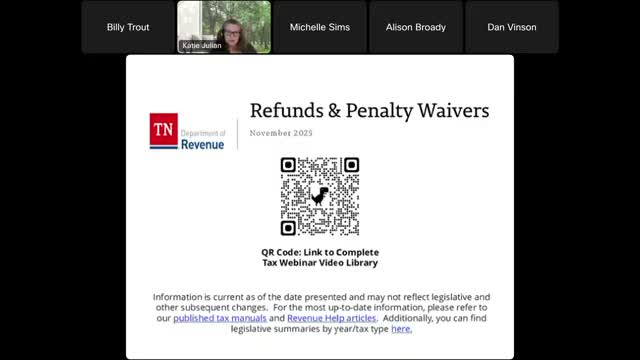
Billy Trout, manager of taxpayer education at the Tennessee Department of Revenue, and auditors from the department’s audit division outlined how taxpayers can request penalty waivers and what to expect from the process.
Katie Julian, a taxpayer-education specialist, said the law does not allow interest to be waived: “First and foremost, unfortunately, interest cannot be waived,” and added that the department will consider penalties for waiver only after the underlying tax is paid or is on an approved payment plan. Michelle Sims of the audit division said claim review times are not immediate: “penalty waivers can take 30 to 45 business days for complete process,” and waivers over $100,000 typically require additional approvals up to the Tennessee Attorney General’s office, which can extend processing.
Who can request a waiver and how it is evaluated
Taxpayers request waivers either online through the TenTap portal (recommended) or by paper form. The department evaluates waivers by tax type/account: a waiver submitted for sales and use tax is considered only on that tax account’s returns and payments, not on unrelated accounts such as franchise and excise. Michelle Sims said applicants should ensure all returns for the tax account in question are filed and that taxes are paid before the waiver can be considered.
Paper forms and TenTap differences
The department emphasized TenTap’s advantages: it is faster, supports a digital signature and makes it less likely that submissions will be rejected for missing signatures or illegible handwriting. Michelle Sims warned that “whenever a paper form is submitted, that form must be signed. If that form is not signed, we cannot process that penalty waiver.”
Documentation and selecting periods
On TenTap users select specific periods for review; if a period does not appear it may be out of statute and must be added explicitly or handled by paper form with exact dates. Staff recommended selecting all periods with penalties for review (rather than only the largest), because the department can issue partial approvals across selected periods. Taxpayers should use the TenTap narrative box to explain the cause and may attach supporting documents; entering “see attached” is acceptable when documents are uploaded.
Practical tips and timing
Speakers urged taxpayers to document events that support good-and-reasonable-cause claims (for example, death in the family or bank changes leading to returned payments) and to contact taxpayer services with account-specific questions rather than submitting incomplete waiver requests. For large or complex cases, or for waivers routed to the Attorney General, processing can exceed the typical 30–45 business-day window.
What happens if a waiver is approved
If a taxpayer already paid the penalty and the waiver is approved, the account will be credited and TenTap will show a decision letter. TenTap also offers an option to request a refund if a post-waiver credit is created.
Next steps
Taxpayers seeking help or status updates were directed to the department’s penalty-waivers email (penalty.waivers@tn.gov) and the department phone lines provided during the webinar.
Katie Julian, a taxpayer-education specialist, said the law does not allow interest to be waived: “First and foremost, unfortunately, interest cannot be waived,” and added that the department will consider penalties for waiver only after the underlying tax is paid or is on an approved payment plan. Michelle Sims of the audit division said claim review times are not immediate: “penalty waivers can take 30 to 45 business days for complete process,” and waivers over $100,000 typically require additional approvals up to the Tennessee Attorney General’s office, which can extend processing.
Who can request a waiver and how it is evaluated
Taxpayers request waivers either online through the TenTap portal (recommended) or by paper form. The department evaluates waivers by tax type/account: a waiver submitted for sales and use tax is considered only on that tax account’s returns and payments, not on unrelated accounts such as franchise and excise. Michelle Sims said applicants should ensure all returns for the tax account in question are filed and that taxes are paid before the waiver can be considered.
Paper forms and TenTap differences
The department emphasized TenTap’s advantages: it is faster, supports a digital signature and makes it less likely that submissions will be rejected for missing signatures or illegible handwriting. Michelle Sims warned that “whenever a paper form is submitted, that form must be signed. If that form is not signed, we cannot process that penalty waiver.”
Documentation and selecting periods
On TenTap users select specific periods for review; if a period does not appear it may be out of statute and must be added explicitly or handled by paper form with exact dates. Staff recommended selecting all periods with penalties for review (rather than only the largest), because the department can issue partial approvals across selected periods. Taxpayers should use the TenTap narrative box to explain the cause and may attach supporting documents; entering “see attached” is acceptable when documents are uploaded.
Practical tips and timing
Speakers urged taxpayers to document events that support good-and-reasonable-cause claims (for example, death in the family or bank changes leading to returned payments) and to contact taxpayer services with account-specific questions rather than submitting incomplete waiver requests. For large or complex cases, or for waivers routed to the Attorney General, processing can exceed the typical 30–45 business-day window.
What happens if a waiver is approved
If a taxpayer already paid the penalty and the waiver is approved, the account will be credited and TenTap will show a decision letter. TenTap also offers an option to request a refund if a post-waiver credit is created.
Next steps
Taxpayers seeking help or status updates were directed to the department’s penalty-waivers email (penalty.waivers@tn.gov) and the department phone lines provided during the webinar.
Don't Miss a Word: See the Full Meeting!
Go beyond summaries. Unlock every video, transcript, and key insight with a Founder Membership.
✓
Get instant access to full meeting videos
✓
Search and clip any phrase from complete transcripts
✓
Receive AI-powered summaries & custom alerts
✓
Enjoy lifetime, unrestricted access to government data
30-day money-back guarantee
