Timberlane committee reviews cost of proposed tuition‑free full‑day kindergarten; first‑year net cost estimated about $271,000
November 25, 2025 | Timberlane Regional School District, School Districts, New Hampshire
This article was created by AI summarizing key points discussed. AI makes mistakes, so for full details and context, please refer to the video of the full meeting. Please report any errors so we can fix them. Report an error »
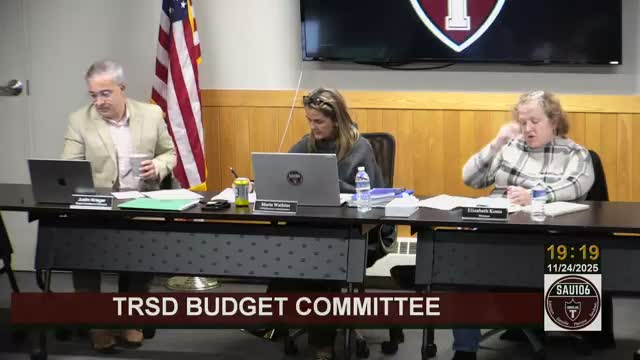
District staff told the Timberlane Regional School District budget committee on Nov. 24 that a move to tuition‑free, full‑day kindergarten would shift costs and revenues across multiple budget lines and generate a modest net cost in the first year.
The administrator presenting the analysis said the district currently offers two kindergarten pathways — a tuition‑free half‑day program and a tuition‑based full‑day program families pay $4,500 a year to attend — and that eliminating tuition would remove that revenue stream. "If that tuition remains the same ... the tuition that we would stand to lose in fiscal 27 is $765,000," the presenter said.
The presenter also said the New Hampshire Department of Education would award a one‑time, noncompetitive start‑up adequacy grant of $2,175.50 per child in fiscal 2027 to help districts transition; in fiscal 2028 and thereafter full base adequacy funding would apply to full‑day kindergarten students. The administrator summarized staff modeling as projecting about 240 total kindergarten students, with roughly 170 in full‑day placements next year, and presented an estimated first‑year net cost to the district of about $271,000.
Why it matters: Committee members noted the timing of state adequacy dollars makes the first year the most challenging. Board members and commenters also highlighted research and equity arguments suggesting full‑day kindergarten can reduce later intervention and retention costs, which the presenter said are difficult to quantify in single‑year budget math.
Committee questions focused on the assumptions behind the estimates: how many students would enroll in full‑day programs at each school (the presenter said Sandown Central currently has 57 full‑day students), whether staff additions or reductions would be required, and whether transportation would change if the district eliminated a midday bus run. The presenter said the staffing model currently assumes 12.5 FTE kindergarten teachers and 12 paraprofessionals in the operating budget and that converting to full‑day could allow a half‑time teacher reduction in some scenarios (an estimated saving of about $50,000) but would still require ongoing staffing and transportation adjustments.
Next steps: The presenter said the school board intends to draft warrant language and bring it to the Dec. 1 board meeting; if the board approves it there, the warrant article would be returned to the budget committee for recommendation and then go to voters. The committee will continue its review in December before the public hearing in January and deliberative session in February.
Representative quotes from the meeting include comments from a resident who urged fiscal caution: "I have no more money to give you guys," and from a committee commenter who said, "Our job here is to provide an education."
The administrator presenting the analysis said the district currently offers two kindergarten pathways — a tuition‑free half‑day program and a tuition‑based full‑day program families pay $4,500 a year to attend — and that eliminating tuition would remove that revenue stream. "If that tuition remains the same ... the tuition that we would stand to lose in fiscal 27 is $765,000," the presenter said.
The presenter also said the New Hampshire Department of Education would award a one‑time, noncompetitive start‑up adequacy grant of $2,175.50 per child in fiscal 2027 to help districts transition; in fiscal 2028 and thereafter full base adequacy funding would apply to full‑day kindergarten students. The administrator summarized staff modeling as projecting about 240 total kindergarten students, with roughly 170 in full‑day placements next year, and presented an estimated first‑year net cost to the district of about $271,000.
Why it matters: Committee members noted the timing of state adequacy dollars makes the first year the most challenging. Board members and commenters also highlighted research and equity arguments suggesting full‑day kindergarten can reduce later intervention and retention costs, which the presenter said are difficult to quantify in single‑year budget math.
Committee questions focused on the assumptions behind the estimates: how many students would enroll in full‑day programs at each school (the presenter said Sandown Central currently has 57 full‑day students), whether staff additions or reductions would be required, and whether transportation would change if the district eliminated a midday bus run. The presenter said the staffing model currently assumes 12.5 FTE kindergarten teachers and 12 paraprofessionals in the operating budget and that converting to full‑day could allow a half‑time teacher reduction in some scenarios (an estimated saving of about $50,000) but would still require ongoing staffing and transportation adjustments.
Next steps: The presenter said the school board intends to draft warrant language and bring it to the Dec. 1 board meeting; if the board approves it there, the warrant article would be returned to the budget committee for recommendation and then go to voters. The committee will continue its review in December before the public hearing in January and deliberative session in February.
Representative quotes from the meeting include comments from a resident who urged fiscal caution: "I have no more money to give you guys," and from a committee commenter who said, "Our job here is to provide an education."
Don't Miss a Word: See the Full Meeting!
Go beyond summaries. Unlock every video, transcript, and key insight with a Founder Membership.
✓
Get instant access to full meeting videos
✓
Search and clip any phrase from complete transcripts
✓
Receive AI-powered summaries & custom alerts
✓
Enjoy lifetime, unrestricted access to government data
30-day money-back guarantee
