Schuylkill Valley board reviews new growth data; leaders point to curriculum, internal benchmarks
November 25, 2025 | Schuylkill Valley SD, School Districts, Pennsylvania
This article was created by AI summarizing key points discussed. AI makes mistakes, so for full details and context, please refer to the video of the full meeting. Please report any errors so we can fix them. Report an error »
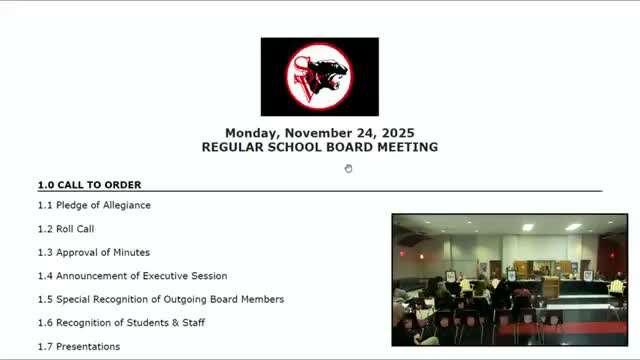
Administrators for the Schuylkill Valley School District presented building‑level assessment data on student growth and new internal benchmarks, telling the board the district is beginning to see measurable year‑to‑year gains in reading while middle‑school math remains an area of concern.
Dr. Shannon O'Donnell, who opened the presentations, said the elementary school’s academic growth score for English language arts was 77 for the 2024–25 cohort — above the state growth standard of 70 and the statewide average of 75.4 — and that elementary mathematics showed an academic growth score of 96, “which is well above the state growth standard of 70 and the statewide average of 74.9.” She described the kindergarten entry inventory (KEI) and teacher‑administered Independent Reading Level Assessment (IRLA) and said the district will pair those internal measures with ALEKS math diagnostics to guide instruction.
Why it matters: the district is using a mix of state‑reported growth data (the Future Ready Index/PSSA outputs) and fresh internal diagnostics to identify gaps earlier in the year and target interventions rather than waiting for annual state test results. Several board members asked for trend data that reaches pre‑COVID years and for clearer distributions behind the growth scores so the board can see whether gains reflect small improvements across many students or larger changes among a subset.
Presenters described how IRLA is administered one‑on‑one by teachers to determine a reading level and how ALEKS provides adaptive, item‑level math diagnostics. A principal told the board these internal tools let teachers identify skill gaps early and form small instructional groups. On the middle‑school panel, presenters reported an ELA growth score of 83 (above the state standard) but a math growth score of 50, below the state growth standard of 70; the middle‑school team said they are responding with new curriculum alignment, common benchmarking and targeted remediation.
Board members repeatedly sought longitudinal context. "It would be interesting to see where the trend is and how close we are to pre‑COVID numbers," one asked; presenters replied that consistent three‑year growth data are only now available after pandemic disruptions and that comparisons would be prepared on request. The high school review noted cohort variation tied to which assessments (Keystone, CDT) and grade levels contributed to the reported scores: the high school reported an ELA growth score of 56 and a math/algebra growth score of 72 for the cohort that will graduate in June 2026.
Next steps: district leaders said they will share additional trend and distribution tables so the board can evaluate where gains are strongest and where targeted supports are required. The presentations concluded with a reminder that implementing new curricula often takes multiple years before expected effects fully appear.
Dr. Shannon O'Donnell, who opened the presentations, said the elementary school’s academic growth score for English language arts was 77 for the 2024–25 cohort — above the state growth standard of 70 and the statewide average of 75.4 — and that elementary mathematics showed an academic growth score of 96, “which is well above the state growth standard of 70 and the statewide average of 74.9.” She described the kindergarten entry inventory (KEI) and teacher‑administered Independent Reading Level Assessment (IRLA) and said the district will pair those internal measures with ALEKS math diagnostics to guide instruction.
Why it matters: the district is using a mix of state‑reported growth data (the Future Ready Index/PSSA outputs) and fresh internal diagnostics to identify gaps earlier in the year and target interventions rather than waiting for annual state test results. Several board members asked for trend data that reaches pre‑COVID years and for clearer distributions behind the growth scores so the board can see whether gains reflect small improvements across many students or larger changes among a subset.
Presenters described how IRLA is administered one‑on‑one by teachers to determine a reading level and how ALEKS provides adaptive, item‑level math diagnostics. A principal told the board these internal tools let teachers identify skill gaps early and form small instructional groups. On the middle‑school panel, presenters reported an ELA growth score of 83 (above the state standard) but a math growth score of 50, below the state growth standard of 70; the middle‑school team said they are responding with new curriculum alignment, common benchmarking and targeted remediation.
Board members repeatedly sought longitudinal context. "It would be interesting to see where the trend is and how close we are to pre‑COVID numbers," one asked; presenters replied that consistent three‑year growth data are only now available after pandemic disruptions and that comparisons would be prepared on request. The high school review noted cohort variation tied to which assessments (Keystone, CDT) and grade levels contributed to the reported scores: the high school reported an ELA growth score of 56 and a math/algebra growth score of 72 for the cohort that will graduate in June 2026.
Next steps: district leaders said they will share additional trend and distribution tables so the board can evaluate where gains are strongest and where targeted supports are required. The presentations concluded with a reminder that implementing new curricula often takes multiple years before expected effects fully appear.
Don't Miss a Word: See the Full Meeting!
Go beyond summaries. Unlock every video, transcript, and key insight with a Founder Membership.
✓
Get instant access to full meeting videos
✓
Search and clip any phrase from complete transcripts
✓
Receive AI-powered summaries & custom alerts
✓
Enjoy lifetime, unrestricted access to government data
30-day money-back guarantee
