Holland City Council adopts FY2025 audit, cites strong fund balance and single recommendation
December 04, 2025 | Holland City, Ottawa County, Michigan
This article was created by AI summarizing key points discussed. AI makes mistakes, so for full details and context, please refer to the video of the full meeting. Please report any errors so we can fix them. Report an error »
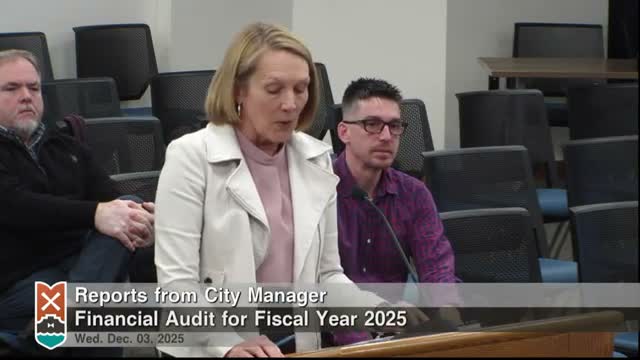
HOLLAND, Mich. — The Holland City Council unanimously adopted the city's fiscal year 2025 financial audit at its Dec. 3 meeting, after a presentation from Finance Director Lynn McCammon that said outside auditors issued an unmodified opinion.
McCammon told the council the auditing firm delivered a 263-page report and that the city earned the highest-level opinion, meaning the audited financial statements are materially accurate and reliable for decision-making. She highlighted a $2,200,000 increase in the city's total fund balance to $16,282,000, roughly just under 50% of annual expenditures and transfers out. That increase was driven by higher-than-expected investment income and some unspent budgeted purchases that may carry into the next fiscal year.
The audit included one formal recommendation related to budgeting for grant funds; staff said they will make improvements next year. McCammon also noted the city has $1.9 million designated for pension funding and reported a net pension liability of about $30 million as of June 30, 2025, a decrease of roughly $250,000 from the prior year.
Councilmember Corbin moved to adopt the audit; Councilmember Raymond supported the motion. A roll-call vote recorded unanimous support (Freeman, Raymond, Corbin, Schulteis, Mary Keane, Shay, Clomparans and Mayor Nathan Box), and the audit was adopted.
McCammon encouraged residents and council members to review the report's transmittal letter and the management discussion and analysis, and pointed to a 14-page "popular annual financial report" that summarizes the document in consumer-friendly graphics. She said staff and the auditors submit these documents for awards and that the city has won multiple recognitions for its reporting.
The council's adoption is procedural: the action transmits the audit as the official report for the year. The document and the shorter popular annual report are available on the city's website for public review.
What's next: Council did not attach additional directives to the audit vote; staff said they will address the single grant-budgeting recommendation in future budget and audit cycles.
McCammon told the council the auditing firm delivered a 263-page report and that the city earned the highest-level opinion, meaning the audited financial statements are materially accurate and reliable for decision-making. She highlighted a $2,200,000 increase in the city's total fund balance to $16,282,000, roughly just under 50% of annual expenditures and transfers out. That increase was driven by higher-than-expected investment income and some unspent budgeted purchases that may carry into the next fiscal year.
The audit included one formal recommendation related to budgeting for grant funds; staff said they will make improvements next year. McCammon also noted the city has $1.9 million designated for pension funding and reported a net pension liability of about $30 million as of June 30, 2025, a decrease of roughly $250,000 from the prior year.
Councilmember Corbin moved to adopt the audit; Councilmember Raymond supported the motion. A roll-call vote recorded unanimous support (Freeman, Raymond, Corbin, Schulteis, Mary Keane, Shay, Clomparans and Mayor Nathan Box), and the audit was adopted.
McCammon encouraged residents and council members to review the report's transmittal letter and the management discussion and analysis, and pointed to a 14-page "popular annual financial report" that summarizes the document in consumer-friendly graphics. She said staff and the auditors submit these documents for awards and that the city has won multiple recognitions for its reporting.
The council's adoption is procedural: the action transmits the audit as the official report for the year. The document and the shorter popular annual report are available on the city's website for public review.
What's next: Council did not attach additional directives to the audit vote; staff said they will address the single grant-budgeting recommendation in future budget and audit cycles.
View the Full Meeting & All Its Details
This article offers just a summary. Unlock complete video, transcripts, and insights as a Founder Member.
✓
Watch full, unedited meeting videos
✓
Search every word spoken in unlimited transcripts
✓
AI summaries & real-time alerts (all government levels)
✓
Permanent access to expanding government content
30-day money-back guarantee
