Oakland Mills parents, students and staff urge Howard County board to restore renovation funding
December 04, 2025 | Howard County Public Schools, School Boards, Maryland
This article was created by AI summarizing key points discussed. AI makes mistakes, so for full details and context, please refer to the video of the full meeting. Please report any errors so we can fix them. Report an error »
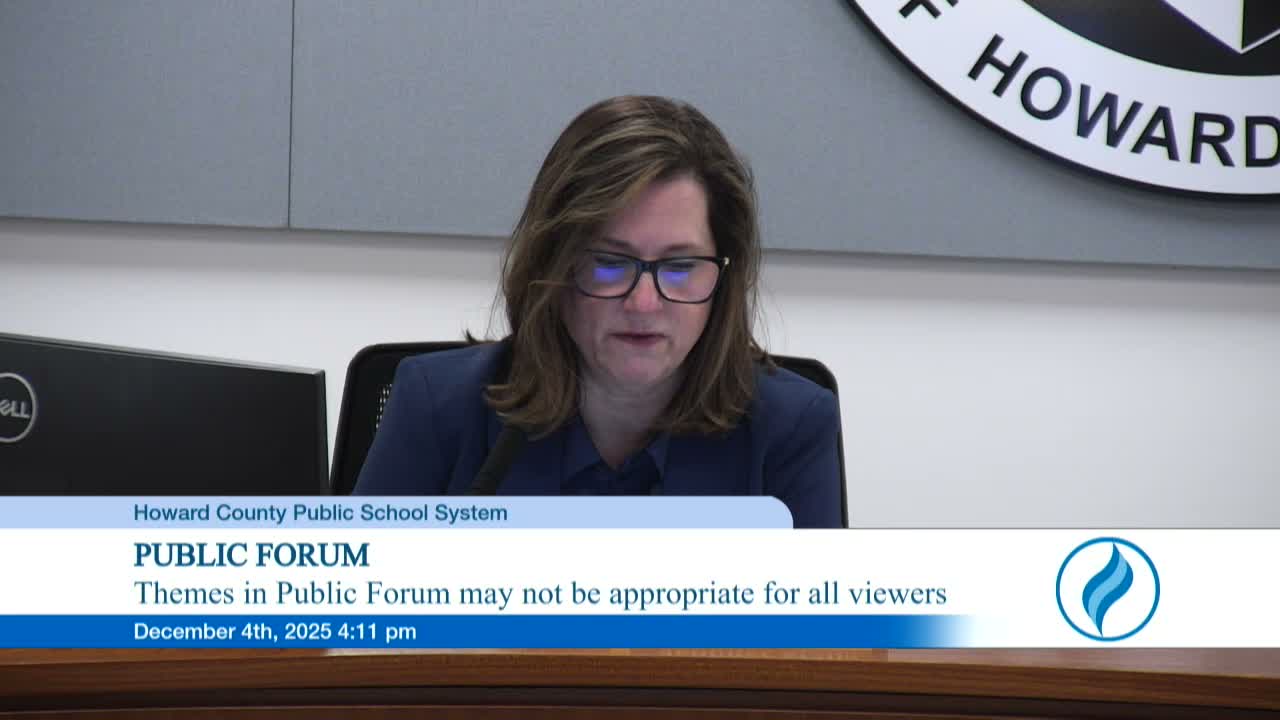
Dozens of students, teachers and parents from Oakland Mills High School told the Howard County Board of Education on Dec. 4 that the board’s recent decision to remove their school from near‑term renovation funding must be reversed.
At a packed public forum and again in the evening session, community members recounted recurring pipe bursts, mold in classrooms and athletic spaces, elevated lead readings in water outlets, and limited access to working bathrooms. “Our school is falling apart,” said Erica Gold Smith, a special educator and HCEA representative, adding that “classrooms are being flooded” and that mold and pesticides have been observed in multiple areas.
Nicholas Berry, a social studies teacher who cited the board’s prior votes that placed Oakland Mills in the capital plan, said the system’s new prioritization formula undervalues health and safety: “This flawed formula is being treated as a sacred tablet… if it calculates 45% of the score from capacity and a mere 10% from health and safety.” Berry urged the board to recall its vote to remove Oakland Mills from the renovation schedule.
Student leaders pressed the board as well. McKenna Grama, senior class president at Oakland Mills and organizer of a petition with more than 1,500 signatures, said delays would cost students critical years: “A delay of two isn’t just a number. For a middle schooler, two years is nearly their entire experience. For a high schooler, it is half their career.”
Several speakers framed the issue as one of equity. Tawanda Brown, representing a local elders’ council, said students who staged a peaceful walkout were later told they could not make up missed classwork, conflicting with system guidance on student expression.
Board members did not take immediate action on the capital‑budget priorities that evening. Superintendent Barnes acknowledged the walkout and thanked students for their peaceful advocacy; he said staff would follow up with school leaders and invited community stakeholders to submit written testimony to boe@hcpss.org.
The board previously adopted a capital plan that included Oakland Mills; community speakers said the sudden reprioritization — described in testimony as a vote removing funds — has left families and staff deeply frustrated and demanding a public reconsideration of the ranking process.
What’s next: Community members asked the board to restore the renovation in the FY27 capital budget and pressed for a transparent, data‑driven review of the prioritization formula. The board did not announce any change immediately after the testimony.
At a packed public forum and again in the evening session, community members recounted recurring pipe bursts, mold in classrooms and athletic spaces, elevated lead readings in water outlets, and limited access to working bathrooms. “Our school is falling apart,” said Erica Gold Smith, a special educator and HCEA representative, adding that “classrooms are being flooded” and that mold and pesticides have been observed in multiple areas.
Nicholas Berry, a social studies teacher who cited the board’s prior votes that placed Oakland Mills in the capital plan, said the system’s new prioritization formula undervalues health and safety: “This flawed formula is being treated as a sacred tablet… if it calculates 45% of the score from capacity and a mere 10% from health and safety.” Berry urged the board to recall its vote to remove Oakland Mills from the renovation schedule.
Student leaders pressed the board as well. McKenna Grama, senior class president at Oakland Mills and organizer of a petition with more than 1,500 signatures, said delays would cost students critical years: “A delay of two isn’t just a number. For a middle schooler, two years is nearly their entire experience. For a high schooler, it is half their career.”
Several speakers framed the issue as one of equity. Tawanda Brown, representing a local elders’ council, said students who staged a peaceful walkout were later told they could not make up missed classwork, conflicting with system guidance on student expression.
Board members did not take immediate action on the capital‑budget priorities that evening. Superintendent Barnes acknowledged the walkout and thanked students for their peaceful advocacy; he said staff would follow up with school leaders and invited community stakeholders to submit written testimony to boe@hcpss.org.
The board previously adopted a capital plan that included Oakland Mills; community speakers said the sudden reprioritization — described in testimony as a vote removing funds — has left families and staff deeply frustrated and demanding a public reconsideration of the ranking process.
What’s next: Community members asked the board to restore the renovation in the FY27 capital budget and pressed for a transparent, data‑driven review of the prioritization formula. The board did not announce any change immediately after the testimony.
Don't Miss a Word: See the Full Meeting!
Go beyond summaries. Unlock every video, transcript, and key insight with a Founder Membership.
✓
Get instant access to full meeting videos
✓
Search and clip any phrase from complete transcripts
✓
Receive AI-powered summaries & custom alerts
✓
Enjoy lifetime, unrestricted access to government data
30-day money-back guarantee
