Norwood Selectmen set FY26 shift (TIP factor) at 71% after assessor presentation
December 04, 2025 | Town of Norwood, Norfolk County, Massachusetts
This article was created by AI summarizing key points discussed. AI makes mistakes, so for full details and context, please refer to the video of the full meeting. Please report any errors so we can fix them. Report an error »
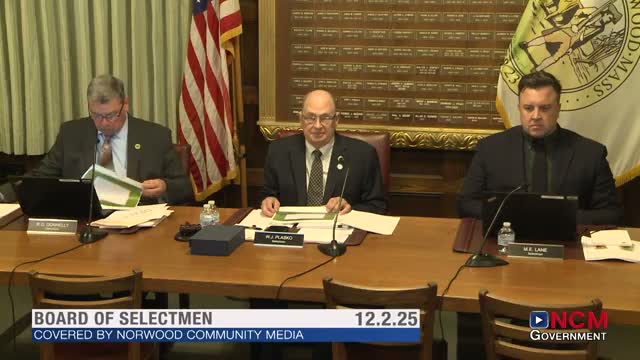
The Town of Norwood Board of Selectmen voted Dec. 2 to set the local property-class shift (the TIP factor) at 71 percent for fiscal year 2026 after a public hearing with the Board of Assessors.
Assessor Tim McDonough told the board the town’s new growth this year is the highest he has seen, driven primarily by the construction at FM Global (about 70% complete), continued hospital projects and Moderna. McDonough said those commercial and industrial increases — including a roughly $210 million FM Global building — produced an unusually large new‑growth figure and expanded the town’s levy capacity. He presented a range of shift options (70–73%), explaining the Department of Revenue determines allowable factors and the board must choose the percentage to allocate the levy among property classes.
During the presentation McDonough and the assessors’ board provided supporting figures: the average single‑family assessed value cited was $719,477 and residential assessed values rose about 6% year‑over‑year; condominium and 2–3 family assessments increased about 7%. The assessors’ materials showed the choices would produce only small changes to the average homeowner’s bill, and the 71% shift was described by board members as a balance that yields modest residential relief while keeping commercial increases under thresholds board members sought to avoid.
A member of the public, Jan Lynch, spoke during the hearing raising concerns about future assessments and broader community conditions she said could influence property values. After public comment the board closed the hearing and Selectman Plasco moved to set the shift at 71%; the motion was seconded and approved by the board.
The board's announcement emphasized that adopting the 71% shift is a legal step that allows staff to finalize tax-rate calculations and prepare bills; the assessors noted that unused levy capacity remains available to the town in future years. The decision follows a year of significant commercial growth the assessors said, and town officials said they would proceed to produce tax bills under the adopted factor.
The board did not change assessed values at the hearing; the vote set the distribution of the levy among property classes for FY26. Next procedural steps are for staff to complete the rate calculation and issue tax bills per state timelines.
Assessor Tim McDonough told the board the town’s new growth this year is the highest he has seen, driven primarily by the construction at FM Global (about 70% complete), continued hospital projects and Moderna. McDonough said those commercial and industrial increases — including a roughly $210 million FM Global building — produced an unusually large new‑growth figure and expanded the town’s levy capacity. He presented a range of shift options (70–73%), explaining the Department of Revenue determines allowable factors and the board must choose the percentage to allocate the levy among property classes.
During the presentation McDonough and the assessors’ board provided supporting figures: the average single‑family assessed value cited was $719,477 and residential assessed values rose about 6% year‑over‑year; condominium and 2–3 family assessments increased about 7%. The assessors’ materials showed the choices would produce only small changes to the average homeowner’s bill, and the 71% shift was described by board members as a balance that yields modest residential relief while keeping commercial increases under thresholds board members sought to avoid.
A member of the public, Jan Lynch, spoke during the hearing raising concerns about future assessments and broader community conditions she said could influence property values. After public comment the board closed the hearing and Selectman Plasco moved to set the shift at 71%; the motion was seconded and approved by the board.
The board's announcement emphasized that adopting the 71% shift is a legal step that allows staff to finalize tax-rate calculations and prepare bills; the assessors noted that unused levy capacity remains available to the town in future years. The decision follows a year of significant commercial growth the assessors said, and town officials said they would proceed to produce tax bills under the adopted factor.
The board did not change assessed values at the hearing; the vote set the distribution of the levy among property classes for FY26. Next procedural steps are for staff to complete the rate calculation and issue tax bills per state timelines.
View the Full Meeting & All Its Details
This article offers just a summary. Unlock complete video, transcripts, and insights as a Founder Member.
✓
Watch full, unedited meeting videos
✓
Search every word spoken in unlimited transcripts
✓
AI summaries & real-time alerts (all government levels)
✓
Permanent access to expanding government content
30-day money-back guarantee
