Baldwin Park staff to return proposed animal‑control contract with Inland Valley Humane Society after study session
December 04, 2025 | Baldwin Park City, Los Angeles County, California
This article was created by AI summarizing key points discussed. AI makes mistakes, so for full details and context, please refer to the video of the full meeting. Please report any errors so we can fix them. Report an error »
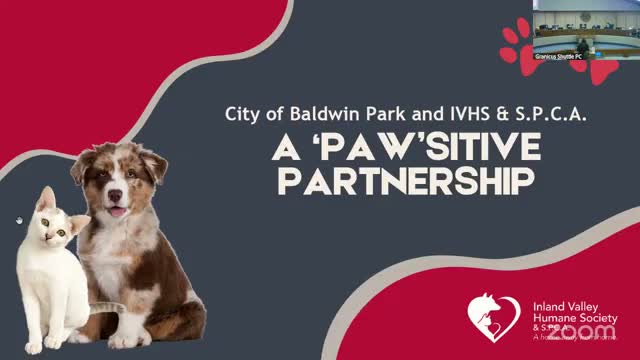
Baldwin Park officials on Dec. 3 heard a presentation from the Inland Valley Humane Society (IBHS) outlining services and a proposed contract that city staff said could replace the city’s existing agreement with Los Angeles County’s animal control department.
City staff told the council that Baldwin Park’s animal‑control costs have climbed steeply in recent years. A staff presenter said the city paid about $192,000 annually for full services in fiscal 2014–15 but now projects between $1.6 million and $1.9 million for fiscal 2025–26, and cited an October monthly county invoice of about $145,000 as a driver of budget concerns. “Our costs have increased 8 to tenfold,” the staff presenter said during the study session.
Nicole Resiani, president and CEO of IBHS, described the nonprofit’s shelter and field services from its Pomona campus, low‑cost veterinary services at the Alex and Elizabeth Lewitt Medical Center (opened 2023), mobile spay/neuter capacity, licensing partnerships and community outreach. She said IBHS operates a mobile clinic — the “GoodMobile” — that performs roughly 30–35 spay/neuter surgeries per day and offers reduced fees of about $80–$150 per procedure, including vaccines and microchip. Resiani also told council members IBHS would place Baldwin Park on a regular rotation for mobile services if the city contracted with the nonprofit.
On pricing, Resiani said IBHS’s quoted maximum gross cost for Baldwin Park in year one (fiscal 26/27) would be $1,000,085 plus a $100,000 capital infrastructure investment, with actual monthly charges offset by revenue credits such as licensing and impound fees. “The quote that we’ve given is 1,000,085 with a $100,000 capital infrastructure investment,” she said. She added IBHS would provide monthly activity reports listing calls for service, hours in the community, outcomes (adoptions, transfers, euthanasia) and live‑release rates.
Council members asked about operational details, including response times for injured wildlife and dead‑animal pickup. Resiani said dog‑bite and aggressive‑animal calls and injured wildlife are priority calls and that IBHS’s internal policy targets carcass pickup within 48 hours, prioritizing hazards in the public right of way. She acknowledged some constraints — for example, rescuing a bird inside a private home may be limited by safety considerations — and said a point of contact from IBHS would be available for urgent concerns.
On staffing and deployment, Resiani explained IBHS’s shared‑resource model across contiguous cities and said a permanently assigned officer in Baldwin Park would be possible only through additional funding negotiation at renewal. She said residents could relinquish animals to IBHS for a fee and that, in practice, IBHS and neighboring agencies sometimes transfer animals among campuses.
City staff described the next steps: with council direction, staff will return a draft agreement for council consideration at the Dec. 17 meeting, and preparing that item would allow the city to meet a six‑month notice requirement to Los Angeles County if Baldwin Park elects to leave the county contract. Manny Carrillo told the council, “With council direction this evening, we plan on bringing back an agreement at the next city council meeting.”
No formal vote or contract award occurred during the Dec. 3 special meeting. The council moved into closed session at the meeting’s end; staff said the draft agreement and a detailed invoice breakdown (base rate and additional add‑ons) will be provided when the item returns to the council. The presentation materials and an invitation were offered for council members to tour IBHS’s Pomona campus at 500 Humane Way.
Sources: presentation and Q&A at Baldwin Park City Council special meeting, Dec. 3, 2025. Quotes and attributions are drawn from remarks by a city staff representative, IBHS president and CEO Nicole Resiani, and Manny Carrillo, who spoke about next steps.
City staff told the council that Baldwin Park’s animal‑control costs have climbed steeply in recent years. A staff presenter said the city paid about $192,000 annually for full services in fiscal 2014–15 but now projects between $1.6 million and $1.9 million for fiscal 2025–26, and cited an October monthly county invoice of about $145,000 as a driver of budget concerns. “Our costs have increased 8 to tenfold,” the staff presenter said during the study session.
Nicole Resiani, president and CEO of IBHS, described the nonprofit’s shelter and field services from its Pomona campus, low‑cost veterinary services at the Alex and Elizabeth Lewitt Medical Center (opened 2023), mobile spay/neuter capacity, licensing partnerships and community outreach. She said IBHS operates a mobile clinic — the “GoodMobile” — that performs roughly 30–35 spay/neuter surgeries per day and offers reduced fees of about $80–$150 per procedure, including vaccines and microchip. Resiani also told council members IBHS would place Baldwin Park on a regular rotation for mobile services if the city contracted with the nonprofit.
On pricing, Resiani said IBHS’s quoted maximum gross cost for Baldwin Park in year one (fiscal 26/27) would be $1,000,085 plus a $100,000 capital infrastructure investment, with actual monthly charges offset by revenue credits such as licensing and impound fees. “The quote that we’ve given is 1,000,085 with a $100,000 capital infrastructure investment,” she said. She added IBHS would provide monthly activity reports listing calls for service, hours in the community, outcomes (adoptions, transfers, euthanasia) and live‑release rates.
Council members asked about operational details, including response times for injured wildlife and dead‑animal pickup. Resiani said dog‑bite and aggressive‑animal calls and injured wildlife are priority calls and that IBHS’s internal policy targets carcass pickup within 48 hours, prioritizing hazards in the public right of way. She acknowledged some constraints — for example, rescuing a bird inside a private home may be limited by safety considerations — and said a point of contact from IBHS would be available for urgent concerns.
On staffing and deployment, Resiani explained IBHS’s shared‑resource model across contiguous cities and said a permanently assigned officer in Baldwin Park would be possible only through additional funding negotiation at renewal. She said residents could relinquish animals to IBHS for a fee and that, in practice, IBHS and neighboring agencies sometimes transfer animals among campuses.
City staff described the next steps: with council direction, staff will return a draft agreement for council consideration at the Dec. 17 meeting, and preparing that item would allow the city to meet a six‑month notice requirement to Los Angeles County if Baldwin Park elects to leave the county contract. Manny Carrillo told the council, “With council direction this evening, we plan on bringing back an agreement at the next city council meeting.”
No formal vote or contract award occurred during the Dec. 3 special meeting. The council moved into closed session at the meeting’s end; staff said the draft agreement and a detailed invoice breakdown (base rate and additional add‑ons) will be provided when the item returns to the council. The presentation materials and an invitation were offered for council members to tour IBHS’s Pomona campus at 500 Humane Way.
Sources: presentation and Q&A at Baldwin Park City Council special meeting, Dec. 3, 2025. Quotes and attributions are drawn from remarks by a city staff representative, IBHS president and CEO Nicole Resiani, and Manny Carrillo, who spoke about next steps.
Don't Miss a Word: See the Full Meeting!
Go beyond summaries. Unlock every video, transcript, and key insight with a Founder Membership.
✓
Get instant access to full meeting videos
✓
Search and clip any phrase from complete transcripts
✓
Receive AI-powered summaries & custom alerts
✓
Enjoy lifetime, unrestricted access to government data
30-day money-back guarantee
