Town attorney outlines how decades of voter measures shape town‑center rules
December 04, 2025 | Woodside Town, San Mateo County, California
This article was created by AI summarizing key points discussed. AI makes mistakes, so for full details and context, please refer to the video of the full meeting. Please report any errors so we can fix them. Report an error »
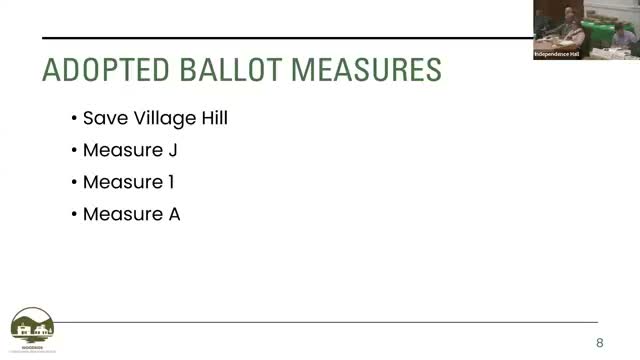
Deputy Town Attorney Kai Ruiz reviewed the legal history that frames the Town Center Area Plan update, telling the Community Advisory Committee that voter action dating to the 1970s and 1980s still constrains development in central Woodside.
Ruiz said Measure J, adopted by voters in November 1988, contains three central restrictions: it preserves three residential parcels inside the TCAP as residential-only, it allowed the former PG&E parcel to be used for a 5,000-square-foot public building and supporting parking, and it limited parcels immediately adjacent to Woodside Road to one story. “All of these restrictions have been put in place by the voters,” Ruiz said, and any change to those restrictions would require another vote of the residents.
Sage, the town’s planning director, explained how Measure J and later voter actions were incorporated into the municipal code. The code now measures building height from the edge of the paved right of way and typically prevents structures fronting Woodside Road from exceeding about 17 feet above that edge; parcels within roughly 100 feet of Woodside Road may have slightly different limits in some parts of Area B. “That’s the limitation that is in place today,” the planning director said.
Consultants and staff emphasized the difference between the legal constraint and the advisory nature of the CAC’s work: the committee’s visioning can propose options outside the current rules, but implementing most of those ideas — such as allowing taller mixed‑use buildings on parcels protected by voter measures — would require an affirmative vote by Woodside residents and amendments to the municipal code.
Next steps listed by staff include mapping which restrictions apply to specific parcels, diagramming potential outcomes under different height assumptions, and flagging where any recommended change would depend on future voter action.
Ruiz said Measure J, adopted by voters in November 1988, contains three central restrictions: it preserves three residential parcels inside the TCAP as residential-only, it allowed the former PG&E parcel to be used for a 5,000-square-foot public building and supporting parking, and it limited parcels immediately adjacent to Woodside Road to one story. “All of these restrictions have been put in place by the voters,” Ruiz said, and any change to those restrictions would require another vote of the residents.
Sage, the town’s planning director, explained how Measure J and later voter actions were incorporated into the municipal code. The code now measures building height from the edge of the paved right of way and typically prevents structures fronting Woodside Road from exceeding about 17 feet above that edge; parcels within roughly 100 feet of Woodside Road may have slightly different limits in some parts of Area B. “That’s the limitation that is in place today,” the planning director said.
Consultants and staff emphasized the difference between the legal constraint and the advisory nature of the CAC’s work: the committee’s visioning can propose options outside the current rules, but implementing most of those ideas — such as allowing taller mixed‑use buildings on parcels protected by voter measures — would require an affirmative vote by Woodside residents and amendments to the municipal code.
Next steps listed by staff include mapping which restrictions apply to specific parcels, diagramming potential outcomes under different height assumptions, and flagging where any recommended change would depend on future voter action.
Don't Miss a Word: See the Full Meeting!
Go beyond summaries. Unlock every video, transcript, and key insight with a Founder Membership.
✓
Get instant access to full meeting videos
✓
Search and clip any phrase from complete transcripts
✓
Receive AI-powered summaries & custom alerts
✓
Enjoy lifetime, unrestricted access to government data
30-day money-back guarantee
