Terrell seeks new 2.5M‑gallon tank; staff targets TWDB loan and Dec. 5 public meeting
October 30, 2024 | Terrell, Kaufman County, Texas
This article was created by AI summarizing key points discussed. AI makes mistakes, so for full details and context, please refer to the video of the full meeting. Please report any errors so we can fix them. Report an error »
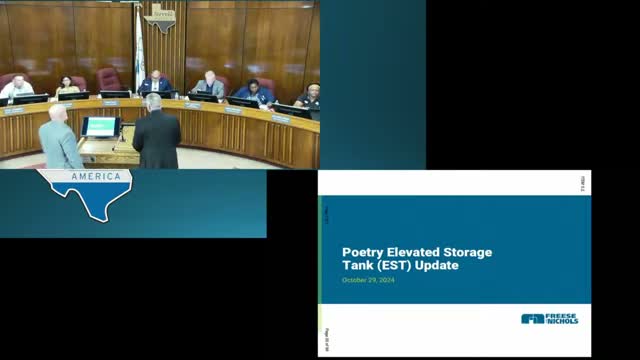
Scott of engineering firm Friesen Nichols told the Terrell City Council that the existing Poultry Road elevated steel tank — built in about 1969 and sized at 1,000,000 gallons — has reached the end of its practical service life and should be replaced before it fails.
The proposal calls for a new 2,500,000‑gallon composite elevated storage tank near the current site, about 550 linear feet of 16‑inch waterline to serve surrounding properties, and demolition of the old tank once the new structure is in service.
Scott said the environmental information document (EID) required by the Texas Water Development Board (TWDB) is in a 30‑day public review; the staff set a public meeting on the EID for Dec. 5. The schedule presented to council anticipates submitting TWDB materials in December 2024, completing final design in 2025 (9–12 months), starting construction in late 2025 or early 2026 and placing the tank in service in 2028.
On financing, staff said the city will use existing preconstruction TWDB loan funds from 2019 to finish design work and then pursue a subsidized TWDB construction loan. Staff cited a preliminary construction estimate of about $7,000,000 for planning purposes and said the final borrowing timeline will determine which fiscal year utility rates, if any, carry the debt service.
Council members asked whether the 2.5M size was sufficient; engineers said modeling supports that capacity. Members also raised demolition funding and hazardous‑material testing (lead paint on the 1969 tank): staff said remediation costs for hazardous materials would come from utility reserves if required, while most demolition would be included in the construction contract.
Next steps: staff will incorporate interagency comments into the final EID, present final design contracts for council approval, and return to council with the construction contract and any TWDB loan closing items when ready.
The proposal calls for a new 2,500,000‑gallon composite elevated storage tank near the current site, about 550 linear feet of 16‑inch waterline to serve surrounding properties, and demolition of the old tank once the new structure is in service.
Scott said the environmental information document (EID) required by the Texas Water Development Board (TWDB) is in a 30‑day public review; the staff set a public meeting on the EID for Dec. 5. The schedule presented to council anticipates submitting TWDB materials in December 2024, completing final design in 2025 (9–12 months), starting construction in late 2025 or early 2026 and placing the tank in service in 2028.
On financing, staff said the city will use existing preconstruction TWDB loan funds from 2019 to finish design work and then pursue a subsidized TWDB construction loan. Staff cited a preliminary construction estimate of about $7,000,000 for planning purposes and said the final borrowing timeline will determine which fiscal year utility rates, if any, carry the debt service.
Council members asked whether the 2.5M size was sufficient; engineers said modeling supports that capacity. Members also raised demolition funding and hazardous‑material testing (lead paint on the 1969 tank): staff said remediation costs for hazardous materials would come from utility reserves if required, while most demolition would be included in the construction contract.
Next steps: staff will incorporate interagency comments into the final EID, present final design contracts for council approval, and return to council with the construction contract and any TWDB loan closing items when ready.
View the Full Meeting & All Its Details
This article offers just a summary. Unlock complete video, transcripts, and insights as a Founder Member.
✓
Watch full, unedited meeting videos
✓
Search every word spoken in unlimited transcripts
✓
AI summaries & real-time alerts (all government levels)
✓
Permanent access to expanding government content
30-day money-back guarantee
