RSU 9 reports roughly 45 McKinney‑Vento students, staff cite underreporting and recent audit
May 14, 2024 | Howard County, Maryland
This article was created by AI summarizing key points discussed. AI makes mistakes, so for full details and context, please refer to the video of the full meeting. Please report any errors so we can fix them. Report an error »
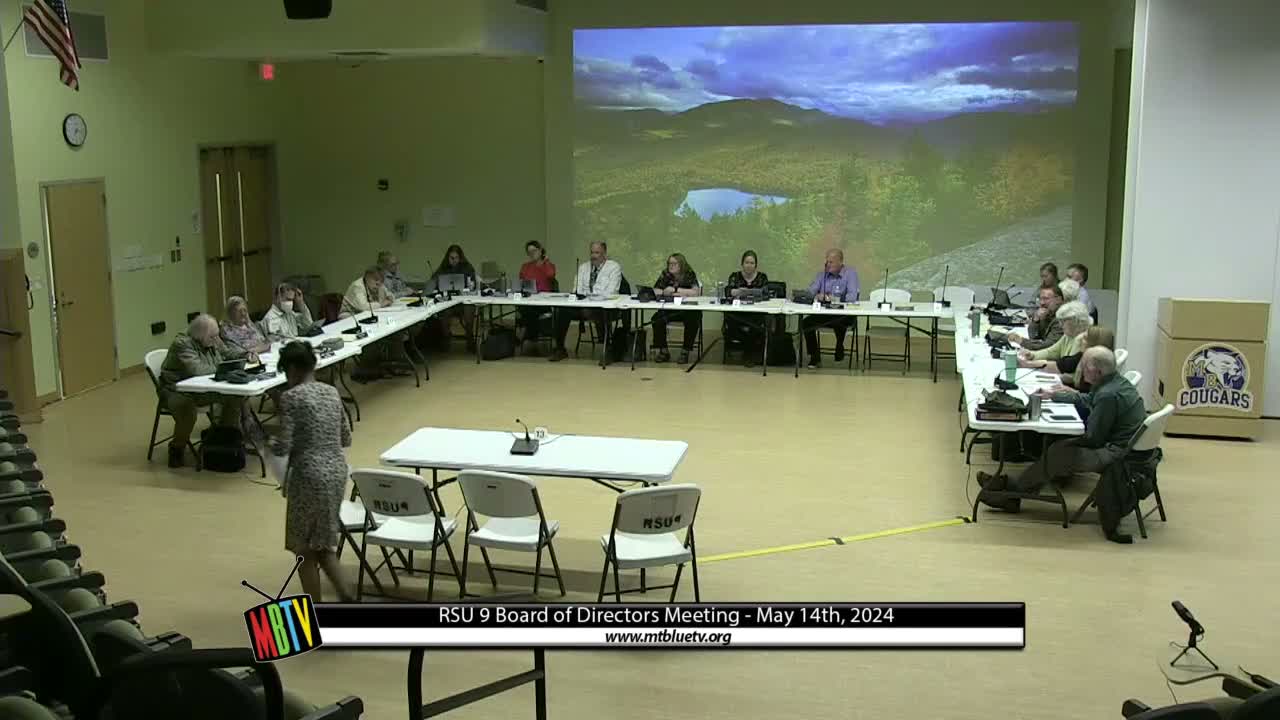
Amanda Clark, a district staff member working on McKinney‑Vento services, told the RSU 9 School Board the district had 45 students identified under the McKinney‑Vento definition as of April 12 and that number was "close to 50" at the time of the meeting. She gave a grade‑band breakdown: pre‑K–5 = 26 students, grades 6–8 = 8 and grades 9–12 = 11; six of the 45 were listed as unaccompanied minors.
Clark said most students are "doubled up"—living temporarily with relatives or other households—and described district efforts to identify and support those students, including designated support staff, transportation assistance, basic‑needs help, housing referrals and warm handoffs to community partners. She recounted a case in which the district provided a security deposit and first month’s rent to move a family from a tent into stable housing, and said the student was doing well afterward.
Board members discussed the likelihood of underreporting. "Do you have any idea of how underreported it might be?" asked Board Member (speaker 21). Clark said she could not give a precise multiplier but that underreporting is likely and that relationship‑building and outreach at registration improve reporting. Another board member described two McKinney‑Vento cases that became "contentious" with neighboring districts and said in those instances the other district had not applied the law correctly; board members credited Clark with pursuing the cases and coordinating with the state liaison.
Clark also said the district recently completed and submitted a McKinney‑Vento audit (submitted by the May 1 due date) and expects additional McKinney‑Vento funding next year as a result of that work. Board members and administrators thanked Clark for her advocacy and noted that outreach and trust are key to identifying students who qualify.
The board did not take formal action on policy changes in this meeting; members asked for continued outreach and emphasized confidentiality concerns that can keep families "under the radar." The presentation concluded with board recognition of the difficulty of quantifying underreporting and a pledge to continue outreach and coordination with neighboring districts and state agencies.
Clark said most students are "doubled up"—living temporarily with relatives or other households—and described district efforts to identify and support those students, including designated support staff, transportation assistance, basic‑needs help, housing referrals and warm handoffs to community partners. She recounted a case in which the district provided a security deposit and first month’s rent to move a family from a tent into stable housing, and said the student was doing well afterward.
Board members discussed the likelihood of underreporting. "Do you have any idea of how underreported it might be?" asked Board Member (speaker 21). Clark said she could not give a precise multiplier but that underreporting is likely and that relationship‑building and outreach at registration improve reporting. Another board member described two McKinney‑Vento cases that became "contentious" with neighboring districts and said in those instances the other district had not applied the law correctly; board members credited Clark with pursuing the cases and coordinating with the state liaison.
Clark also said the district recently completed and submitted a McKinney‑Vento audit (submitted by the May 1 due date) and expects additional McKinney‑Vento funding next year as a result of that work. Board members and administrators thanked Clark for her advocacy and noted that outreach and trust are key to identifying students who qualify.
The board did not take formal action on policy changes in this meeting; members asked for continued outreach and emphasized confidentiality concerns that can keep families "under the radar." The presentation concluded with board recognition of the difficulty of quantifying underreporting and a pledge to continue outreach and coordination with neighboring districts and state agencies.
Don't Miss a Word: See the Full Meeting!
Go beyond summaries. Unlock every video, transcript, and key insight with a Founder Membership.
✓
Get instant access to full meeting videos
✓
Search and clip any phrase from complete transcripts
✓
Receive AI-powered summaries & custom alerts
✓
Enjoy lifetime, unrestricted access to government data
30-day money-back guarantee
