Washington officials say investments in reentry correlate with falling recidivism
April 24, 2024 | Results Washington, Governor- appointed Executive Agencies, Executive, Washington
This article was created by AI summarizing key points discussed. AI makes mistakes, so for full details and context, please refer to the video of the full meeting. Please report any errors so we can fix them. Report an error »
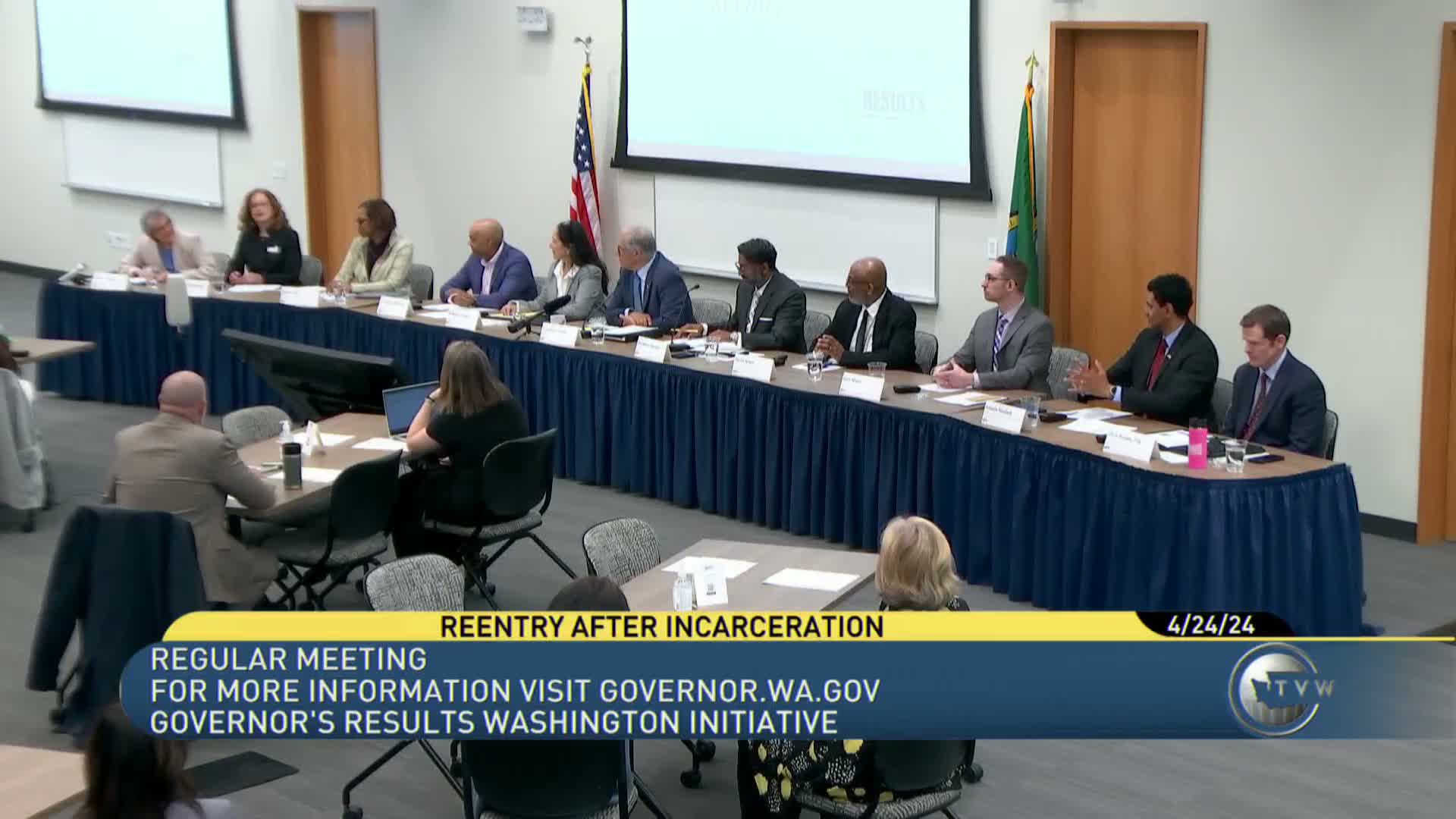
Governor Inslee and state leaders used a Results Washington public performance review to present recent data and program work aimed at reducing recidivism and improving outcomes for people released from custody.
Cheryl Strange, secretary of the Washington State Department of Corrections, told the governor that Washington’s prison census is roughly 14,000 — down from 18,000 in 2019 — and that between 2020 and 2023 the department released more than 25,000 people. Strange said national and state recidivism comparisons show improvement: "If you look at 2016, for example, you can see that individuals leaving prison in 2016 had a 1 in 3 chance of returning to prison within 3 years on a new charge. But if you look at 2019, people released in 2019 and 2020, you see that it's a little over 1 in 5." She credited legislative changes, sentence alternatives and agency investments for the decline.
Governor Inslee framed successful reintegration as a public-safety strategy. "We've gone from 34% recidivism rate to 22%," he said, and argued that a 10-point decline over releases of roughly 25,000 people translates into thousands of crimes avoided. The governor also highlighted programs that support family connections and vocational training in women's facilities.
Danielle Armbrester, assistant secretary of the DOC reentry division, described DOC’s integrated reentry model: individual reentry plans on admission, intake assessments (medical, mental health, education, substance use), and partnerships to provide identification cards at release to reduce barriers to housing, employment and services. She said DOC is expanding education and work-readiness programs and cited the reinstatement of Pell Grants as a route to grow postsecondary pathways.
Secretary Strange and other panelists emphasized efforts to reduce restrictive housing and solitary confinement: the department reported a 40% reduction in individuals in restrictive housing since 2018 and set a goal to reduce solitary confinement by 90% within five years, supported by recent operating and capital funding. Strange said the department is piloting peer-based certification programs and increasing out-of-cell engagement as part of that work.
The session closed with the governor urging continued acceleration of these efforts, noting that reentry supports also address workforce shortages in construction and manufacturing.
The review did not include formal votes; panelists asked for continued coordination and funding to scale promising programs.
Cheryl Strange, secretary of the Washington State Department of Corrections, told the governor that Washington’s prison census is roughly 14,000 — down from 18,000 in 2019 — and that between 2020 and 2023 the department released more than 25,000 people. Strange said national and state recidivism comparisons show improvement: "If you look at 2016, for example, you can see that individuals leaving prison in 2016 had a 1 in 3 chance of returning to prison within 3 years on a new charge. But if you look at 2019, people released in 2019 and 2020, you see that it's a little over 1 in 5." She credited legislative changes, sentence alternatives and agency investments for the decline.
Governor Inslee framed successful reintegration as a public-safety strategy. "We've gone from 34% recidivism rate to 22%," he said, and argued that a 10-point decline over releases of roughly 25,000 people translates into thousands of crimes avoided. The governor also highlighted programs that support family connections and vocational training in women's facilities.
Danielle Armbrester, assistant secretary of the DOC reentry division, described DOC’s integrated reentry model: individual reentry plans on admission, intake assessments (medical, mental health, education, substance use), and partnerships to provide identification cards at release to reduce barriers to housing, employment and services. She said DOC is expanding education and work-readiness programs and cited the reinstatement of Pell Grants as a route to grow postsecondary pathways.
Secretary Strange and other panelists emphasized efforts to reduce restrictive housing and solitary confinement: the department reported a 40% reduction in individuals in restrictive housing since 2018 and set a goal to reduce solitary confinement by 90% within five years, supported by recent operating and capital funding. Strange said the department is piloting peer-based certification programs and increasing out-of-cell engagement as part of that work.
The session closed with the governor urging continued acceleration of these efforts, noting that reentry supports also address workforce shortages in construction and manufacturing.
The review did not include formal votes; panelists asked for continued coordination and funding to scale promising programs.
Don't Miss a Word: See the Full Meeting!
Go beyond summaries. Unlock every video, transcript, and key insight with a Founder Membership.
✓
Get instant access to full meeting videos
✓
Search and clip any phrase from complete transcripts
✓
Receive AI-powered summaries & custom alerts
✓
Enjoy lifetime, unrestricted access to government data
30-day money-back guarantee
