Senate committee narrows soil-amendment bill to let Ag department target problem sites
March 12, 2024 | Agriculture and Consumer Affairs, SENATE, Committees, Legislative, Georgia
This article was created by AI summarizing key points discussed. AI makes mistakes, so for full details and context, please refer to the video of the full meeting. Please report any errors so we can fix them. Report an error »
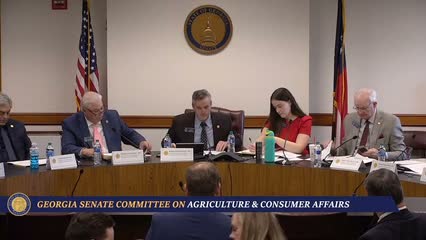
Representative Chaz Leverett told the Senate Agriculture and Consumer Affairs committee he introduced House Bill 1223 to curb abuses in the state's Soil Amendment program while preserving the tool for most farmers.
"So that's basically the bill, mister chairman," Leverett said, describing a measure that would make it a violation to "apply or distribute a soil amendment on a tract of land" when (1) the owner or operator is subject to a consent order or active enforcement or investigation by the Department of Agriculture or the Environmental Protection Division (EPD) and (2) a notice of violation has been issued and the owner/operator has been notified to cease application.
The bill, Leverett said, was written narrowly: a site is the area identified in a nutrient-management plan and a prohibition could be limited to a particular field or portion of a plan rather than shutting down an entire multi-field operation.
Commissioner Tyler Harper of the Georgia Department of Agriculture told senators the agency already has a range of enforcement tools and that HB 1223 is intended to let the department work more closely with EPD on sites where runoff or water contamination is at issue. "This gives us the ability to work with EPD in that particular area," Harper said, adding that existing statute permits administrative penalties, fines and, in severe cases, criminal prosecution.
Committee debate focused on two related risks: that the language could be read too broadly and that vague terms such as "geographic proximity" or "operational nexus" could be stretched to affect unrelated fields. Senator Hatchett proposed an amendment to add the word "close" to geographic proximity, to replace "operational nexus" with "operationally connected with the underlying site," and to add "with respect to such site" after references to agency action. Supporters said the amendment clarifies legislative intent without removing needed enforcement flexibility; the committee recorded seven "yes" votes and the amendment passed.
Senators voiced differing priorities about enforcement scope. Senator Max Burns and others said they wanted to preserve strong tools for truly egregious cases, while also ensuring minor or technical violations do not shut down otherwise compliant operations. Harper said the agency can escalate penalties for repeated or serious violations, including pulling product registration where appropriate.
Brian Toler, representing Grow Green Services, testified that compliance among registrants is high and supported language allowing problem fields to be targeted without closing entire operations. "We would love to see that connectivity between the regulatory agency follow through all the way," Toler said.
After debate and the Hatchett amendment, Senator Anderson moved to pass HB 1223; Senator Burns seconded the motion and the committee voted to pass the bill unanimously. The committee recorded the amendment and the committee-level passage; Representative Leverett said he planned to work with a senator to carry the legislation forward in the Senate.
What happens next: HB 1223 now moves from committee to the Senate floor; the committee's amendments narrow the bill's reach but leave discretion for the Department of Agriculture and EPD to act where they find an active enforcement action related to soil amendments.
Authorities cited in committee testimony included the Soil Amendment Act of 1976 and existing department rules and regulations governing penalties and consent orders.
"So that's basically the bill, mister chairman," Leverett said, describing a measure that would make it a violation to "apply or distribute a soil amendment on a tract of land" when (1) the owner or operator is subject to a consent order or active enforcement or investigation by the Department of Agriculture or the Environmental Protection Division (EPD) and (2) a notice of violation has been issued and the owner/operator has been notified to cease application.
The bill, Leverett said, was written narrowly: a site is the area identified in a nutrient-management plan and a prohibition could be limited to a particular field or portion of a plan rather than shutting down an entire multi-field operation.
Commissioner Tyler Harper of the Georgia Department of Agriculture told senators the agency already has a range of enforcement tools and that HB 1223 is intended to let the department work more closely with EPD on sites where runoff or water contamination is at issue. "This gives us the ability to work with EPD in that particular area," Harper said, adding that existing statute permits administrative penalties, fines and, in severe cases, criminal prosecution.
Committee debate focused on two related risks: that the language could be read too broadly and that vague terms such as "geographic proximity" or "operational nexus" could be stretched to affect unrelated fields. Senator Hatchett proposed an amendment to add the word "close" to geographic proximity, to replace "operational nexus" with "operationally connected with the underlying site," and to add "with respect to such site" after references to agency action. Supporters said the amendment clarifies legislative intent without removing needed enforcement flexibility; the committee recorded seven "yes" votes and the amendment passed.
Senators voiced differing priorities about enforcement scope. Senator Max Burns and others said they wanted to preserve strong tools for truly egregious cases, while also ensuring minor or technical violations do not shut down otherwise compliant operations. Harper said the agency can escalate penalties for repeated or serious violations, including pulling product registration where appropriate.
Brian Toler, representing Grow Green Services, testified that compliance among registrants is high and supported language allowing problem fields to be targeted without closing entire operations. "We would love to see that connectivity between the regulatory agency follow through all the way," Toler said.
After debate and the Hatchett amendment, Senator Anderson moved to pass HB 1223; Senator Burns seconded the motion and the committee voted to pass the bill unanimously. The committee recorded the amendment and the committee-level passage; Representative Leverett said he planned to work with a senator to carry the legislation forward in the Senate.
What happens next: HB 1223 now moves from committee to the Senate floor; the committee's amendments narrow the bill's reach but leave discretion for the Department of Agriculture and EPD to act where they find an active enforcement action related to soil amendments.
Authorities cited in committee testimony included the Soil Amendment Act of 1976 and existing department rules and regulations governing penalties and consent orders.
View the Full Meeting & All Its Details
This article offers just a summary. Unlock complete video, transcripts, and insights as a Founder Member.
✓
Watch full, unedited meeting videos
✓
Search every word spoken in unlimited transcripts
✓
AI summaries & real-time alerts (all government levels)
✓
Permanent access to expanding government content
30-day money-back guarantee
