Committee backs bill to bar Georgia participation in Federal Reserve CBDC tests
March 12, 2024 | Banking and Financial Institutions, SENATE, Committees, Legislative, Georgia
This article was created by AI summarizing key points discussed. AI makes mistakes, so for full details and context, please refer to the video of the full meeting. Please report any errors so we can fix them. Report an error »
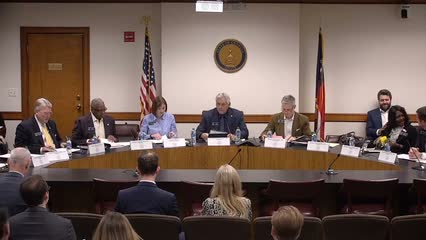
Representative Barrett presented House Bill 1053 (LC500613), telling the Banking and Financial Institutions Committee that the measure would prevent Georgia from participating in Federal Reserve CBDC pilot programs and would bar state agencies from accepting payments in a federally issued central bank digital currency. "A CBDC would replace the dollars in your bank account and your wallet with programmable, traceable, and trackable digital dollars," he said, arguing the change would concentrate power in the Federal Reserve and undermine local banks and credit unions.
The bill drew support from banking and advocacy groups. Beau Brannen of the Georgia Bankers Association said a CBDC "would cannibalize rather than complement" deposits that local banks use to make community loans and that moving deposits to the Federal Reserve would leave local institutions with fewer resources to lend. Brian Allen, vice chair of the Libertarian Party of Georgia, described privacy and security concerns, warning a centrally controlled digital currency could remove financial privacy and create a single point of failure if compromised. James Quarles of Heritage Action for America and Cash Dravette of the Georgia Credit Unions Association also urged passage, citing risks to privacy, infrastructure and rural industries.
Supporters pointed to activity elsewhere: witnesses and the presenter referenced Federal Reserve research and New York Fed pilot programs as evidence the issue is actively being studied and, in some places, piloted. Taylor Hawkins of Frontline Policy Counsel said some members of Congress and governors have expressed opposition to a CBDC and that state-level restrictions are already appearing in other states.
Committee members pressed whether the Federal Reserve could act without congressional authorization and how pilots are being conducted; Representative Barrett said pilots and research materials are publicly described on Federal Reserve websites and that some federal-level legislative proposals aim to constrain, not expand, the effort. Several witnesses framed the bill as largely symbolic at the federal level but as a concrete way for Georgia to opt out of pilot programs and signal concern.
Senator Buren moved that the committee "do pass" House Bill 1053; Vice Chairman Kennedy seconded the motion. The chair called for hands and the motion carried unanimously.
The committee report will move the bill to the next legislative step and committee members indicated willingness to assist in carrying the measure forward.
The bill drew support from banking and advocacy groups. Beau Brannen of the Georgia Bankers Association said a CBDC "would cannibalize rather than complement" deposits that local banks use to make community loans and that moving deposits to the Federal Reserve would leave local institutions with fewer resources to lend. Brian Allen, vice chair of the Libertarian Party of Georgia, described privacy and security concerns, warning a centrally controlled digital currency could remove financial privacy and create a single point of failure if compromised. James Quarles of Heritage Action for America and Cash Dravette of the Georgia Credit Unions Association also urged passage, citing risks to privacy, infrastructure and rural industries.
Supporters pointed to activity elsewhere: witnesses and the presenter referenced Federal Reserve research and New York Fed pilot programs as evidence the issue is actively being studied and, in some places, piloted. Taylor Hawkins of Frontline Policy Counsel said some members of Congress and governors have expressed opposition to a CBDC and that state-level restrictions are already appearing in other states.
Committee members pressed whether the Federal Reserve could act without congressional authorization and how pilots are being conducted; Representative Barrett said pilots and research materials are publicly described on Federal Reserve websites and that some federal-level legislative proposals aim to constrain, not expand, the effort. Several witnesses framed the bill as largely symbolic at the federal level but as a concrete way for Georgia to opt out of pilot programs and signal concern.
Senator Buren moved that the committee "do pass" House Bill 1053; Vice Chairman Kennedy seconded the motion. The chair called for hands and the motion carried unanimously.
The committee report will move the bill to the next legislative step and committee members indicated willingness to assist in carrying the measure forward.
Don't Miss a Word: See the Full Meeting!
Go beyond summaries. Unlock every video, transcript, and key insight with a Founder Membership.
✓
Get instant access to full meeting videos
✓
Search and clip any phrase from complete transcripts
✓
Receive AI-powered summaries & custom alerts
✓
Enjoy lifetime, unrestricted access to government data
30-day money-back guarantee
