Senate committee advances study on preserving Georgia farmland, timber and water supplies
February 07, 2024 | Agriculture and Consumer Affairs, SENATE, Committees, Legislative, Georgia
This article was created by AI summarizing key points discussed. AI makes mistakes, so for full details and context, please refer to the video of the full meeting. Please report any errors so we can fix them. Report an error »
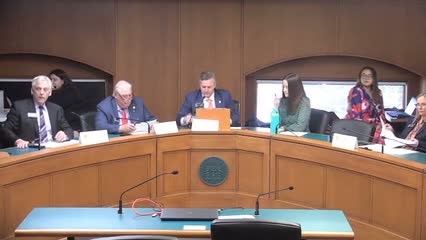
Senator Billy Hickman, a farmer and certified public accountant, told the Senate Agriculture and Consumer Affairs Committee that a newly approved resolution would create a seven-member study committee to examine preservation of Georgia farmland, timberland and water supplies and recommend any necessary legislation.
Hickman said the resolution (LC 442558) grew out of farmer concerns in his region as development accelerates near new industrial projects. "We live in a county that's got a 20 26 percent poverty rate," Hickman said, and added that economic growth must be balanced with protecting food production. He described local land pressures in blunt terms: "farmland is renting for a $100 an acre if you're drawing cotton on it, but it's selling for $25,000 acre to build houses on," and said the state has “lost 2,600,000 acres of land in the last 10 or 15, 20 years to development.”
Hickman also raised competition from solar projects: "the solar farm people are paying $1,000 an acre for solar farms," he said, framing lease and sale prices as a key tension the study committee should examine. He told the committee the resolution responds to outreach led by regional official TJ Hudson and follow-up listening by Brad Vaughn, including a Statesboro meeting attended by roughly 50 farmers who flagged water, input costs and shrinking acreage as concerns.
The resolution calls for a nine-month study panel composed of seven members — four of them appointed from the Agriculture and Consumer Affairs Committee — with a statutory abolishment date of December 1, 2024. Hickman described the panel's charge as "to undertake a study of the conditions, needs, issues and problems mentioned and recommend any action or legislation which the committee deems necessary or appropriate."
Chair remarks noted prior measures intended to support farmers, including the Georgia Farmland Conservation Act of 2023 and the 2022 Freedom of Farm Bill, and the Chair said budget language looked likely to include seed money for a PACE program tied to farmland conservation. Members raised questions about who would fill the non-committee seats and about abandoned or absentee-owned farms in parts of the state; Hickman said names for additional appointments had not yet been finalized.
A motion to "do pass" the resolution was made by Senator Summers and seconded by Senator Sims; the committee approved the resolution by voice vote with verbal 'aye' responses and indicated it would proceed to work on recommendations. The transcript records the voice vote but does not include a roll-call tally.
The next step identified in the meeting transcript is formation and staffing of the study committee and follow-up work to develop recommendations; no statutory changes beyond the study committee authorization were taken at the meeting.
The resolution and the committee it creates aim to weigh competing goals — supporting new industry and jobs while protecting agricultural land and water resources — and to return recommendations to the legislature after the study period.
Hickman said the resolution (LC 442558) grew out of farmer concerns in his region as development accelerates near new industrial projects. "We live in a county that's got a 20 26 percent poverty rate," Hickman said, and added that economic growth must be balanced with protecting food production. He described local land pressures in blunt terms: "farmland is renting for a $100 an acre if you're drawing cotton on it, but it's selling for $25,000 acre to build houses on," and said the state has “lost 2,600,000 acres of land in the last 10 or 15, 20 years to development.”
Hickman also raised competition from solar projects: "the solar farm people are paying $1,000 an acre for solar farms," he said, framing lease and sale prices as a key tension the study committee should examine. He told the committee the resolution responds to outreach led by regional official TJ Hudson and follow-up listening by Brad Vaughn, including a Statesboro meeting attended by roughly 50 farmers who flagged water, input costs and shrinking acreage as concerns.
The resolution calls for a nine-month study panel composed of seven members — four of them appointed from the Agriculture and Consumer Affairs Committee — with a statutory abolishment date of December 1, 2024. Hickman described the panel's charge as "to undertake a study of the conditions, needs, issues and problems mentioned and recommend any action or legislation which the committee deems necessary or appropriate."
Chair remarks noted prior measures intended to support farmers, including the Georgia Farmland Conservation Act of 2023 and the 2022 Freedom of Farm Bill, and the Chair said budget language looked likely to include seed money for a PACE program tied to farmland conservation. Members raised questions about who would fill the non-committee seats and about abandoned or absentee-owned farms in parts of the state; Hickman said names for additional appointments had not yet been finalized.
A motion to "do pass" the resolution was made by Senator Summers and seconded by Senator Sims; the committee approved the resolution by voice vote with verbal 'aye' responses and indicated it would proceed to work on recommendations. The transcript records the voice vote but does not include a roll-call tally.
The next step identified in the meeting transcript is formation and staffing of the study committee and follow-up work to develop recommendations; no statutory changes beyond the study committee authorization were taken at the meeting.
The resolution and the committee it creates aim to weigh competing goals — supporting new industry and jobs while protecting agricultural land and water resources — and to return recommendations to the legislature after the study period.
Don't Miss a Word: See the Full Meeting!
Go beyond summaries. Unlock every video, transcript, and key insight with a Founder Membership.
✓
Get instant access to full meeting videos
✓
Search and clip any phrase from complete transcripts
✓
Receive AI-powered summaries & custom alerts
✓
Enjoy lifetime, unrestricted access to government data
30-day money-back guarantee
