Committee advances bill to regulate earned‑wage access, capping fees and defaulting tips to zero
March 19, 2024 | Banking and Financial Institutions, SENATE, Committees, Legislative, Georgia
This article was created by AI summarizing key points discussed. AI makes mistakes, so for full details and context, please refer to the video of the full meeting. Please report any errors so we can fix them. Report an error »
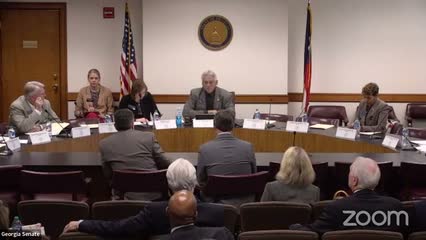
The Banking and Financial Institutions Committee advanced a substitute to House Bill 84 after a public hearing that featured competing testimony from fintech providers, consumer advocates and payroll representatives.
Representative Rhodes summarized the substitute, saying it removes the prior House Bill 84 text and inserts language that (1) defaults tip fields to $0 on earned‑wage access (EWA) apps and (2) caps any provider charge at $5 per transaction. "We put a cap on that and then set the tipping at default at 0," Representative Rhodes said while walking the committee through the changes.
Nick Stowell of Chime Financial described how the product would work in practice and emphasized that providers must offer a free option. "This is not a loan," Stowell said, adding that Chime charges a $2 expedited fee for instant transfers but provides the same funds for free if customers wait 24 to 48 hours. Stowell said Chime typically limits an advance to about 50% of a consumer's earned wages in a pay period and that Chime's broader revenue comes from interchange fees when customers use their cards.
Liz Coyle, executive director of the consumer advocacy group Georgia Watch, urged caution. She told the committee the substitute as drafted "would have the opposite effect" of protecting consumers because third‑party EWA models can steer users into paying voluntary tips, debit bank accounts to recoup advances and create effective APRs that can exceed the state's usury limits. Coyle urged the committee to consider explicit regulation by the Department of Banking and Finance or to treat EWA products as credit subject to consumer‑protection laws.
Other witnesses were split. Alice Jacobson (PayrollOrg) offered quick support and said the substitute correctly identifies EWA as not a loan. Vadushi Dayal of the Chamber of Progress said consumer surveys show many users understand EWA and that the product can help families manage between paychecks "with the right regulatory framework."
Committee members focused questions on the mechanics of fees and oversight. One member asked who would "ride herd over the industry"; witnesses suggested the attorney general's office could have a role, but the substitute currently references the Fair Business Practices Act rather than Department of Banking and Finance supervision. The record also captured concrete program details: the substitute would cap provider charges at $5 per transaction and set tip fields to default to $0; Chime representatives described a $2 instant‑access fee and said some providers offer a free delay option.
After discussion, Senator Hodges moved to advance the substitute and Senator Anderson seconded. The chair counted six in favor and one opposed; the motion carried. Chairman Dixon will carry the bill to rules for further consideration.
The committee closed the public hearing and adjourned to other scheduled business.
Representative Rhodes summarized the substitute, saying it removes the prior House Bill 84 text and inserts language that (1) defaults tip fields to $0 on earned‑wage access (EWA) apps and (2) caps any provider charge at $5 per transaction. "We put a cap on that and then set the tipping at default at 0," Representative Rhodes said while walking the committee through the changes.
Nick Stowell of Chime Financial described how the product would work in practice and emphasized that providers must offer a free option. "This is not a loan," Stowell said, adding that Chime charges a $2 expedited fee for instant transfers but provides the same funds for free if customers wait 24 to 48 hours. Stowell said Chime typically limits an advance to about 50% of a consumer's earned wages in a pay period and that Chime's broader revenue comes from interchange fees when customers use their cards.
Liz Coyle, executive director of the consumer advocacy group Georgia Watch, urged caution. She told the committee the substitute as drafted "would have the opposite effect" of protecting consumers because third‑party EWA models can steer users into paying voluntary tips, debit bank accounts to recoup advances and create effective APRs that can exceed the state's usury limits. Coyle urged the committee to consider explicit regulation by the Department of Banking and Finance or to treat EWA products as credit subject to consumer‑protection laws.
Other witnesses were split. Alice Jacobson (PayrollOrg) offered quick support and said the substitute correctly identifies EWA as not a loan. Vadushi Dayal of the Chamber of Progress said consumer surveys show many users understand EWA and that the product can help families manage between paychecks "with the right regulatory framework."
Committee members focused questions on the mechanics of fees and oversight. One member asked who would "ride herd over the industry"; witnesses suggested the attorney general's office could have a role, but the substitute currently references the Fair Business Practices Act rather than Department of Banking and Finance supervision. The record also captured concrete program details: the substitute would cap provider charges at $5 per transaction and set tip fields to default to $0; Chime representatives described a $2 instant‑access fee and said some providers offer a free delay option.
After discussion, Senator Hodges moved to advance the substitute and Senator Anderson seconded. The chair counted six in favor and one opposed; the motion carried. Chairman Dixon will carry the bill to rules for further consideration.
The committee closed the public hearing and adjourned to other scheduled business.
Don't Miss a Word: See the Full Meeting!
Go beyond summaries. Unlock every video, transcript, and key insight with a Founder Membership.
✓
Get instant access to full meeting videos
✓
Search and clip any phrase from complete transcripts
✓
Receive AI-powered summaries & custom alerts
✓
Enjoy lifetime, unrestricted access to government data
30-day money-back guarantee
