Senate committee hears bill to let banks offer capped low-interest emergency loans to Georgia veterans
February 15, 2024 | Banking and Financial Institutions, SENATE, Committees, Legislative, Georgia
This article was created by AI summarizing key points discussed. AI makes mistakes, so for full details and context, please refer to the video of the full meeting. Please report any errors so we can fix them. Report an error »
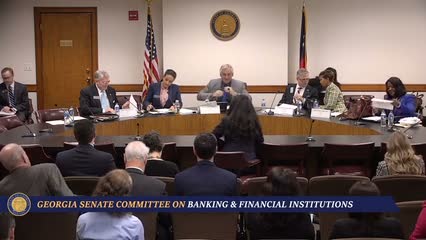
Senator Islam Parks brought Senate Bill 451, the Support for Economic Resilience and Veterans Empowerment (SERVE) Act, to the Senate Committee on Banking and Financial Institutions in a hearing-only session, proposing a voluntary program that would let certified financial institutions provide short-term, low-interest loans to Georgia veterans.
Parks said the program is designed as a bridge for veterans who face lengthy waits for federal benefits. "It's called the SERVE Act," she told the committee, and described a model that would provide "low interest loans up to $10,000 to veterans facing financial emergencies" with a four-year payback period and a 1.5% interest rate on loans lent back into the program.
The bill would allow donors—individuals and corporations—to apply to the Georgia Department of Revenue for approval of a contribution and receive a 100% state tax credit. Parks said the tax-credit pool is capped at $20,000,000 and that donations would be routed to certified banks, which would hold segregated accounts to fund the veteran loans. Under the bill language Parks cited, no less than 65% of funds must be used for lines of credit to eligible veterans, no less than 15% must be used for investments to sustain the program, and no more than 20% may be retained by participating institutions for administrative costs.
The bill assigns roles for oversight: the Department of Veterans Services would maintain a public list of certified veteran-assistance financial institutions and assist with prescreening veterans' eligibility; the Department of Banking and Finance would certify participating institutions, set program standards and conduct examinations on a three-year cycle; and the Department of Revenue would approve donor tax-credit applications. Parks told the committee that donor-verified funds would be issued to veterans on a "veteran debit card" restricted to approved uses including housing, health care, food and personal wellness.
Banking and advocacy witnesses raised operational concerns. Lori Godfrey of the Community Bankers Association said the substitute under consideration may differ from earlier drafts and warned the Department of Banking and Finance "does not have the staff or the resources to be able to oversee this type of program without specific appropriations." She also questioned how banks would verify veteran eligibility and prevent multiple awards across institutions and how card transactions would be enforced to approved categories.
Commissioner Trish Ross of the Georgia Department of Veterans Service urged the committee to consider the program's potential to address urgent needs, offering a recent case of an elderly veteran who lost his home in a fire and was temporarily sheltered by relief organizations. "We simply don't have the resources to assist," Ross said, arguing that the department could help prescreen veterans for eligibility but not serve as the program's bank operator.
Joe Bridal of the Georgia Bankers Association said bankers recognized the problem and were willing to work with sponsors on operational details, but reiterated concerns that using taxpayer-allocated donor funds through banks could be administratively complex and might be better administered through an established state revolving-fund mechanism.
On fiscal impacts, Parks said she had requested a fiscal note; she relayed an estimate from the deputy commissioner at the Department of Banking that initial implementation for the department could be roughly $1,000,000, but the committee was awaiting an official fiscal note.
The committee did not vote on the SERVE Act; Chairman Summers closed the presentation and asked the sponsor to work with banking stakeholders on operational details, offering to schedule another hearing if the bill is refined.
The committee's discussion highlighted several implementation questions that would need resolution before a policy or appropriation: verification and database access to prevent duplicate loans, staffing and funding for regulatory oversight, whether loans are secured or non-recourse for borrowers, and how donor funds retained by banks would be audited and reported.
The bill remains under consideration pending follow-up work with banking stakeholders and a formal fiscal note.
Parks said the program is designed as a bridge for veterans who face lengthy waits for federal benefits. "It's called the SERVE Act," she told the committee, and described a model that would provide "low interest loans up to $10,000 to veterans facing financial emergencies" with a four-year payback period and a 1.5% interest rate on loans lent back into the program.
The bill would allow donors—individuals and corporations—to apply to the Georgia Department of Revenue for approval of a contribution and receive a 100% state tax credit. Parks said the tax-credit pool is capped at $20,000,000 and that donations would be routed to certified banks, which would hold segregated accounts to fund the veteran loans. Under the bill language Parks cited, no less than 65% of funds must be used for lines of credit to eligible veterans, no less than 15% must be used for investments to sustain the program, and no more than 20% may be retained by participating institutions for administrative costs.
The bill assigns roles for oversight: the Department of Veterans Services would maintain a public list of certified veteran-assistance financial institutions and assist with prescreening veterans' eligibility; the Department of Banking and Finance would certify participating institutions, set program standards and conduct examinations on a three-year cycle; and the Department of Revenue would approve donor tax-credit applications. Parks told the committee that donor-verified funds would be issued to veterans on a "veteran debit card" restricted to approved uses including housing, health care, food and personal wellness.
Banking and advocacy witnesses raised operational concerns. Lori Godfrey of the Community Bankers Association said the substitute under consideration may differ from earlier drafts and warned the Department of Banking and Finance "does not have the staff or the resources to be able to oversee this type of program without specific appropriations." She also questioned how banks would verify veteran eligibility and prevent multiple awards across institutions and how card transactions would be enforced to approved categories.
Commissioner Trish Ross of the Georgia Department of Veterans Service urged the committee to consider the program's potential to address urgent needs, offering a recent case of an elderly veteran who lost his home in a fire and was temporarily sheltered by relief organizations. "We simply don't have the resources to assist," Ross said, arguing that the department could help prescreen veterans for eligibility but not serve as the program's bank operator.
Joe Bridal of the Georgia Bankers Association said bankers recognized the problem and were willing to work with sponsors on operational details, but reiterated concerns that using taxpayer-allocated donor funds through banks could be administratively complex and might be better administered through an established state revolving-fund mechanism.
On fiscal impacts, Parks said she had requested a fiscal note; she relayed an estimate from the deputy commissioner at the Department of Banking that initial implementation for the department could be roughly $1,000,000, but the committee was awaiting an official fiscal note.
The committee did not vote on the SERVE Act; Chairman Summers closed the presentation and asked the sponsor to work with banking stakeholders on operational details, offering to schedule another hearing if the bill is refined.
The committee's discussion highlighted several implementation questions that would need resolution before a policy or appropriation: verification and database access to prevent duplicate loans, staffing and funding for regulatory oversight, whether loans are secured or non-recourse for borrowers, and how donor funds retained by banks would be audited and reported.
The bill remains under consideration pending follow-up work with banking stakeholders and a formal fiscal note.
Don't Miss a Word: See the Full Meeting!
Go beyond summaries. Unlock every video, transcript, and key insight with a Founder Membership.
✓
Get instant access to full meeting videos
✓
Search and clip any phrase from complete transcripts
✓
Receive AI-powered summaries & custom alerts
✓
Enjoy lifetime, unrestricted access to government data
30-day money-back guarantee
