Senate committee advances 'Wesley’s Law' to expand Narcan access in Georgia schools
February 09, 2024 | Education and Youth, SENATE, Committees, Legislative, Georgia
This article was created by AI summarizing key points discussed. AI makes mistakes, so for full details and context, please refer to the video of the full meeting. Please report any errors so we can fix them. Report an error »
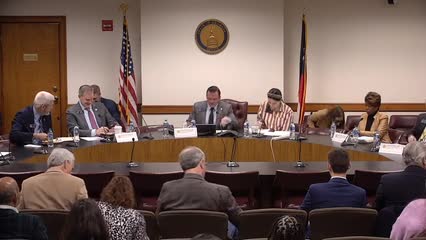
The Georgia Senate Education Committee voted to advance SB 395, nicknamed "Wesley’s Law," after a lengthy hearing in which witnesses and members described opioid overdoses in schools and debated liability and implementation details. The bill, as amended, would require school systems to acquire and maintain a supply of opioid antagonist (Narcan) in secure locations and allow school personnel and, in some cases, students to possess or carry the medication.
The sponsor of SB 395 (identified in the transcript only as the bill's author) opened by describing a personal connection: the measure is named for a relative who died from an overdose. The sponsor said current Georgia law permits only a school nurse to administer an opioid antagonist and to store it in the clinic; the bill would broaden access and include civil- and professional-discipline immunity for personnel who in good faith administer or decline to administer the medication.
The bill drew both personal testimony and technical questions. Britney, who identified herself as executive director of Living Proof Recovery in Floyd County and a person in long-term recovery, told the committee she survived an overdose after paramedics administered an opioid antagonist and said putting Narcan in schools "enhance[s] our ability to save the lives of students, teachers, and support staff." Jeff Breedlove, representing the Georgia Council for Recovery and also speaking from long-term recovery, said the choice is "either we put this tool in there and give a chance for life, or we say it's a burden," warning that rural 911 response times can be long and that "minutes count." Jocelyn Wallace, founder and executive director of the Never Alone Clubhouse Addiction Recovery Support Center, described multiple personal overdoses and credited Narcan with saving her life.
Committee members pressed on implementation details and liability. Senator Sams said she could not support the bill because it imposes medical duties on teachers and other school staff who are trained for instruction, not medical care. Several members and counsel debated whether the statutory language should create a mandatory duty for systems to "acquire and maintain" supplies or make that function discretionary; legal counsel and other senators worked to add an immunity subsection that shields local school systems and school personnel from civil liability except for willful and wanton failures to comply. A witness and the sponsor also said precise details — how many units constitute a "supply," replacement and expiration practices, and exact per-unit costs — were not specified in testimony and could be clarified in implementing rules or floor amendments.
After debate the committee adopted the proposed immunity amendment (vote recorded as 7–1) and then gave SB 395 a favorable recommendation as amended, with a 6–2 vote to report the bill to the Senate floor. Committee members noted the chamber was scheduled to go to the floor shortly after the committee adjourned.
What remains unclear from the hearing is the precise operational definition of "supply" (how many doses per school or per box), how schools will budget for replacement and expiration, and how implementing guidance will be issued; witnesses did not provide statewide counts of how many schools already stock Narcan and did not provide a per-unit statewide cost estimate. Those details were raised repeatedly during questioning and could be addressed before floor consideration.
The committee record includes extensive personal testimony supporting broader access to opioid antagonists and repeated concerns about placing medical responsibilities on instructional staff; the amendment and the sponsor’s remarks emphasised immunity and flexibility to encourage systems to keep supplies available. The bill now moves to the Senate floor for further consideration.
The sponsor of SB 395 (identified in the transcript only as the bill's author) opened by describing a personal connection: the measure is named for a relative who died from an overdose. The sponsor said current Georgia law permits only a school nurse to administer an opioid antagonist and to store it in the clinic; the bill would broaden access and include civil- and professional-discipline immunity for personnel who in good faith administer or decline to administer the medication.
The bill drew both personal testimony and technical questions. Britney, who identified herself as executive director of Living Proof Recovery in Floyd County and a person in long-term recovery, told the committee she survived an overdose after paramedics administered an opioid antagonist and said putting Narcan in schools "enhance[s] our ability to save the lives of students, teachers, and support staff." Jeff Breedlove, representing the Georgia Council for Recovery and also speaking from long-term recovery, said the choice is "either we put this tool in there and give a chance for life, or we say it's a burden," warning that rural 911 response times can be long and that "minutes count." Jocelyn Wallace, founder and executive director of the Never Alone Clubhouse Addiction Recovery Support Center, described multiple personal overdoses and credited Narcan with saving her life.
Committee members pressed on implementation details and liability. Senator Sams said she could not support the bill because it imposes medical duties on teachers and other school staff who are trained for instruction, not medical care. Several members and counsel debated whether the statutory language should create a mandatory duty for systems to "acquire and maintain" supplies or make that function discretionary; legal counsel and other senators worked to add an immunity subsection that shields local school systems and school personnel from civil liability except for willful and wanton failures to comply. A witness and the sponsor also said precise details — how many units constitute a "supply," replacement and expiration practices, and exact per-unit costs — were not specified in testimony and could be clarified in implementing rules or floor amendments.
After debate the committee adopted the proposed immunity amendment (vote recorded as 7–1) and then gave SB 395 a favorable recommendation as amended, with a 6–2 vote to report the bill to the Senate floor. Committee members noted the chamber was scheduled to go to the floor shortly after the committee adjourned.
What remains unclear from the hearing is the precise operational definition of "supply" (how many doses per school or per box), how schools will budget for replacement and expiration, and how implementing guidance will be issued; witnesses did not provide statewide counts of how many schools already stock Narcan and did not provide a per-unit statewide cost estimate. Those details were raised repeatedly during questioning and could be addressed before floor consideration.
The committee record includes extensive personal testimony supporting broader access to opioid antagonists and repeated concerns about placing medical responsibilities on instructional staff; the amendment and the sponsor’s remarks emphasised immunity and flexibility to encourage systems to keep supplies available. The bill now moves to the Senate floor for further consideration.
View the Full Meeting & All Its Details
This article offers just a summary. Unlock complete video, transcripts, and insights as a Founder Member.
✓
Watch full, unedited meeting videos
✓
Search every word spoken in unlimited transcripts
✓
AI summaries & real-time alerts (all government levels)
✓
Permanent access to expanding government content
30-day money-back guarantee
