Committee advances bill, resolution to let fast‑growing school districts levy impact fees for school construction
January 23, 2024 | Education and Youth, SENATE, Committees, Legislative, Georgia
This article was created by AI summarizing key points discussed. AI makes mistakes, so for full details and context, please refer to the video of the full meeting. Please report any errors so we can fix them. Report an error »
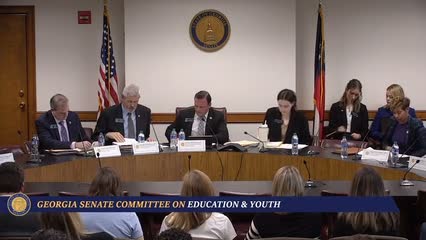
Sen. Dolezal told the Senate Education Committee that SB 208 would enable boards of education in fast‑growing school districts to levy impact fees to help fund school construction, and that SR 189 would put a constitutional amendment on the ballot so voters could decide on allowing those fees.
Dolezal said the bill is narrowly tailored: eligible districts must show at least 20% enrollment growth over the previous 10 years and at least $250 million in capital construction spending over the same period. He described existing impact‑fee processes for other infrastructure—committees that include development‑community representatives, studies that set pro rata fees—and argued a similar, study‑based approach for schools is “one of the most fair ways that we collect revenue” because it ties fees to the pro rata burden new development places on infrastructure.
Committee members asked how many districts would be affected and whether local boards sought the change. Dolezal said Forsyth County’s board passed a unanimous resolution supporting the measure and cited interest from Cherokee and Henry counties; he also acknowledged past opposition from some developers and an apartment association during earlier hearings.
The committee recorded a do‑pass motion on SB 208 (LC 491280 S) and advanced the bill unanimously. The committee then advanced SR 189, the companion constitutional amendment to allow school impact fees, by unanimous vote; SR 189 would place the question before Georgia voters rather than directly changing the constitution in committee.
If enacted through the constitutional amendment and enabling legislation, the package would let eligible boards set impact fees after following the state’s impact‑fee procedures, including a study and a committee process that typically includes members of the development community. Dolezal emphasized the bill is not a statewide mandate but an option for a small number of high‑growth districts.
Next steps: SB 208 and SR 189 now move out of the committee to the next stage in the Senate process.
Dolezal said the bill is narrowly tailored: eligible districts must show at least 20% enrollment growth over the previous 10 years and at least $250 million in capital construction spending over the same period. He described existing impact‑fee processes for other infrastructure—committees that include development‑community representatives, studies that set pro rata fees—and argued a similar, study‑based approach for schools is “one of the most fair ways that we collect revenue” because it ties fees to the pro rata burden new development places on infrastructure.
Committee members asked how many districts would be affected and whether local boards sought the change. Dolezal said Forsyth County’s board passed a unanimous resolution supporting the measure and cited interest from Cherokee and Henry counties; he also acknowledged past opposition from some developers and an apartment association during earlier hearings.
The committee recorded a do‑pass motion on SB 208 (LC 491280 S) and advanced the bill unanimously. The committee then advanced SR 189, the companion constitutional amendment to allow school impact fees, by unanimous vote; SR 189 would place the question before Georgia voters rather than directly changing the constitution in committee.
If enacted through the constitutional amendment and enabling legislation, the package would let eligible boards set impact fees after following the state’s impact‑fee procedures, including a study and a committee process that typically includes members of the development community. Dolezal emphasized the bill is not a statewide mandate but an option for a small number of high‑growth districts.
Next steps: SB 208 and SR 189 now move out of the committee to the next stage in the Senate process.
View the Full Meeting & All Its Details
This article offers just a summary. Unlock complete video, transcripts, and insights as a Founder Member.
✓
Watch full, unedited meeting videos
✓
Search every word spoken in unlimited transcripts
✓
AI summaries & real-time alerts (all government levels)
✓
Permanent access to expanding government content
30-day money-back guarantee
