UCAN reports high exit rates from Gary Leak Navigation Center; neighbor urges rethink of Dream Center campground site
March 25, 2024 | Roseburg City, Douglas County, Oregon
This article was created by AI summarizing key points discussed. AI makes mistakes, so for full details and context, please refer to the video of the full meeting. Please report any errors so we can fix them. Report an error »
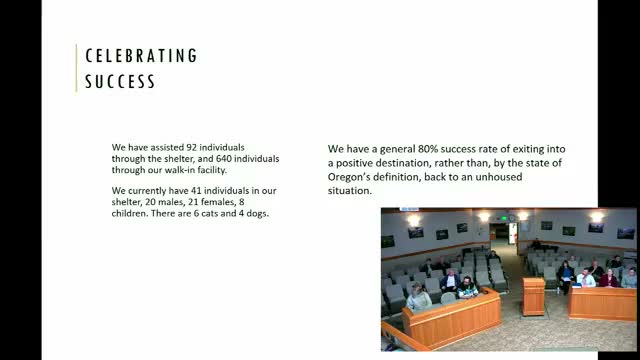
The Roseburg City Council heard an update March 25 from UCAN on the Gary Leak Navigation Center’s operations and outcomes, and a nearby resident urged councilors to reject a proposed campground at the Dream Center site.
Jacob Schluter, housing and homeless services program manager for Douglas County at UCAN, told the council the navigation center follows a low‑barrier model that allows pets and provides 24/7 shelter staffing and partner services. “92 individuals have exited the program,” Schluter said, and “75 to 80% have gone into successful sustainable housing situations,” figures he attributed to the third‑party homeless management information system UCAN uses.
Schluter described current program capacity and partners: the shelter was serving 41 people at the time of the presentation (“20 males, 21 females, 8 children”), and UCAN partners include Aviva, ADAPT, UHA and HIV Alliance. He said staff are peer‑support trained, security is contracted overnight, and the program connects people to services including DHS, health insurance enrollment and housing resources.
In public comment earlier in the meeting, Sherry Cooper of 222 Rifle Range Street asked the council to reject using 2555 NE Diamond Lake Blvd (the Dream Center) as a temporary campground. Cooper said the site is “far from any services the homeless need,” expressed safety concerns and cited cost figures she said were associated with the project: “The start up amount of this campground is over $700,000 and a monthly operating cost of over $50,000 a month,” she told councilors.
Will Kehaneke, who spoke as a former resident and first guest host at UCAN, described his path from homelessness to permanent housing and credited navigation center supports. “It took me 5 months from the time I arrived at the pods to find my permanent housing in November of 2022,” Kehaneke said, summarizing the kind of assistance UCAN staff provide.
Council members asked UCAN about program details and metrics, including how exits are counted and how many clients are enrolled, and were told that some measures (point‑in‑time counts and HMIS outputs) come later in reporting cycles. Schluter acknowledged the center’s outcomes are measured through a standardized HMIS questionnaire and said that, while UCAN is a smaller program than many statewide counterparts, their reported success rate exceeds the state average cited in the presentation.
The council did not take a formal vote on the Dream Center location during the meeting. Staff will continue to present information to council as site studies and cost analyses proceed; UCAN said it will return with updates and additional data as it becomes available.
Jacob Schluter, housing and homeless services program manager for Douglas County at UCAN, told the council the navigation center follows a low‑barrier model that allows pets and provides 24/7 shelter staffing and partner services. “92 individuals have exited the program,” Schluter said, and “75 to 80% have gone into successful sustainable housing situations,” figures he attributed to the third‑party homeless management information system UCAN uses.
Schluter described current program capacity and partners: the shelter was serving 41 people at the time of the presentation (“20 males, 21 females, 8 children”), and UCAN partners include Aviva, ADAPT, UHA and HIV Alliance. He said staff are peer‑support trained, security is contracted overnight, and the program connects people to services including DHS, health insurance enrollment and housing resources.
In public comment earlier in the meeting, Sherry Cooper of 222 Rifle Range Street asked the council to reject using 2555 NE Diamond Lake Blvd (the Dream Center) as a temporary campground. Cooper said the site is “far from any services the homeless need,” expressed safety concerns and cited cost figures she said were associated with the project: “The start up amount of this campground is over $700,000 and a monthly operating cost of over $50,000 a month,” she told councilors.
Will Kehaneke, who spoke as a former resident and first guest host at UCAN, described his path from homelessness to permanent housing and credited navigation center supports. “It took me 5 months from the time I arrived at the pods to find my permanent housing in November of 2022,” Kehaneke said, summarizing the kind of assistance UCAN staff provide.
Council members asked UCAN about program details and metrics, including how exits are counted and how many clients are enrolled, and were told that some measures (point‑in‑time counts and HMIS outputs) come later in reporting cycles. Schluter acknowledged the center’s outcomes are measured through a standardized HMIS questionnaire and said that, while UCAN is a smaller program than many statewide counterparts, their reported success rate exceeds the state average cited in the presentation.
The council did not take a formal vote on the Dream Center location during the meeting. Staff will continue to present information to council as site studies and cost analyses proceed; UCAN said it will return with updates and additional data as it becomes available.
Don't Miss a Word: See the Full Meeting!
Go beyond summaries. Unlock every video, transcript, and key insight with a Founder Membership.
✓
Get instant access to full meeting videos
✓
Search and clip any phrase from complete transcripts
✓
Receive AI-powered summaries & custom alerts
✓
Enjoy lifetime, unrestricted access to government data
30-day money-back guarantee
