Downtown parking group urges citywide water‑meter fee to fund enforcement; council asks staff for analysis
March 25, 2024 | Roseburg City, Douglas County, Oregon
This article was created by AI summarizing key points discussed. AI makes mistakes, so for full details and context, please refer to the video of the full meeting. Please report any errors so we can fix them. Report an error »
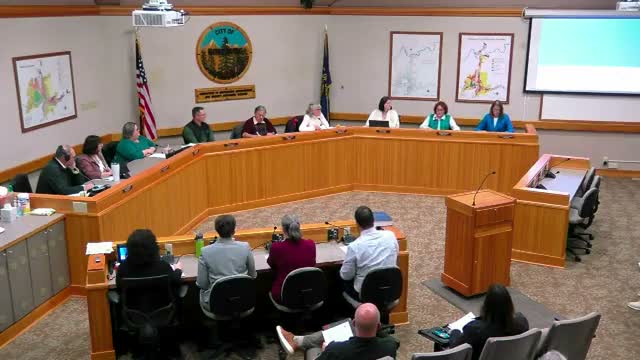
Councilors received a recommendation March 25 from the downtown parking committee to study spreading parking enforcement and maintenance costs across the whole city via a monthly charge on water meters.
Patrice Sippos, speaking for the committee, said the group found enforcement responsibilities extend beyond the downtown district (to areas such as Laurelwood and the county courthouse) and noted downtown business owners would bear an outsized share of costs without a broader funding mechanism. “We propose a motion to ask the city staff to draft an analysis of the financial impact of a city wide water meter fee where the proceeds from this fee would be specifically used for city wide parking enforcement,” she said.
Council members pressed for data before advancing policy. Mayor Larry Rich and Councilor David Moore asked staff to provide two scenarios: the minimum per‑meter fee to cover the enforcement shortfall, and a higher per‑meter fee that would also fund upgrades and increased maintenance of the parking garage (including security improvements). The presenter estimated the city has roughly 15,000 water meters; councilors asked staff to confirm that figure and to return with precise cost estimates.
Ellen Porter emphasized the distinction between a fee and a tax, and some councilors signaled concern about asking all residents to shoulder costs for assets used by a broader region (for example, courthouse and high school parking used by county residents). Councilor Porter and others said a public hearing should follow staff analysis so residents and downtown stakeholders can offer input.
Council did not adopt a fee at the meeting; members gave staff direction by consensus to analyze the proposal and present pros and cons, then schedule a public hearing.
Patrice Sippos, speaking for the committee, said the group found enforcement responsibilities extend beyond the downtown district (to areas such as Laurelwood and the county courthouse) and noted downtown business owners would bear an outsized share of costs without a broader funding mechanism. “We propose a motion to ask the city staff to draft an analysis of the financial impact of a city wide water meter fee where the proceeds from this fee would be specifically used for city wide parking enforcement,” she said.
Council members pressed for data before advancing policy. Mayor Larry Rich and Councilor David Moore asked staff to provide two scenarios: the minimum per‑meter fee to cover the enforcement shortfall, and a higher per‑meter fee that would also fund upgrades and increased maintenance of the parking garage (including security improvements). The presenter estimated the city has roughly 15,000 water meters; councilors asked staff to confirm that figure and to return with precise cost estimates.
Ellen Porter emphasized the distinction between a fee and a tax, and some councilors signaled concern about asking all residents to shoulder costs for assets used by a broader region (for example, courthouse and high school parking used by county residents). Councilor Porter and others said a public hearing should follow staff analysis so residents and downtown stakeholders can offer input.
Council did not adopt a fee at the meeting; members gave staff direction by consensus to analyze the proposal and present pros and cons, then schedule a public hearing.
View the Full Meeting & All Its Details
This article offers just a summary. Unlock complete video, transcripts, and insights as a Founder Member.
✓
Watch full, unedited meeting videos
✓
Search every word spoken in unlimited transcripts
✓
AI summaries & real-time alerts (all government levels)
✓
Permanent access to expanding government content
30-day money-back guarantee
