Roseburg council orders work session after staff outlines $205,000 downtown parking fund shortfall
April 22, 2024 | Roseburg City, Douglas County, Oregon
This article was created by AI summarizing key points discussed. AI makes mistakes, so for full details and context, please refer to the video of the full meeting. Please report any errors so we can fix them. Report an error »
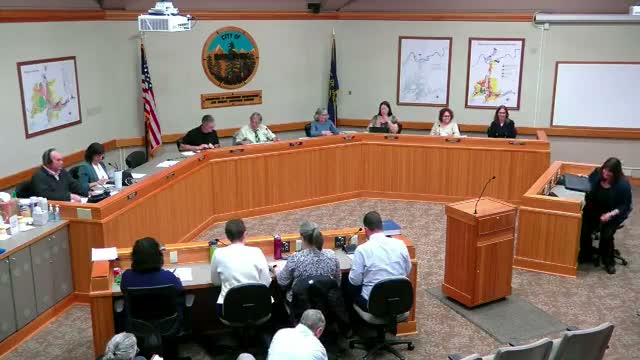
Roseburg City Council on April 22 directed staff to prepare a work session after being briefed on a structural deficit in the off‑street parking fund and on a menu of revenue and policy options.
City staff told council the parking program currently generates about $125,000 a year in revenue under the existing contract but incurs contract and overhead costs of roughly $219,000 plus additional noncontract costs (cleaning, security and building utilities), resulting in a funding gap in the neighborhood of $200,000–$210,000 annually. Staff presented a range of partial solutions: zone‑based time limits, pay‑on‑entry mobile apps, expanded permit parking for improved top‑level floors, targeted permit pricing, selling underused surface lots for one‑time revenue, and—in the short term—a per‑water‑meter fee to cover the immediate deficit.
Using the city’s estimate of about 9,000 water meters as a starting point, staff said a flat fee that covered only the present deficit would equate to roughly $23 per meter per year (about $4 per bi‑monthly billing cycle). Staff and councilors flagged equity and administrative concerns: a flat meter fee treats a single‑family home the same as a large commercial account, meter sizes vary and would complicate simple allocation, and many customers who use downtown parking do so without living inside city limits.
Council members and staff discussed alternatives to spreading the entire shortfall across every city water meter, including a mix of user charges (apps and time limits), permit revenues from an improved parking structure, selective assessments in a downtown improvement area, and potential interfund loans if a repayable revenue source is identified. Councilors also asked staff to identify groups who could share the burden (property owners, businesses, customers, metered water accounts outside city limits) and to provide options scaled to different fairness and administrative complexity tradeoffs.
The council agreed to ask staff to convene a focused work session on downtown parking and revenue options and to return with a recommended menu of alternatives and estimates of revenue generation, administrative costs and equity impacts.
Next steps: staff will assemble work‑session materials, refine the water‑meter counts and produce comparative revenue estimates for council review.
City staff told council the parking program currently generates about $125,000 a year in revenue under the existing contract but incurs contract and overhead costs of roughly $219,000 plus additional noncontract costs (cleaning, security and building utilities), resulting in a funding gap in the neighborhood of $200,000–$210,000 annually. Staff presented a range of partial solutions: zone‑based time limits, pay‑on‑entry mobile apps, expanded permit parking for improved top‑level floors, targeted permit pricing, selling underused surface lots for one‑time revenue, and—in the short term—a per‑water‑meter fee to cover the immediate deficit.
Using the city’s estimate of about 9,000 water meters as a starting point, staff said a flat fee that covered only the present deficit would equate to roughly $23 per meter per year (about $4 per bi‑monthly billing cycle). Staff and councilors flagged equity and administrative concerns: a flat meter fee treats a single‑family home the same as a large commercial account, meter sizes vary and would complicate simple allocation, and many customers who use downtown parking do so without living inside city limits.
Council members and staff discussed alternatives to spreading the entire shortfall across every city water meter, including a mix of user charges (apps and time limits), permit revenues from an improved parking structure, selective assessments in a downtown improvement area, and potential interfund loans if a repayable revenue source is identified. Councilors also asked staff to identify groups who could share the burden (property owners, businesses, customers, metered water accounts outside city limits) and to provide options scaled to different fairness and administrative complexity tradeoffs.
The council agreed to ask staff to convene a focused work session on downtown parking and revenue options and to return with a recommended menu of alternatives and estimates of revenue generation, administrative costs and equity impacts.
Next steps: staff will assemble work‑session materials, refine the water‑meter counts and produce comparative revenue estimates for council review.
Don't Miss a Word: See the Full Meeting!
Go beyond summaries. Unlock every video, transcript, and key insight with a Founder Membership.
✓
Get instant access to full meeting videos
✓
Search and clip any phrase from complete transcripts
✓
Receive AI-powered summaries & custom alerts
✓
Enjoy lifetime, unrestricted access to government data
30-day money-back guarantee
