Roseburg council agrees to pursue long-term vision and interim goals, asks staff to draft next steps
April 29, 2024 | Roseburg City, Douglas County, Oregon
This article was created by AI summarizing key points discussed. AI makes mistakes, so for full details and context, please refer to the video of the full meeting. Please report any errors so we can fix them. Report an error »
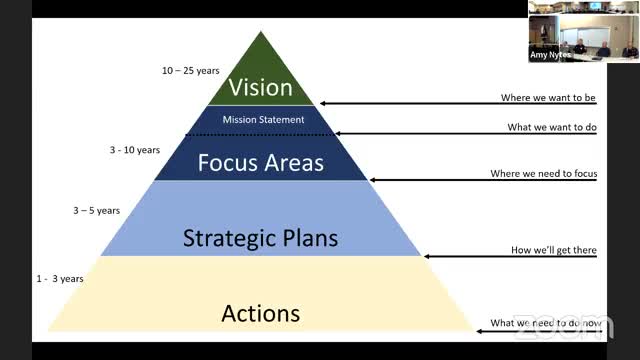
Speaker 1 (unnamed participant) opened the retreat by asking the council to identify a clear vision and the priority areas—housing, infrastructure, economic development, livability and public safety—that the city should focus on and to align those with existing master plans. “What are those areas? And then the strategic plans are looking at those focus areas,” Speaker 1 said, framing the discussion around six priorities put forward as a starting point.
Speakers across the table agreed on the need for a shared north star. Speaker 3 summarized two complementary approaches: continue bottoms-up work to solve immediate problems while pursuing a top-down, community-owned vision that defines where the city should be 20–25 years from now. “There is no articulated vision for the future,” Speaker 3 said, urging a deliberate outreach process and warning that meaningful community visioning could take months.
Councilors and staff described the approach the group settled on as two tracks: finalize interim council goals (3–5 years) that give staff clear short-term direction, and concurrently scope a broader long-range visioning process with community engagement. Several members stressed the need to translate the vision into measurable priorities so staff and the city manager have concrete evaluation benchmarks.
Budget and capacity were recurring concerns. Speaker 8 (budget staff) told the council that under Oregon budget law the council can make mid-year appropriation changes but many revenue streams are legally restricted to specific uses, and that the general fund, while relatively flexible, primarily supports ongoing operations. “General fund revenues are unrestricted for the most part,” Speaker 8 said, while cautioning that reallocating funds has consequences for service delivery.
Staff emphasized operational constraints. Planning staff noted heavy day-to-day workloads—"we will have processed 435 site reviews" was cited as the year’s projected regulatory workload—underscoring the tension between long-term planning and legally required service work.
Council members raised process and continuity issues: turnover on the council, limited onboarding for new members and the need for quarterly progress updates so elected officials can see the activities that support long-term goals. Speaker 2 recommended periodic status briefings to demonstrate what staff are doing behind the scenes to meet stated priorities.
On personnel evaluation, the council confirmed a standard timetable for the city manager’s review. Speaker 2 stated the evaluation period for the city manager (referred to in the discussion as Nikki) “starts in July and ends in September,” and the group agreed that interim evaluations would continue to reference the previous year’s goals until new goals are adopted.
Next steps: staff were asked to prepare tools and a draft structure, circulate materials to councilors for feedback, and ensure the visioning work follows public meeting requirements. No formal motions or votes were recorded in the transcript; council discussion closed with an agreement to pursue interim goals while initiating the longer visioning process.
The council’s conversation will feed into future sessions in which staff will return with proposed interim goals and a plan to engage the community on a longer-term vision.
Speakers across the table agreed on the need for a shared north star. Speaker 3 summarized two complementary approaches: continue bottoms-up work to solve immediate problems while pursuing a top-down, community-owned vision that defines where the city should be 20–25 years from now. “There is no articulated vision for the future,” Speaker 3 said, urging a deliberate outreach process and warning that meaningful community visioning could take months.
Councilors and staff described the approach the group settled on as two tracks: finalize interim council goals (3–5 years) that give staff clear short-term direction, and concurrently scope a broader long-range visioning process with community engagement. Several members stressed the need to translate the vision into measurable priorities so staff and the city manager have concrete evaluation benchmarks.
Budget and capacity were recurring concerns. Speaker 8 (budget staff) told the council that under Oregon budget law the council can make mid-year appropriation changes but many revenue streams are legally restricted to specific uses, and that the general fund, while relatively flexible, primarily supports ongoing operations. “General fund revenues are unrestricted for the most part,” Speaker 8 said, while cautioning that reallocating funds has consequences for service delivery.
Staff emphasized operational constraints. Planning staff noted heavy day-to-day workloads—"we will have processed 435 site reviews" was cited as the year’s projected regulatory workload—underscoring the tension between long-term planning and legally required service work.
Council members raised process and continuity issues: turnover on the council, limited onboarding for new members and the need for quarterly progress updates so elected officials can see the activities that support long-term goals. Speaker 2 recommended periodic status briefings to demonstrate what staff are doing behind the scenes to meet stated priorities.
On personnel evaluation, the council confirmed a standard timetable for the city manager’s review. Speaker 2 stated the evaluation period for the city manager (referred to in the discussion as Nikki) “starts in July and ends in September,” and the group agreed that interim evaluations would continue to reference the previous year’s goals until new goals are adopted.
Next steps: staff were asked to prepare tools and a draft structure, circulate materials to councilors for feedback, and ensure the visioning work follows public meeting requirements. No formal motions or votes were recorded in the transcript; council discussion closed with an agreement to pursue interim goals while initiating the longer visioning process.
The council’s conversation will feed into future sessions in which staff will return with proposed interim goals and a plan to engage the community on a longer-term vision.
Don't Miss a Word: See the Full Meeting!
Go beyond summaries. Unlock every video, transcript, and key insight with a Founder Membership.
✓
Get instant access to full meeting videos
✓
Search and clip any phrase from complete transcripts
✓
Receive AI-powered summaries & custom alerts
✓
Enjoy lifetime, unrestricted access to government data
30-day money-back guarantee
