Massachusetts DEP to finalize first‑in‑the‑nation cumulative‑impact rules for air permits
March 14, 2024 | Executive Office of Energy and Environmental Affairs, Executive , Massachusetts
This article was created by AI summarizing key points discussed. AI makes mistakes, so for full details and context, please refer to the video of the full meeting. Please report any errors so we can fix them. Report an error »
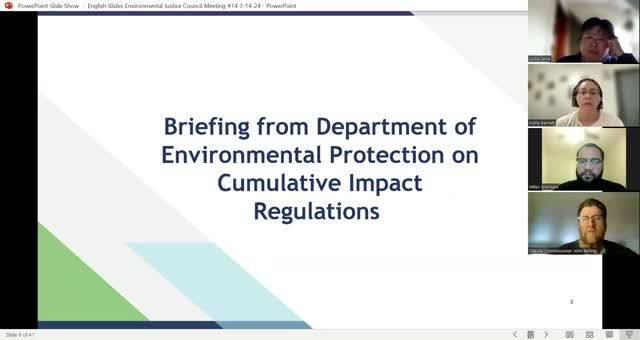
The Massachusetts Department of Environmental Protection told the Environmental Justice Council in Worcester that it will soon publish final regulations requiring cumulative impact analyses for air permits affecting environmental justice communities.
Commissioner Bonnie Heiple said the rules — launched from the state’s 2021 Climate Roadmap Law work — are meant to ensure permits are evaluated in the context of ‘‘past, present, and future actions’’ affecting a community. ‘‘We are about to become, I should say, the first state to require analysis of cumulative impacts for air quality permits in or near environmental justice populations,’’ Heiple said during the Nov. 1 briefing.
Under the rules described by DEP staff, applicants for new or expanded facilities that emit air pollutants and are ‘‘in or near’’ an environmental justice (EJ) population must complete a cumulative impact analysis (CIA) before submitting an air permit application. DEP officials said the rule sets different distance triggers: non‑major projects within 1 mile of an EJ block group, larger comprehensive plan applications within 5 miles, and existing facilities that increase emissions by 1 ton also trigger the requirement. Temporary emission increases are excluded.
DEP said the CIA will have three core elements: robust pre‑application outreach to nearby EJ populations (required at least 60 days before filing), an assessment of existing environmental, health and socioeconomic conditions, and a cumulative air toxics risk characterization with numeric limits. ‘‘Applicants have to assess 33 indicators that apply to environmental, health, and socioeconomic factors,’’ said Christine Kirby, identified in the presentation as an assistant commissioner involved in the rulemaking.
DEP staff demonstrated tools that will accompany the rule: a mapping tool that shows EJ block groups, sensitive receptors and regulated sites; an indicator spreadsheet with block‑group data; and an air toxic risk screening matrix. The risk spreadsheet includes 237 air toxics and computes cumulative cancer and non‑cancer risk. According to DEP, a CIA must show a cumulative excess lifetime cancer risk no greater than 10 in 1,000,000 and a hazard index not exceeding 1; if those thresholds are not met, applicants must perform more refined dispersion modeling and propose mitigation or face possible denial.
The agency also said the public comment period for CIA submissions will be extended to 60 days — double DEP’s usual 30‑day period — and that applicants must document community concerns raised during pre‑application outreach and respond in writing. DEP previewed planned training and guidance resources and said it will conduct a program review by the end of 2025 to consider refinements, including the possibility of adding multimedia measures beyond air quality.
Council members pressed DEP about whether the agency could simply deny permits near already burdened communities; DEP responded that the regulation is designed to enforce more stringent standards and that a permit that does not meet the risk criteria would be denied. Officials said the administration has added staff — nearly 80 new hires across DEP, including positions in air permitting and monitoring — to support implementation.
The rule package, DEP said, is the product of multi‑year stakeholder engagement and is intended as a first step that will be refined after real‑world testing and additional science becomes available. DEP staff invited continued input on indicators, monitoring and the planned program review.
The council moved on to its next agenda item after the DEP briefing; DEP staff said final regulations would be announced in the coming weeks and that trainings and guidance would follow.
Commissioner Bonnie Heiple said the rules — launched from the state’s 2021 Climate Roadmap Law work — are meant to ensure permits are evaluated in the context of ‘‘past, present, and future actions’’ affecting a community. ‘‘We are about to become, I should say, the first state to require analysis of cumulative impacts for air quality permits in or near environmental justice populations,’’ Heiple said during the Nov. 1 briefing.
Under the rules described by DEP staff, applicants for new or expanded facilities that emit air pollutants and are ‘‘in or near’’ an environmental justice (EJ) population must complete a cumulative impact analysis (CIA) before submitting an air permit application. DEP officials said the rule sets different distance triggers: non‑major projects within 1 mile of an EJ block group, larger comprehensive plan applications within 5 miles, and existing facilities that increase emissions by 1 ton also trigger the requirement. Temporary emission increases are excluded.
DEP said the CIA will have three core elements: robust pre‑application outreach to nearby EJ populations (required at least 60 days before filing), an assessment of existing environmental, health and socioeconomic conditions, and a cumulative air toxics risk characterization with numeric limits. ‘‘Applicants have to assess 33 indicators that apply to environmental, health, and socioeconomic factors,’’ said Christine Kirby, identified in the presentation as an assistant commissioner involved in the rulemaking.
DEP staff demonstrated tools that will accompany the rule: a mapping tool that shows EJ block groups, sensitive receptors and regulated sites; an indicator spreadsheet with block‑group data; and an air toxic risk screening matrix. The risk spreadsheet includes 237 air toxics and computes cumulative cancer and non‑cancer risk. According to DEP, a CIA must show a cumulative excess lifetime cancer risk no greater than 10 in 1,000,000 and a hazard index not exceeding 1; if those thresholds are not met, applicants must perform more refined dispersion modeling and propose mitigation or face possible denial.
The agency also said the public comment period for CIA submissions will be extended to 60 days — double DEP’s usual 30‑day period — and that applicants must document community concerns raised during pre‑application outreach and respond in writing. DEP previewed planned training and guidance resources and said it will conduct a program review by the end of 2025 to consider refinements, including the possibility of adding multimedia measures beyond air quality.
Council members pressed DEP about whether the agency could simply deny permits near already burdened communities; DEP responded that the regulation is designed to enforce more stringent standards and that a permit that does not meet the risk criteria would be denied. Officials said the administration has added staff — nearly 80 new hires across DEP, including positions in air permitting and monitoring — to support implementation.
The rule package, DEP said, is the product of multi‑year stakeholder engagement and is intended as a first step that will be refined after real‑world testing and additional science becomes available. DEP staff invited continued input on indicators, monitoring and the planned program review.
The council moved on to its next agenda item after the DEP briefing; DEP staff said final regulations would be announced in the coming weeks and that trainings and guidance would follow.
Don't Miss a Word: See the Full Meeting!
Go beyond summaries. Unlock every video, transcript, and key insight with a Founder Membership.
✓
Get instant access to full meeting videos
✓
Search and clip any phrase from complete transcripts
✓
Receive AI-powered summaries & custom alerts
✓
Enjoy lifetime, unrestricted access to government data
30-day money-back guarantee
