Healthy Minds outlines youth mental-health gaps, network issues and 2023 legislative wins
February 01, 2024 | Oklahoma Commission on Children and Youth, Executive, Oklahoma
This article was created by AI summarizing key points discussed. AI makes mistakes, so for full details and context, please refer to the video of the full meeting. Please report any errors so we can fix them. Report an error »
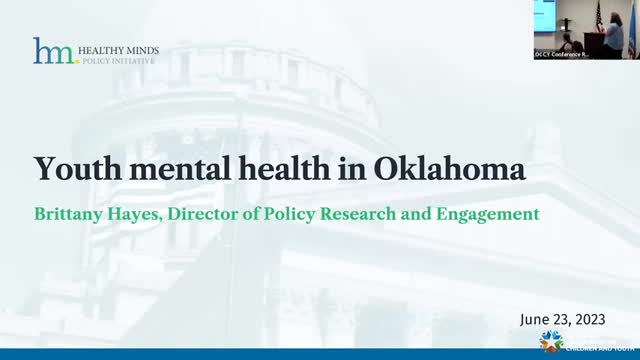
Healthy Minds director of Policy Research and Engagement presented the organization's assessment of Oklahoma's youth mental-health system, calling attention to a tallied increase in self-reported psychological distress, rising pediatric emergency visits for mental-health crises, and a shortage of intensive community-based services for adolescents.
The presentation underscored several structural problems: a shortage of psychiatrists and other higher-level clinicians, inaccurate provider directories, low commercial-insurer participation among behavioral-health providers, and reimbursement gaps that discourage provider participation in networks. Healthy Minds cited a network-auditing exercise that found many behavioral-health providers listed in directories could not be reached or had inaccurate contact information.
The organization highlighted several 2023 legislative actions that it said will help address gaps: SB442 (directory accuracy / network adequacy reporting), SB254 (requires insurers to arrange behavioral-health care if not available in network), SB444 (billing codes supporting collaborative care models), and HB2175 (Behavioral Health Workforce Development Fund). Healthy Minds also described community investments (YES Tulsa crisis stabilization, Parkside Psychiatric Hospital children's beds) and workforce strategies such as licensing reciprocity and loan-repayment proposals.
Commissioners asked for the presentation slides and further detail; Healthy Minds agreed to share materials. The presentation included data on increases in pediatric ER visits for mental-health crises at several major hospitals and advocacy for multi-tiered school-based prevention (MTSS) as essential.
Source: Healthy Minds presentation and Q&A during the June 21 meeting.
The presentation underscored several structural problems: a shortage of psychiatrists and other higher-level clinicians, inaccurate provider directories, low commercial-insurer participation among behavioral-health providers, and reimbursement gaps that discourage provider participation in networks. Healthy Minds cited a network-auditing exercise that found many behavioral-health providers listed in directories could not be reached or had inaccurate contact information.
The organization highlighted several 2023 legislative actions that it said will help address gaps: SB442 (directory accuracy / network adequacy reporting), SB254 (requires insurers to arrange behavioral-health care if not available in network), SB444 (billing codes supporting collaborative care models), and HB2175 (Behavioral Health Workforce Development Fund). Healthy Minds also described community investments (YES Tulsa crisis stabilization, Parkside Psychiatric Hospital children's beds) and workforce strategies such as licensing reciprocity and loan-repayment proposals.
Commissioners asked for the presentation slides and further detail; Healthy Minds agreed to share materials. The presentation included data on increases in pediatric ER visits for mental-health crises at several major hospitals and advocacy for multi-tiered school-based prevention (MTSS) as essential.
Source: Healthy Minds presentation and Q&A during the June 21 meeting.
View the Full Meeting & All Its Details
This article offers just a summary. Unlock complete video, transcripts, and insights as a Founder Member.
✓
Watch full, unedited meeting videos
✓
Search every word spoken in unlimited transcripts
✓
AI summaries & real-time alerts (all government levels)
✓
Permanent access to expanding government content
30-day money-back guarantee
