Clay County votes to prohibit solicitation in road rights-of-way after safety debate
January 10, 2023 | Clay County, Florida
This article was created by AI summarizing key points discussed. AI makes mistakes, so for full details and context, please refer to the video of the full meeting. Please report any errors so we can fix them. Report an error »
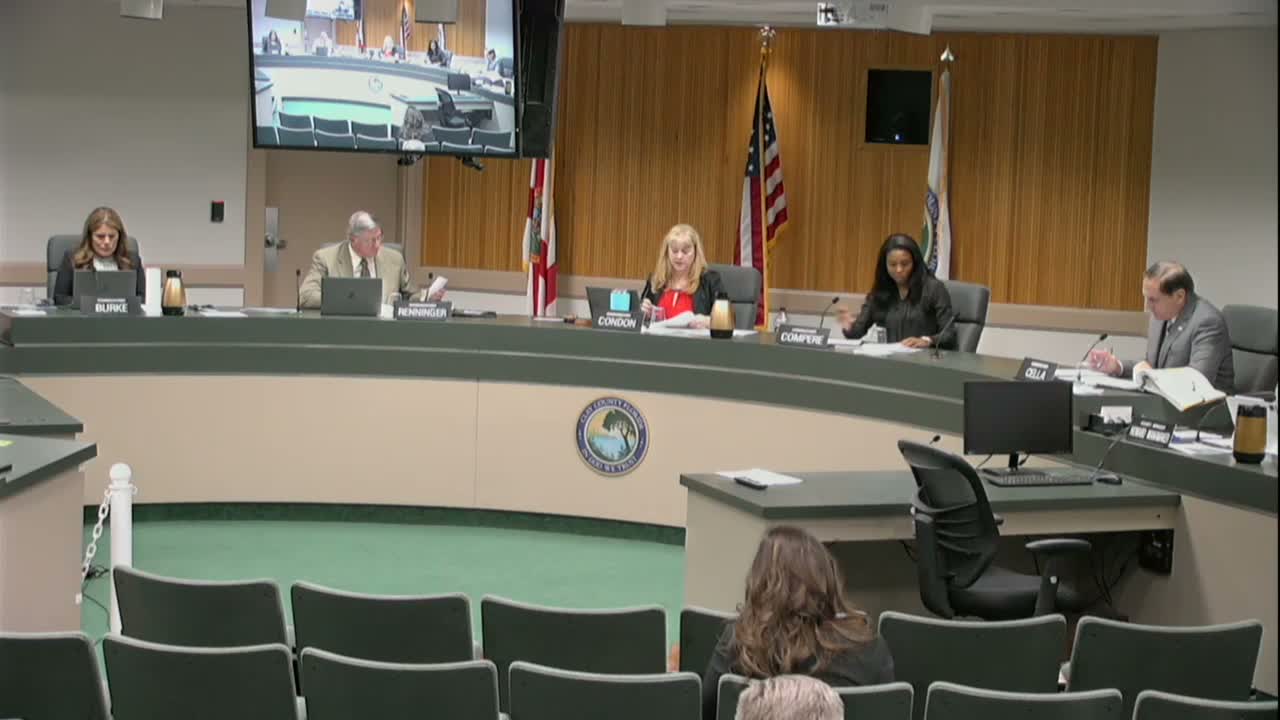
Clay County commissioners on Jan. 10 adopted a county ordinance that bars solicitation in public road rights-of-way, citing public-safety concerns and a recent federal judicial interpretation affecting how local governments regulate speech in public spaces. The measure passed 4–1 after more than an hour of questions and debate.
County staff and the sheriff’s office framed the change as a safety policy. According to the presentation, past enforcement language had been vulnerable to constitutional challenge because it allowed some forms of activity while prohibiting others; the revised text, modeled on a Lee County ordinance, instead prohibits solicitation in the right-of-way with enumerated exceptions such as road closures ordered for safety and lawful crosswalk use.
Sheriff (name given in the meeting) told commissioners the decision stemmed from safety risks created when people stand in medians or along high-speed corridors to solicit funds. “Either the behavior is going to be allowed for everybody or nobody,” the sheriff said during the discussion, arguing that the county had to choose a clear, enforceable rule rather than an uneven permitting regime.
Opponents and some commissioners said the ordinance is broad and could sweep up legitimate fundraising and volunteer activities (youth sports, firefighting fundraisers, car washes) that have traditionally used visible road-edge locations. Commissioner Compere and others raised concerns about the “all or nothing” approach and asked staff to outline alternative ways to facilitate lawful, safe fundraising for civic groups. Staff and the sheriff replied that private property and sidewalks remain available and that the county would work with legitimate groups to find safe alternatives.
The board acknowledged the ordinance could be revisited. A motion to adopt the ordinance carried on a recorded voice vote, 4 in favor and 1 opposed. The ordinance text includes limited exceptions and directs staff to coordinate outreach and enforcement guidance with community organizations.
The board’s discussion also referenced regional coordination: staff said several nearby jurisdictions were examining similar language and that Clay County’s approach had already drawn inquiries from other local governments.
The ordinance will take effect according to the implementation schedule in the adopted document and staff said they will return with enforcement protocols and outreach plans to inform community groups about allowed—and disallowed—locations.
County staff and the sheriff’s office framed the change as a safety policy. According to the presentation, past enforcement language had been vulnerable to constitutional challenge because it allowed some forms of activity while prohibiting others; the revised text, modeled on a Lee County ordinance, instead prohibits solicitation in the right-of-way with enumerated exceptions such as road closures ordered for safety and lawful crosswalk use.
Sheriff (name given in the meeting) told commissioners the decision stemmed from safety risks created when people stand in medians or along high-speed corridors to solicit funds. “Either the behavior is going to be allowed for everybody or nobody,” the sheriff said during the discussion, arguing that the county had to choose a clear, enforceable rule rather than an uneven permitting regime.
Opponents and some commissioners said the ordinance is broad and could sweep up legitimate fundraising and volunteer activities (youth sports, firefighting fundraisers, car washes) that have traditionally used visible road-edge locations. Commissioner Compere and others raised concerns about the “all or nothing” approach and asked staff to outline alternative ways to facilitate lawful, safe fundraising for civic groups. Staff and the sheriff replied that private property and sidewalks remain available and that the county would work with legitimate groups to find safe alternatives.
The board acknowledged the ordinance could be revisited. A motion to adopt the ordinance carried on a recorded voice vote, 4 in favor and 1 opposed. The ordinance text includes limited exceptions and directs staff to coordinate outreach and enforcement guidance with community organizations.
The board’s discussion also referenced regional coordination: staff said several nearby jurisdictions were examining similar language and that Clay County’s approach had already drawn inquiries from other local governments.
The ordinance will take effect according to the implementation schedule in the adopted document and staff said they will return with enforcement protocols and outreach plans to inform community groups about allowed—and disallowed—locations.
View the Full Meeting & All Its Details
This article offers just a summary. Unlock complete video, transcripts, and insights as a Founder Member.
✓
Watch full, unedited meeting videos
✓
Search every word spoken in unlimited transcripts
✓
AI summaries & real-time alerts (all government levels)
✓
Permanent access to expanding government content
30-day money-back guarantee
