Clay County advances Article 3 land‑development rewrite; commissioners debate ADU size, setbacks and jurisdictional limits
June 06, 2023 | Clay County, Florida
This article was created by AI summarizing key points discussed. AI makes mistakes, so for full details and context, please refer to the video of the full meeting. Please report any errors so we can fix them. Report an error »
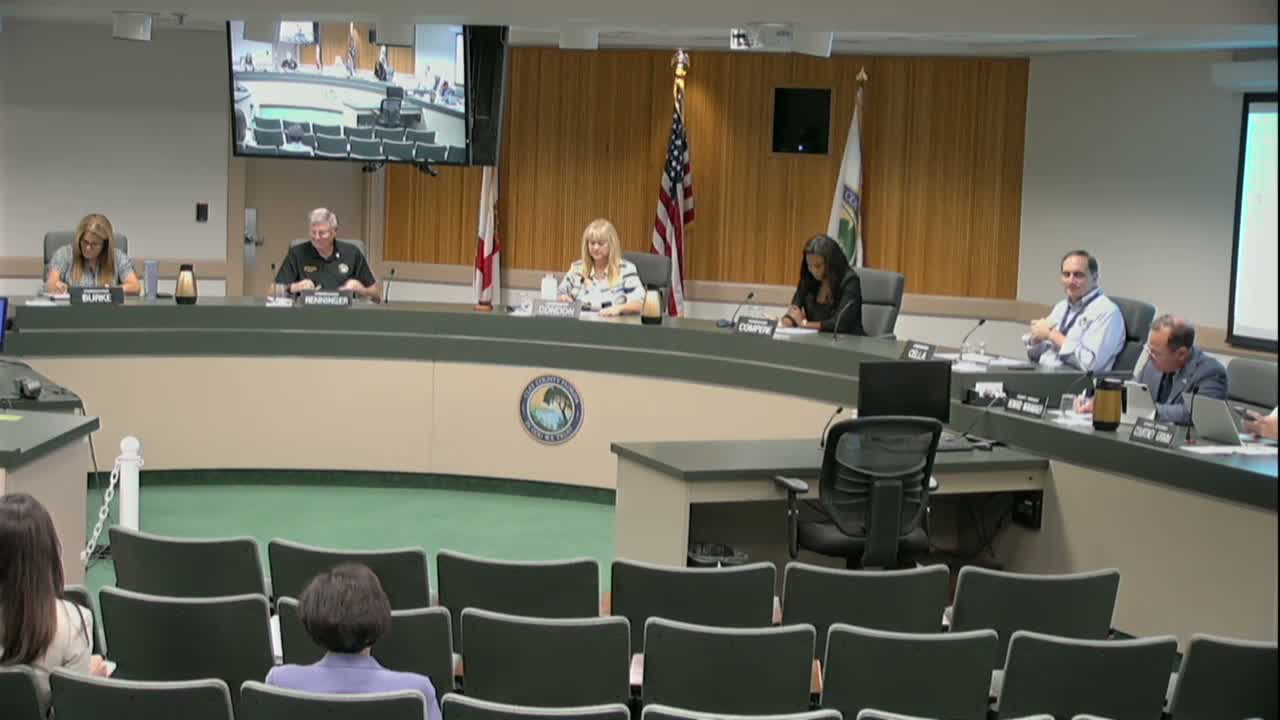
Clay County commissioners heard a detailed presentation June 6 from WGI consultants on a proposed rewrite of Article 3 of the county's land development code, intended to reorganize zoning districts, clarify uses and reduce repeated or conflicting language.
Angela Biaggi of WGI told the board the overhaul focuses on three priorities: reduce redundancies in code language, introduce standardized templates and add graphics and use matrices to make rules easier to interpret. Mary Anne Kwok walked commissioners through parts A through F of the proposed Article 3, which WGI has split into general provisions; nonconformities; future land use and density bonuses; zoning districts; use types and standards; and adequate public facilities and technical standards.
Why it matters: county staff and consultants said clearer diagrams and a single template for each zoning district should cut down on requests for interpretation and variance applications. WGI said the first draft is available online and a second draft was scheduled for posting June 14, with final adoption tied to a comprehensive-plan transmittal expected in January 2024 and adoption of Article 3 targeted for late spring 2024.
Key proposals and responses
- Templates, graphics and cross-references: WGI proposed uniform templates for each district (intent, allowed densities, dimensional standards) and graphics to show how setbacks, building heights and separation distances are measured. Consultants said the changes aim to reduce ambiguity that currently produces inconsistent interpretations.
- Nonconformities: The draft carries forward vested-rights and eminent-domain language and adds a fourth category to identify nonconforming site elements (parking, buffers, landscaping) so those components can be managed separately from lots, structures and uses.
- Density-bonus consolidation: WGI proposed consolidating existing density-bonus programs (clustering, point systems, transfer of development rights and traditional neighborhood provisions) and mapped where those programs would be allowed, including references to two master-planned communities mentioned in the materials (transcript references these communities as both "Brandonfield" and later as "Brandonville," and as Lake Asbury).
- Accessory uses and ADU size: Consultants proposed limiting accessory structures to a maximum of 30% of the principal structure's area in the draft (example offered: a 1,000-square-foot principal structure → 300-square-foot accessory). Commissioners pushed back on the 30% figure for residential situations, saying the board recently moved to allow larger accessory-dwelling units and cited a 40% limit for residential ADUs under current local practice. In response, WGI said 30% is a reasonable starting point and agreed to clarify distinctions for residential versus nonresidential applications and list possible exemptions (for example, private-airport hangars on very large lots). The board asked staff to preserve the existing residential percentage where appropriate.
- Setback definitions and waterfront/corner lots: Commissioners raised longstanding confusion about how to define the "front" of a lot for waterfront properties or lots that face two streets. WGI and staff said the rewrite will define front-yard orientation (typically tied to the principal driveway and address) and include graphics to reduce the need for variances and to make measurement methods explicit.
- Alcohol-distance and restaurant impacts: Public commenters and commissioners discussed the county's alcohol-distance rules from churches and other assembly uses, noting past changes in Lake Asbury that sought to avoid unintentionally excluding restaurants. Residents urged the board to balance public-safety concerns and economic development, and staff noted that existing tenants would not be displaced by new rules but clarified how sequencing (which use preexisted) affects allowable future uses.
- Live Local Act and one-mile radius questions: Commissioners asked whether the state's newly signed Live Local Act's one-mile radius provisions could import regulations from adjacent counties into Clay County code. WGI/staff said their understanding is that county jurisdiction determines which properties count for the one-mile measurement (county staff said they would apply requirements within Clay County jurisdiction but that additional statutory interpretation and guidance may be forthcoming).
Process and next steps
WGI said the second draft of Article 3 will be posted June 14; staff will work through additional rounds of comment in June–August and then turn more of the editing and stakeholder engagement over to county staff. The consultants and staff noted that some language in the comprehensive plan that overlaps with zoning (density and intensity language) must be transmittaled and revised before final adoption of Article 3. That comp-plan transmittal is anticipated in January 2024, with the county aiming for final adoption of the revised Article 3 the following spring.
Public input and board direction
Residents urged careful consideration of alcohol-distance changes and better public signage. Susan Fraser, who spoke during public comment, said past debates produced code edits intended to avoid excluding restaurants near churches, and she encouraged the county to revisit those lines thoughtfully. William Shaffer, who identified himself as a Middleburg resident and local builder, thanked the county for stakeholder engagement and the opportunity to comment.
Staff committed to distributing draft files to each commissioner, updating the project timeline graphic on the county website, clarifying ADU and accessory-use percentages in the next draft and adding graphics showing measurement methodologies for separation distances and setbacks. The workshop concluded with commissioners expressing support for clearer graphics and standardized templates and the chair adjourning the meeting.
What remains unresolved: The final sizes allowed for ADUs (the draft's 30% cap versus commissioners'cited 40% residential practice), specific exemptions to height rules for certain accessory structures, and formal interpretation of the Live Local Act's one-mile radius when adjacent jurisdictions differ. Those items are scheduled for further refinement in subsequent drafts and staff review.
Angela Biaggi of WGI told the board the overhaul focuses on three priorities: reduce redundancies in code language, introduce standardized templates and add graphics and use matrices to make rules easier to interpret. Mary Anne Kwok walked commissioners through parts A through F of the proposed Article 3, which WGI has split into general provisions; nonconformities; future land use and density bonuses; zoning districts; use types and standards; and adequate public facilities and technical standards.
Why it matters: county staff and consultants said clearer diagrams and a single template for each zoning district should cut down on requests for interpretation and variance applications. WGI said the first draft is available online and a second draft was scheduled for posting June 14, with final adoption tied to a comprehensive-plan transmittal expected in January 2024 and adoption of Article 3 targeted for late spring 2024.
Key proposals and responses
- Templates, graphics and cross-references: WGI proposed uniform templates for each district (intent, allowed densities, dimensional standards) and graphics to show how setbacks, building heights and separation distances are measured. Consultants said the changes aim to reduce ambiguity that currently produces inconsistent interpretations.
- Nonconformities: The draft carries forward vested-rights and eminent-domain language and adds a fourth category to identify nonconforming site elements (parking, buffers, landscaping) so those components can be managed separately from lots, structures and uses.
- Density-bonus consolidation: WGI proposed consolidating existing density-bonus programs (clustering, point systems, transfer of development rights and traditional neighborhood provisions) and mapped where those programs would be allowed, including references to two master-planned communities mentioned in the materials (transcript references these communities as both "Brandonfield" and later as "Brandonville," and as Lake Asbury).
- Accessory uses and ADU size: Consultants proposed limiting accessory structures to a maximum of 30% of the principal structure's area in the draft (example offered: a 1,000-square-foot principal structure → 300-square-foot accessory). Commissioners pushed back on the 30% figure for residential situations, saying the board recently moved to allow larger accessory-dwelling units and cited a 40% limit for residential ADUs under current local practice. In response, WGI said 30% is a reasonable starting point and agreed to clarify distinctions for residential versus nonresidential applications and list possible exemptions (for example, private-airport hangars on very large lots). The board asked staff to preserve the existing residential percentage where appropriate.
- Setback definitions and waterfront/corner lots: Commissioners raised longstanding confusion about how to define the "front" of a lot for waterfront properties or lots that face two streets. WGI and staff said the rewrite will define front-yard orientation (typically tied to the principal driveway and address) and include graphics to reduce the need for variances and to make measurement methods explicit.
- Alcohol-distance and restaurant impacts: Public commenters and commissioners discussed the county's alcohol-distance rules from churches and other assembly uses, noting past changes in Lake Asbury that sought to avoid unintentionally excluding restaurants. Residents urged the board to balance public-safety concerns and economic development, and staff noted that existing tenants would not be displaced by new rules but clarified how sequencing (which use preexisted) affects allowable future uses.
- Live Local Act and one-mile radius questions: Commissioners asked whether the state's newly signed Live Local Act's one-mile radius provisions could import regulations from adjacent counties into Clay County code. WGI/staff said their understanding is that county jurisdiction determines which properties count for the one-mile measurement (county staff said they would apply requirements within Clay County jurisdiction but that additional statutory interpretation and guidance may be forthcoming).
Process and next steps
WGI said the second draft of Article 3 will be posted June 14; staff will work through additional rounds of comment in June–August and then turn more of the editing and stakeholder engagement over to county staff. The consultants and staff noted that some language in the comprehensive plan that overlaps with zoning (density and intensity language) must be transmittaled and revised before final adoption of Article 3. That comp-plan transmittal is anticipated in January 2024, with the county aiming for final adoption of the revised Article 3 the following spring.
Public input and board direction
Residents urged careful consideration of alcohol-distance changes and better public signage. Susan Fraser, who spoke during public comment, said past debates produced code edits intended to avoid excluding restaurants near churches, and she encouraged the county to revisit those lines thoughtfully. William Shaffer, who identified himself as a Middleburg resident and local builder, thanked the county for stakeholder engagement and the opportunity to comment.
Staff committed to distributing draft files to each commissioner, updating the project timeline graphic on the county website, clarifying ADU and accessory-use percentages in the next draft and adding graphics showing measurement methodologies for separation distances and setbacks. The workshop concluded with commissioners expressing support for clearer graphics and standardized templates and the chair adjourning the meeting.
What remains unresolved: The final sizes allowed for ADUs (the draft's 30% cap versus commissioners'cited 40% residential practice), specific exemptions to height rules for certain accessory structures, and formal interpretation of the Live Local Act's one-mile radius when adjacent jurisdictions differ. Those items are scheduled for further refinement in subsequent drafts and staff review.
Don't Miss a Word: See the Full Meeting!
Go beyond summaries. Unlock every video, transcript, and key insight with a Founder Membership.
✓
Get instant access to full meeting videos
✓
Search and clip any phrase from complete transcripts
✓
Receive AI-powered summaries & custom alerts
✓
Enjoy lifetime, unrestricted access to government data
30-day money-back guarantee
