Clay County sets tentative FY2023–24 millage, adopts tentative budget and designates behavioral health trust fund recipient
September 12, 2023 | Clay County, Florida
This article was created by AI summarizing key points discussed. AI makes mistakes, so for full details and context, please refer to the video of the full meeting. Please report any errors so we can fix them. Report an error »
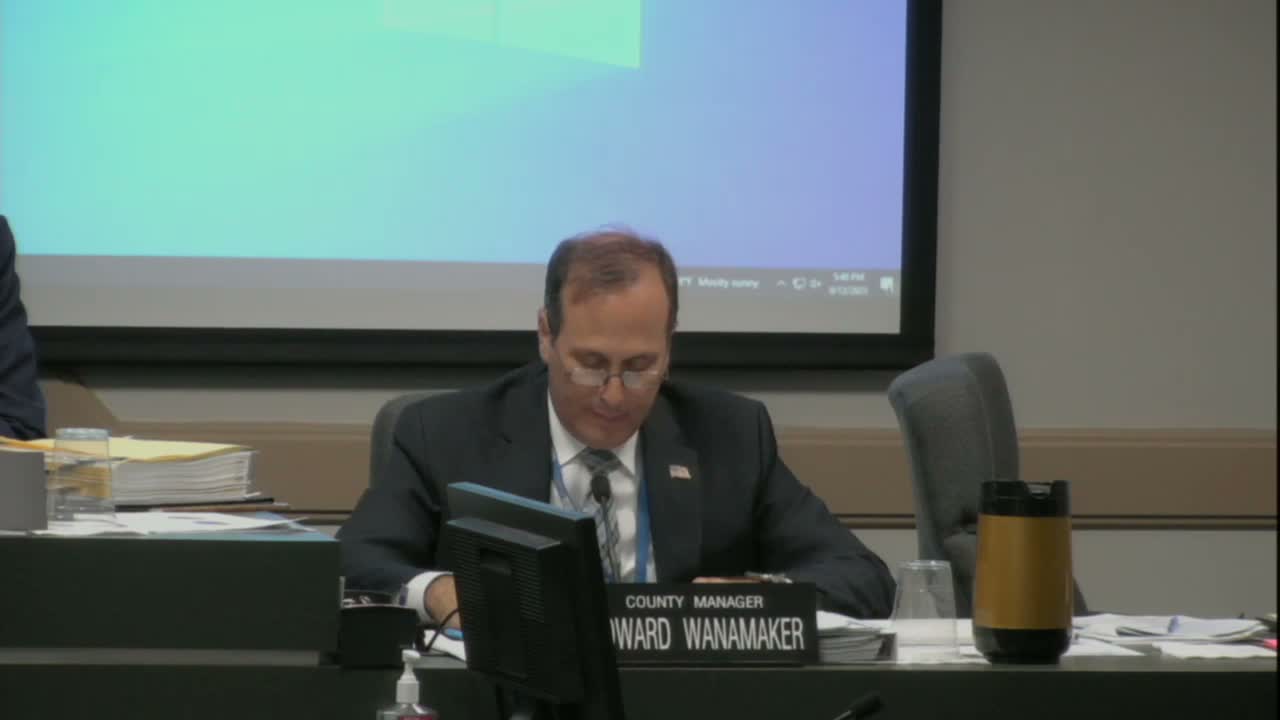
The Clay County Board of County Commissioners on Sept. 12 adopted a tentative aggregate operating millage of 8.3661 mills and approved the county’s tentative budget for fiscal year 2023–24.
County Manager (reading TRIM-required disclosures) said the proposed aggregate rate is 12.3% above the rollback rate and presented the millage breakdown by function: county services (5.5471 mills), unincorporated services/MSTU (0.1477 mills), law enforcement MSTU (2.4014 mills) and fire control MSTU (0.5048 mills), among others. The increase reflects allocations for public safety and MSTU transparency rather than a change from the county’s millage policy in the prior two years, staff said.
During the required public hearing, the board asked about how unallocated American Rescue Plan Act (ARPA) funds would be handled; staff noted roughly $3.5 million remained unallocated and that the board would finalize ARPA decisions before the final budget hearing. The board then adopted three separate resolutions—(1) to set tentative millage rates, (2) to adopt the tentative budgets for the board and Lake Asbury MSBD, and (3) to designate the Clay Behavioral Health Center as the recipient of the County Alcohol and Other Drug Abuse Trust Fund—by separate votes. Each motion carried on voice vote with an affirmative unanimous vote recorded by the chair (motion and second; approved 5–0).
The board set the final public hearing to adopt the millage and the final budget for Sept. 26, 2023 at 5:05 p.m. in the same meeting room. Staff said any changes resulting from ARPA allocations or other adjustments would be circulated to commissioners prior to the final hearing, and that state TRIM and truth-in-millage notices already mailed through the property appraiser’s office remain the governing public notices for the process.
Context: Florida’s TRIM process requires two public hearings and specific disclosures about the percentage change in millage compared with the rollback rate. County staff told commissioners that the proposed distribution places slightly more funding into designated MSTUs that support law enforcement and fire services to align pay and operations with surrounding counties.
County Manager (reading TRIM-required disclosures) said the proposed aggregate rate is 12.3% above the rollback rate and presented the millage breakdown by function: county services (5.5471 mills), unincorporated services/MSTU (0.1477 mills), law enforcement MSTU (2.4014 mills) and fire control MSTU (0.5048 mills), among others. The increase reflects allocations for public safety and MSTU transparency rather than a change from the county’s millage policy in the prior two years, staff said.
During the required public hearing, the board asked about how unallocated American Rescue Plan Act (ARPA) funds would be handled; staff noted roughly $3.5 million remained unallocated and that the board would finalize ARPA decisions before the final budget hearing. The board then adopted three separate resolutions—(1) to set tentative millage rates, (2) to adopt the tentative budgets for the board and Lake Asbury MSBD, and (3) to designate the Clay Behavioral Health Center as the recipient of the County Alcohol and Other Drug Abuse Trust Fund—by separate votes. Each motion carried on voice vote with an affirmative unanimous vote recorded by the chair (motion and second; approved 5–0).
The board set the final public hearing to adopt the millage and the final budget for Sept. 26, 2023 at 5:05 p.m. in the same meeting room. Staff said any changes resulting from ARPA allocations or other adjustments would be circulated to commissioners prior to the final hearing, and that state TRIM and truth-in-millage notices already mailed through the property appraiser’s office remain the governing public notices for the process.
Context: Florida’s TRIM process requires two public hearings and specific disclosures about the percentage change in millage compared with the rollback rate. County staff told commissioners that the proposed distribution places slightly more funding into designated MSTUs that support law enforcement and fire services to align pay and operations with surrounding counties.
Don't Miss a Word: See the Full Meeting!
Go beyond summaries. Unlock every video, transcript, and key insight with a Founder Membership.
✓
Get instant access to full meeting videos
✓
Search and clip any phrase from complete transcripts
✓
Receive AI-powered summaries & custom alerts
✓
Enjoy lifetime, unrestricted access to government data
30-day money-back guarantee
