Senate committee hears debate over proposed phased-in flat income tax in Ohio
January 29, 2024 | Ways and Means, Senate, Committees, Legislative, Ohio
This article was created by AI summarizing key points discussed. AI makes mistakes, so for full details and context, please refer to the video of the full meeting. Please report any errors so we can fix them. Report an error »
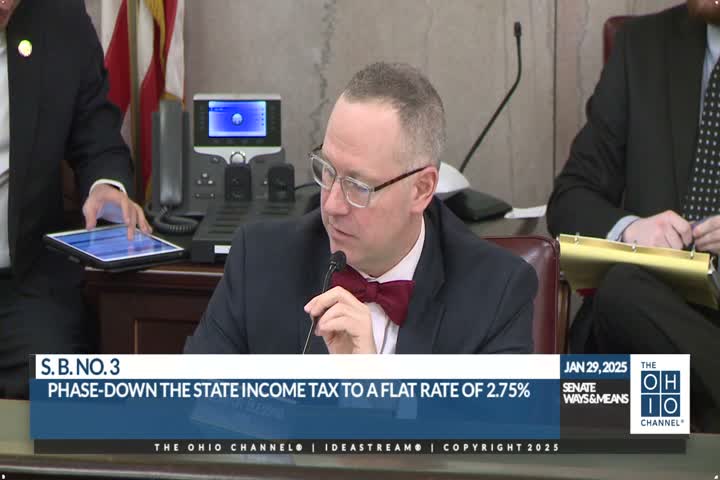
Senate sponsors introduced Senate Bill 3 on first hearing day before the Senate Ways and Means Committee, proposing a phased-in flat income tax to take effect in tax years 2025 and 2026. The sponsors said the change would simplify Ohio’s tax code, keep more earnings in residents’ pockets and help attract businesses and families from higher-tax states.
In sponsor testimony, a presenter speaking for the bill traced Ohio’s income tax history to 1970 and argued that successive tax increases and regulations drove businesses and people away. The sponsor credited recent policies — including business income deductions and regulatory reductions — with increasing startups and jobs, citing an asserted figure of 2,100,000 startups and more than 61,000 new jobs in the last year. The sponsors said the flat tax would not increase taxes for any Ohioan under their design and that lower rates would produce dynamic economic gains.
Committee members pressed for concrete fiscal details. The chair and multiple senators cited Legislative Service Commission (LSC) estimates and prior fiscal notes showing that moving to a flat-rate regime could reduce state revenues on the order of $1.1 billion to $1.6 billion annually under static assumptions. Questioners warned that an estimated revenue loss could translate into reduced state support for local governments and school districts and force higher local property tax levies. One senator summarized the trade-off this way: modest per-household gains for some taxpayers could be offset by a significant aggregate shift in revenue that localities would need to address.
Sponsors disputed static projections, saying that prior state tax reductions did not produce long-term revenue declines and arguing for dynamic effects such as reinvestment by pass-through entities and new business location decisions. Sponsors cited migration and private-sector examples to support competitive claims. Committee members asked whether the modest average per-household gain (often cited in testimony at roughly several hundred dollars per household for higher-income filers) would materially change local economic outcomes or voter willingness to support school levies.
Several senators emphasized distributional questions: committee discussion repeatedly returned to who would benefit (sponsors said top income brackets and middle-class workers both would see gains) and whether the proposal’s benefits would outweigh the projected reduction in state revenues. No formal action or vote occurred; the hearing concluded with the committee scheduling no final disposition during the session.
Next steps: the committee closed the first hearing on SB3 and may receive additional proponent or opponent testimony and fiscal modeling in later sessions.
In sponsor testimony, a presenter speaking for the bill traced Ohio’s income tax history to 1970 and argued that successive tax increases and regulations drove businesses and people away. The sponsor credited recent policies — including business income deductions and regulatory reductions — with increasing startups and jobs, citing an asserted figure of 2,100,000 startups and more than 61,000 new jobs in the last year. The sponsors said the flat tax would not increase taxes for any Ohioan under their design and that lower rates would produce dynamic economic gains.
Committee members pressed for concrete fiscal details. The chair and multiple senators cited Legislative Service Commission (LSC) estimates and prior fiscal notes showing that moving to a flat-rate regime could reduce state revenues on the order of $1.1 billion to $1.6 billion annually under static assumptions. Questioners warned that an estimated revenue loss could translate into reduced state support for local governments and school districts and force higher local property tax levies. One senator summarized the trade-off this way: modest per-household gains for some taxpayers could be offset by a significant aggregate shift in revenue that localities would need to address.
Sponsors disputed static projections, saying that prior state tax reductions did not produce long-term revenue declines and arguing for dynamic effects such as reinvestment by pass-through entities and new business location decisions. Sponsors cited migration and private-sector examples to support competitive claims. Committee members asked whether the modest average per-household gain (often cited in testimony at roughly several hundred dollars per household for higher-income filers) would materially change local economic outcomes or voter willingness to support school levies.
Several senators emphasized distributional questions: committee discussion repeatedly returned to who would benefit (sponsors said top income brackets and middle-class workers both would see gains) and whether the proposal’s benefits would outweigh the projected reduction in state revenues. No formal action or vote occurred; the hearing concluded with the committee scheduling no final disposition during the session.
Next steps: the committee closed the first hearing on SB3 and may receive additional proponent or opponent testimony and fiscal modeling in later sessions.
Don't Miss a Word: See the Full Meeting!
Go beyond summaries. Unlock every video, transcript, and key insight with a Founder Membership.
✓
Get instant access to full meeting videos
✓
Search and clip any phrase from complete transcripts
✓
Receive AI-powered summaries & custom alerts
✓
Enjoy lifetime, unrestricted access to government data
30-day money-back guarantee
