DOTD asks Lake Charles port to concur in revised I-10 Calcasieu River Bridge P3 deal with lower tolls and revenue share
January 29, 2024 | Associated Branch Pilots for the Port of Lake Charles, Boards & Commissions, Organizations, Executive, Louisiana
This article was created by AI summarizing key points discussed. AI makes mistakes, so for full details and context, please refer to the video of the full meeting. Please report any errors so we can fix them. Report an error »
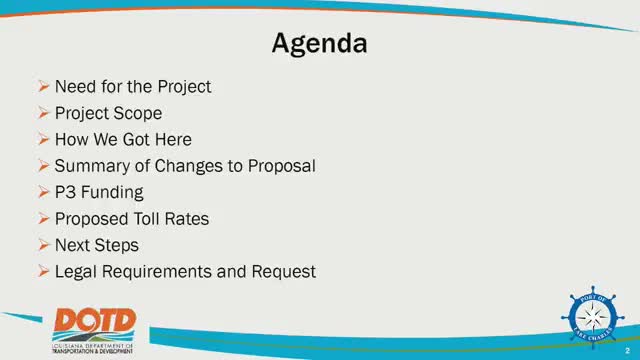
Joe Donahue, secretary of the Louisiana Department of Transportation and Development, asked the Lake Charles Harbor and Terminal District on Jan. 29 to concur with a renegotiated public-private partnership for the I-10 Calcasieu River Bridge that reduces projected state exposure and modifies the toll structure.
Donahue said the project would replace the existing four-lane span with a new six-lane bridge and modify nearby interchanges. Under the revised terms, local private vehicles registered within the five-parish area that obtain a free transponder would pay a 25-cent local toll regardless of vehicle size; large-truck tolls have been reduced from roughly $12.50 to $8.25 with a transponder. The state also negotiated a future revenue share that will “be fixed at financial close” and is expected to be between 14% and 16% of net toll revenue after operations and maintenance, Donahue said.
On financial exposure, Donahue said state cost and risk that were previously estimated at about $415 million have been reduced to roughly $280 million because of a confirmed design change that lets the span clear privately owned pipe racks and rail and because of improved market conditions.
Donahue framed the renegotiated terms as a way to lower costs for users and reduce reliance on trucking as the primary payer. "This is the lowest the toll rates will ever be, is under the deal that is being proposed today," he said during his presentation.
The board voted to adopt submission 2024-005, the DOTD concurrence letter, after a motion and second. During the vocal roll call someone said "I abstain," and another attendee pointed out the board bylaws do not allow abstentions; the chair declared the motion passed.
Next steps Donahue outlined include consideration by the Joint Transportation Committee the day after this meeting, execution of the contract if the JTC advances the project, bond marketing and financing steps and required sales hearings before the state bond commission and the Louisiana Public Facilities Authority prior to financial close.
What the board approved was a formal concurrence to allow the project to proceed to those next administrative and financing steps; it is not a construction authorization. Donahue and staff said the final percentage of revenue to the state and the precise toll schedule will be fixed at financial close and in the final concession documents.
The presentation included multiple technical and financial changes and a number of follow-ups for staff; the board did not record a line-by-line roll-call vote in the meeting transcript. The motion passed and the board moved on to other agenda items.
What remains unresolved: the exact revenue-share percentage and final toll schedule are to be fixed at financial close, and several statutory and financing steps described by Donahue must still occur before construction begins.
Donahue said the project would replace the existing four-lane span with a new six-lane bridge and modify nearby interchanges. Under the revised terms, local private vehicles registered within the five-parish area that obtain a free transponder would pay a 25-cent local toll regardless of vehicle size; large-truck tolls have been reduced from roughly $12.50 to $8.25 with a transponder. The state also negotiated a future revenue share that will “be fixed at financial close” and is expected to be between 14% and 16% of net toll revenue after operations and maintenance, Donahue said.
On financial exposure, Donahue said state cost and risk that were previously estimated at about $415 million have been reduced to roughly $280 million because of a confirmed design change that lets the span clear privately owned pipe racks and rail and because of improved market conditions.
Donahue framed the renegotiated terms as a way to lower costs for users and reduce reliance on trucking as the primary payer. "This is the lowest the toll rates will ever be, is under the deal that is being proposed today," he said during his presentation.
The board voted to adopt submission 2024-005, the DOTD concurrence letter, after a motion and second. During the vocal roll call someone said "I abstain," and another attendee pointed out the board bylaws do not allow abstentions; the chair declared the motion passed.
Next steps Donahue outlined include consideration by the Joint Transportation Committee the day after this meeting, execution of the contract if the JTC advances the project, bond marketing and financing steps and required sales hearings before the state bond commission and the Louisiana Public Facilities Authority prior to financial close.
What the board approved was a formal concurrence to allow the project to proceed to those next administrative and financing steps; it is not a construction authorization. Donahue and staff said the final percentage of revenue to the state and the precise toll schedule will be fixed at financial close and in the final concession documents.
The presentation included multiple technical and financial changes and a number of follow-ups for staff; the board did not record a line-by-line roll-call vote in the meeting transcript. The motion passed and the board moved on to other agenda items.
What remains unresolved: the exact revenue-share percentage and final toll schedule are to be fixed at financial close, and several statutory and financing steps described by Donahue must still occur before construction begins.
Don't Miss a Word: See the Full Meeting!
Go beyond summaries. Unlock every video, transcript, and key insight with a Founder Membership.
✓
Get instant access to full meeting videos
✓
Search and clip any phrase from complete transcripts
✓
Receive AI-powered summaries & custom alerts
✓
Enjoy lifetime, unrestricted access to government data
30-day money-back guarantee
