Junction City staff brief council on DEQ MAO that could limit sewer connections; council eyes moratorium, testing and funding options
May 28, 2024 | Junction City, Lane County, Oregon
This article was created by AI summarizing key points discussed. AI makes mistakes, so for full details and context, please refer to the video of the full meeting. Please report any errors so we can fix them. Report an error »
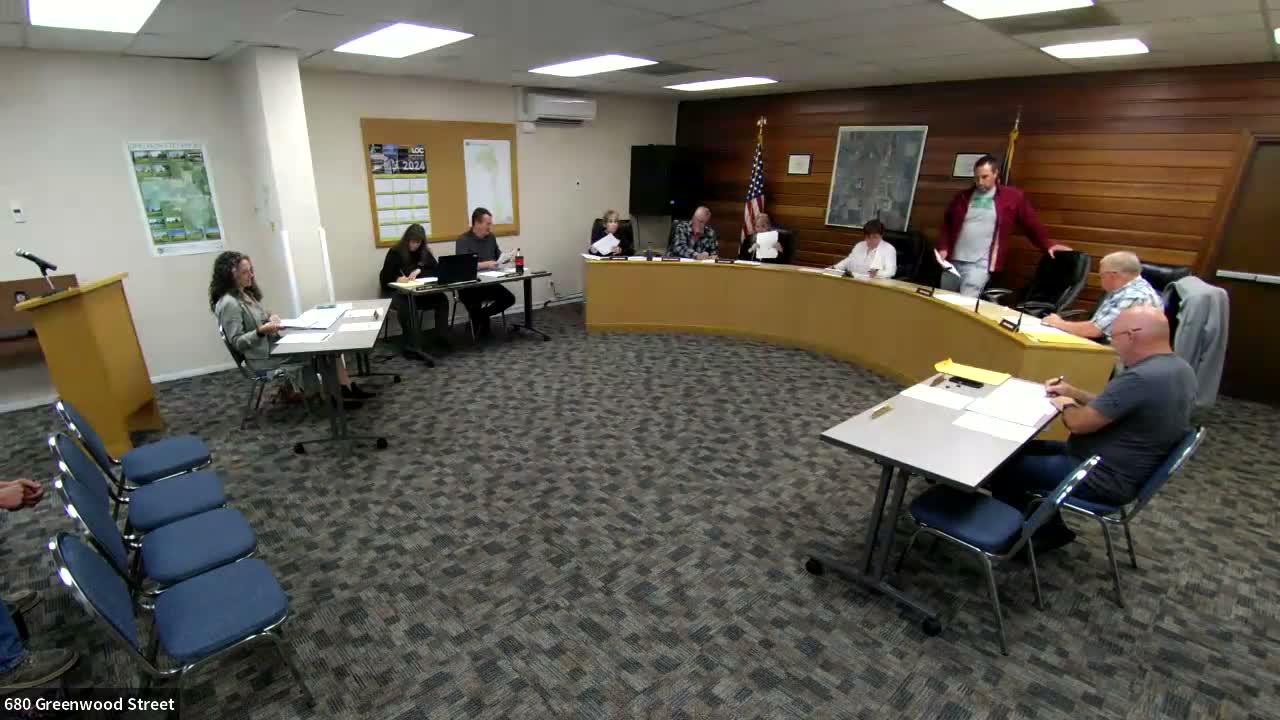
Junction City councilors and staff spent the bulk of a May 28 work session on a Department of Environmental Quality (DEQ) Modified Administrative Order (MAO) that, staff said, would set interim discharge limits and link additional sewer connections (EDUs) to completion of defined tasks.
Public works staff explained the MAO’s intent: “The MAO is the document the state uses to set some relaxed discharge limits in the interim while we’re working on upgrading our plant,” staff said, adding that DEQ can attach additional requirements and deadlines the city must meet. Staff said the MAO gives the city opportunities to earn EDUs for completing specific tasks but also sets deadlines and escalated penalties for missed obligations.
Councilors repeatedly questioned scope and timing. Staff said DEQ is requiring systematic CCTV (TV) inspections and smoke testing to locate leaks and inflow/infiltration across basins; the TV work will be time- and labor-intensive, likely requiring months of summer work or contractor support. Staff estimated they could TV a basin in about 1.5 to 2 months and noted certification and equipment upgrades will carry costs; contracting a vendor could run roughly $75,000 per basin while in-house upgrades would have different upfront expenses.
The MAO also calls for an industrial-user survey and a pretreatment program for high-strength dischargers (for example, a new brewery planned on First Street). Staff said the city currently lacks a formal pretreatment program and will need to identify and manage such users over about a year.
On land-use tools, city legal counsel recommended a local moratorium as the most defensible mechanism to tie connection limits into land-use approvals. Counsel explained moratoria can be adopted for fixed intervals and readopted to preserve allocation control, and that the council could use an engineer’s report to set allocation rules (first-come, reserved housing allotments, commercial set-asides or similar).
Councilors expressed strong concern about household affordability if the compliance costs are passed to ratepayers, and about the practical limits of staff capacity. Several members urged hiring a financial consultant to model funding options (grants, loans, bonds) and a communications specialist to explain trade-offs to residents. Staff said they will solicit proposals and return with more detailed numbers and outreach plans.
Staff recommended pressing DEQ for clarity on timing and EDU counts where the draft MAO appeared to cap the city at relatively low numbers for additional EDUs; they also said specialized legal counsel has been retained to negotiate technical language with DEQ.
As next steps staff proposed returning to council (suggested in July) with legal framework and engineering input on moratorium options, a prioritized list of projects, and cost estimates so council can weigh funding and allocation choices. In a related funding discussion, staff also reported a $1 million federal grant to support construction of water wells and asked whether council would prefer bundling additional well-related infrastructure (generators) into future funding packages.
Public works staff explained the MAO’s intent: “The MAO is the document the state uses to set some relaxed discharge limits in the interim while we’re working on upgrading our plant,” staff said, adding that DEQ can attach additional requirements and deadlines the city must meet. Staff said the MAO gives the city opportunities to earn EDUs for completing specific tasks but also sets deadlines and escalated penalties for missed obligations.
Councilors repeatedly questioned scope and timing. Staff said DEQ is requiring systematic CCTV (TV) inspections and smoke testing to locate leaks and inflow/infiltration across basins; the TV work will be time- and labor-intensive, likely requiring months of summer work or contractor support. Staff estimated they could TV a basin in about 1.5 to 2 months and noted certification and equipment upgrades will carry costs; contracting a vendor could run roughly $75,000 per basin while in-house upgrades would have different upfront expenses.
The MAO also calls for an industrial-user survey and a pretreatment program for high-strength dischargers (for example, a new brewery planned on First Street). Staff said the city currently lacks a formal pretreatment program and will need to identify and manage such users over about a year.
On land-use tools, city legal counsel recommended a local moratorium as the most defensible mechanism to tie connection limits into land-use approvals. Counsel explained moratoria can be adopted for fixed intervals and readopted to preserve allocation control, and that the council could use an engineer’s report to set allocation rules (first-come, reserved housing allotments, commercial set-asides or similar).
Councilors expressed strong concern about household affordability if the compliance costs are passed to ratepayers, and about the practical limits of staff capacity. Several members urged hiring a financial consultant to model funding options (grants, loans, bonds) and a communications specialist to explain trade-offs to residents. Staff said they will solicit proposals and return with more detailed numbers and outreach plans.
Staff recommended pressing DEQ for clarity on timing and EDU counts where the draft MAO appeared to cap the city at relatively low numbers for additional EDUs; they also said specialized legal counsel has been retained to negotiate technical language with DEQ.
As next steps staff proposed returning to council (suggested in July) with legal framework and engineering input on moratorium options, a prioritized list of projects, and cost estimates so council can weigh funding and allocation choices. In a related funding discussion, staff also reported a $1 million federal grant to support construction of water wells and asked whether council would prefer bundling additional well-related infrastructure (generators) into future funding packages.
View the Full Meeting & All Its Details
This article offers just a summary. Unlock complete video, transcripts, and insights as a Founder Member.
✓
Watch full, unedited meeting videos
✓
Search every word spoken in unlimited transcripts
✓
AI summaries & real-time alerts (all government levels)
✓
Permanent access to expanding government content
30-day money-back guarantee
