Chief Justice stresses court workload, security and staffing needs as JFC reviews judiciary budget
February 20, 2024 | 2025 Legislature DE Collection, Legislative, Delaware
This article was created by AI summarizing key points discussed. AI makes mistakes, so for full details and context, please refer to the video of the full meeting. Please report any errors so we can fix them. Report an error »
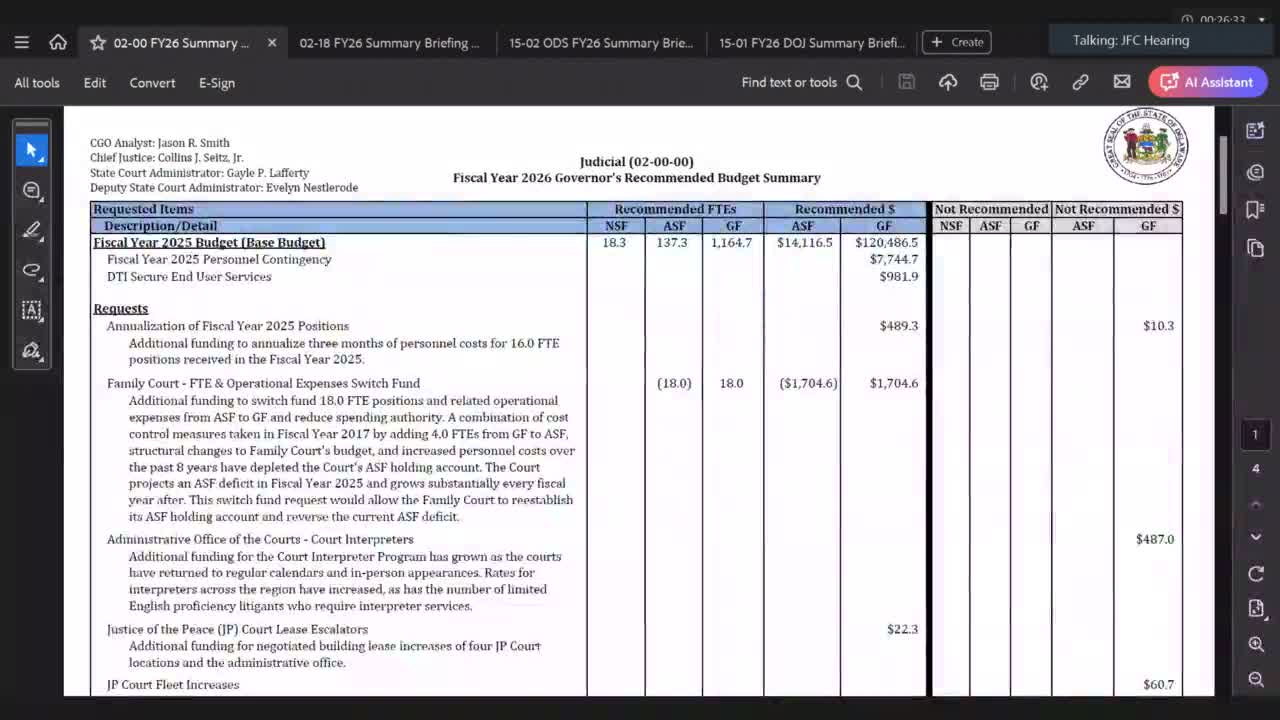
Chief Justice Sites told the Joint Finance Committee on the judiciary’s budget that Delaware’s business courts are busier and more time‑intensive than ever, and that courts are seeing an increase in expedited, high‑profile matters that demand additional staffing and resources.
“The Court of Chancery and the Delaware Supreme Court have never been busier,” Chief Justice Sites said, adding that expedited cases often must be moved to the top of judges’ workloads. She warned the committee that social media can amplify criticism of court decisions and said that the judiciary has seen threats to judges’ personal safety, which prompted a branch‑wide security audit now underway.
The Chief Justice reviewed technology and staffing proposals the judiciary has put forward: a court technology modernization project funded with ARPA support (including an e‑filing and case‑management rollout expected to begin December 2026 for the first court), additional magistrates and support staff for the Court of Chancery, and an increase in interpreter funding after the demand for interpreters exceeded the current appropriation. She said the Court is recommending a short‑term lease of roughly 10,000 square feet (a building already configured for courtroom operations) to relocate JP Court 20 so chancery can have contiguous courtroom and staff space in the Leonard L. Williams Justice Center.
Budget staff earlier presented the mechanics behind several requests the judiciary made: switch‑funding some positions from ASF or other fee funds to the General Fund where revenue declines have produced recurring deficits (for example, Title IV‑D child‑support funds and a court security fee account). The staff noted that some items were not recommended in the governor’s budget package and would need committee action to be added.
Committee members questioned the Chief Justice and budget staff about why certain long‑standing positions were now proposed as General Fund items rather than ASF, whether the judiciary has historical data showing previous funding for nonjudicial agencies, and the timeline for moving the Kent County Family Court (the Chief Justice said the Kent County courthouse is expected to open summer 2026). Senators and representatives also pressed for detail on interpreter demand and the fiscal note assumptions for parental representation implementation.
The Chief Justice framed several requests as responses to concrete operational pressures—courtroom crowding, high volumes of expedited filings and an increase in non‑English language needs—and asked the legislature to consider how to preserve judicial independence while ensuring courts have the personnel and security needed to meet their constitutional duties. She closed by thanking members for prior support and noting the judiciary represents roughly 2 percent of the state budget but claims significant impact on case processing speed and access to justice.
“The Court of Chancery and the Delaware Supreme Court have never been busier,” Chief Justice Sites said, adding that expedited cases often must be moved to the top of judges’ workloads. She warned the committee that social media can amplify criticism of court decisions and said that the judiciary has seen threats to judges’ personal safety, which prompted a branch‑wide security audit now underway.
The Chief Justice reviewed technology and staffing proposals the judiciary has put forward: a court technology modernization project funded with ARPA support (including an e‑filing and case‑management rollout expected to begin December 2026 for the first court), additional magistrates and support staff for the Court of Chancery, and an increase in interpreter funding after the demand for interpreters exceeded the current appropriation. She said the Court is recommending a short‑term lease of roughly 10,000 square feet (a building already configured for courtroom operations) to relocate JP Court 20 so chancery can have contiguous courtroom and staff space in the Leonard L. Williams Justice Center.
Budget staff earlier presented the mechanics behind several requests the judiciary made: switch‑funding some positions from ASF or other fee funds to the General Fund where revenue declines have produced recurring deficits (for example, Title IV‑D child‑support funds and a court security fee account). The staff noted that some items were not recommended in the governor’s budget package and would need committee action to be added.
Committee members questioned the Chief Justice and budget staff about why certain long‑standing positions were now proposed as General Fund items rather than ASF, whether the judiciary has historical data showing previous funding for nonjudicial agencies, and the timeline for moving the Kent County Family Court (the Chief Justice said the Kent County courthouse is expected to open summer 2026). Senators and representatives also pressed for detail on interpreter demand and the fiscal note assumptions for parental representation implementation.
The Chief Justice framed several requests as responses to concrete operational pressures—courtroom crowding, high volumes of expedited filings and an increase in non‑English language needs—and asked the legislature to consider how to preserve judicial independence while ensuring courts have the personnel and security needed to meet their constitutional duties. She closed by thanking members for prior support and noting the judiciary represents roughly 2 percent of the state budget but claims significant impact on case processing speed and access to justice.
View the Full Meeting & All Its Details
This article offers just a summary. Unlock complete video, transcripts, and insights as a Founder Member.
✓
Watch full, unedited meeting videos
✓
Search every word spoken in unlimited transcripts
✓
AI summaries & real-time alerts (all government levels)
✓
Permanent access to expanding government content
30-day money-back guarantee
