Middletown supervisors back advisory committee to study stormwater fee amid rising infrastructure costs
May 13, 2024 | Middletown, Bucks County, Pennsylvania
This article was created by AI summarizing key points discussed. AI makes mistakes, so for full details and context, please refer to the video of the full meeting. Please report any errors so we can fix them. Report an error »
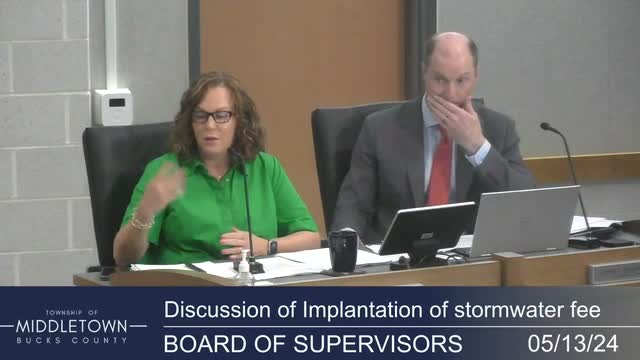
Middletown Township supervisors voted unanimously to form an advisory committee to study a possible stormwater fee after officials outlined the township’s escalating stormwater costs and regulatory obligations.
Township staff and the solicitor told the board that present stormwater responsibilities are growing and costly. The township currently spends “about 500,000 to a million annually on stormwater projects,” a staff member said, and the township’s municipal separate storm sewer system (MS4) needs roughly $8,000,000 of work over the next five years, the presentation showed.
Solicitor Jim Esposito summarized how a fee would work and the principal choices the committee would face: whether to create a separate stormwater authority (not recommended by staff), how to set a rate structure and the use of an ERU — an equivalent residential unit based on impervious surface — to apportion charges. Esposito said municipalities using ERU models typically see residential averages “somewhere around a hundred to a 120 a year,” but stressed those figures are illustrative and would be set by the advisory process.
Esposito also cautioned the board about ongoing litigation that could affect who must pay. “There is current litigation going on about whether the stormwater fee is actually a tax,” he told supervisors, naming a West Chester Borough case that is pending before the Pennsylvania Supreme Court; that decision could exempt tax‑exempt institutions such as schools and churches from payment, he said.
Board members said the advisory committee would include stakeholders — residents, major property owners, the environmental advisory commission and financial advisors — and serve to develop concrete rate options, credit rules for properties with existing stormwater controls, and a recommended timeline tied to the township budget process. Several supervisors urged staff to recruit committee members quickly so a recommendation could inform next year’s budget.
No rate or implementation decision was made tonight; the board’s action directs staff to solicit participants and establish the committee’s charge and timeline. The board recorded a unanimous vote in favor of forming the committee and beginning public outreach and technical work.
Township staff and the solicitor told the board that present stormwater responsibilities are growing and costly. The township currently spends “about 500,000 to a million annually on stormwater projects,” a staff member said, and the township’s municipal separate storm sewer system (MS4) needs roughly $8,000,000 of work over the next five years, the presentation showed.
Solicitor Jim Esposito summarized how a fee would work and the principal choices the committee would face: whether to create a separate stormwater authority (not recommended by staff), how to set a rate structure and the use of an ERU — an equivalent residential unit based on impervious surface — to apportion charges. Esposito said municipalities using ERU models typically see residential averages “somewhere around a hundred to a 120 a year,” but stressed those figures are illustrative and would be set by the advisory process.
Esposito also cautioned the board about ongoing litigation that could affect who must pay. “There is current litigation going on about whether the stormwater fee is actually a tax,” he told supervisors, naming a West Chester Borough case that is pending before the Pennsylvania Supreme Court; that decision could exempt tax‑exempt institutions such as schools and churches from payment, he said.
Board members said the advisory committee would include stakeholders — residents, major property owners, the environmental advisory commission and financial advisors — and serve to develop concrete rate options, credit rules for properties with existing stormwater controls, and a recommended timeline tied to the township budget process. Several supervisors urged staff to recruit committee members quickly so a recommendation could inform next year’s budget.
No rate or implementation decision was made tonight; the board’s action directs staff to solicit participants and establish the committee’s charge and timeline. The board recorded a unanimous vote in favor of forming the committee and beginning public outreach and technical work.
Don't Miss a Word: See the Full Meeting!
Go beyond summaries. Unlock every video, transcript, and key insight with a Founder Membership.
✓
Get instant access to full meeting videos
✓
Search and clip any phrase from complete transcripts
✓
Receive AI-powered summaries & custom alerts
✓
Enjoy lifetime, unrestricted access to government data
30-day money-back guarantee
